
Spaced repetition explained
Why reviewing at the right interval locks in advanced French B2 vocabulary
You have B1 French. You can hold a conversation, read a news article with effort, and navigate work situations. B2 is where that effort drops noticeably. Sentences that used to require active decoding start arriving whole. You stop translating and start thinking in French.
B2 covers roughly 4,000 words in total. This guide focuses on the 1,000+ that actually move the needle: the past subjunctive for completed actions in complex clauses, advanced connectors for argumentation, formal writing phrases for DELF B2 tasks, social vocabulary for opinion work, collocations for natural speech, and media vocabulary for authentic comprehension.
Each of the seven phases below includes a ready-to-use AI prompt. Copy it into the MindCards app and it generates a custom flashcard deck in seconds. Spaced repetition then schedules each card at the right interval, so you retain more with less time reviewing.
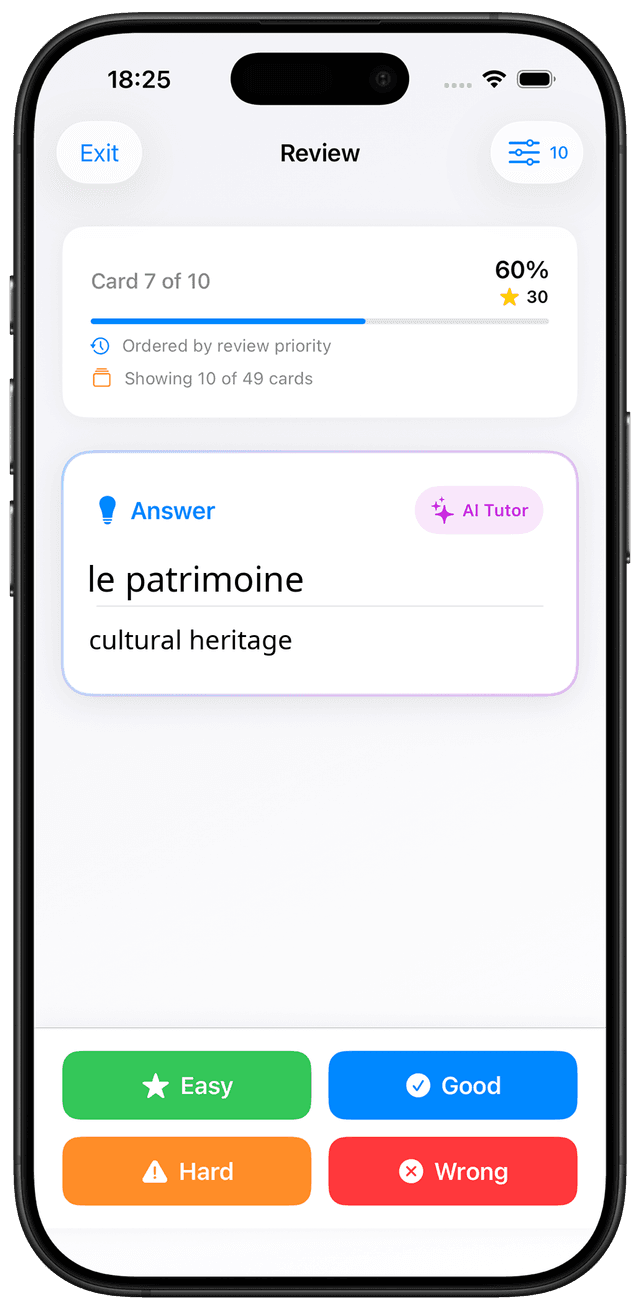
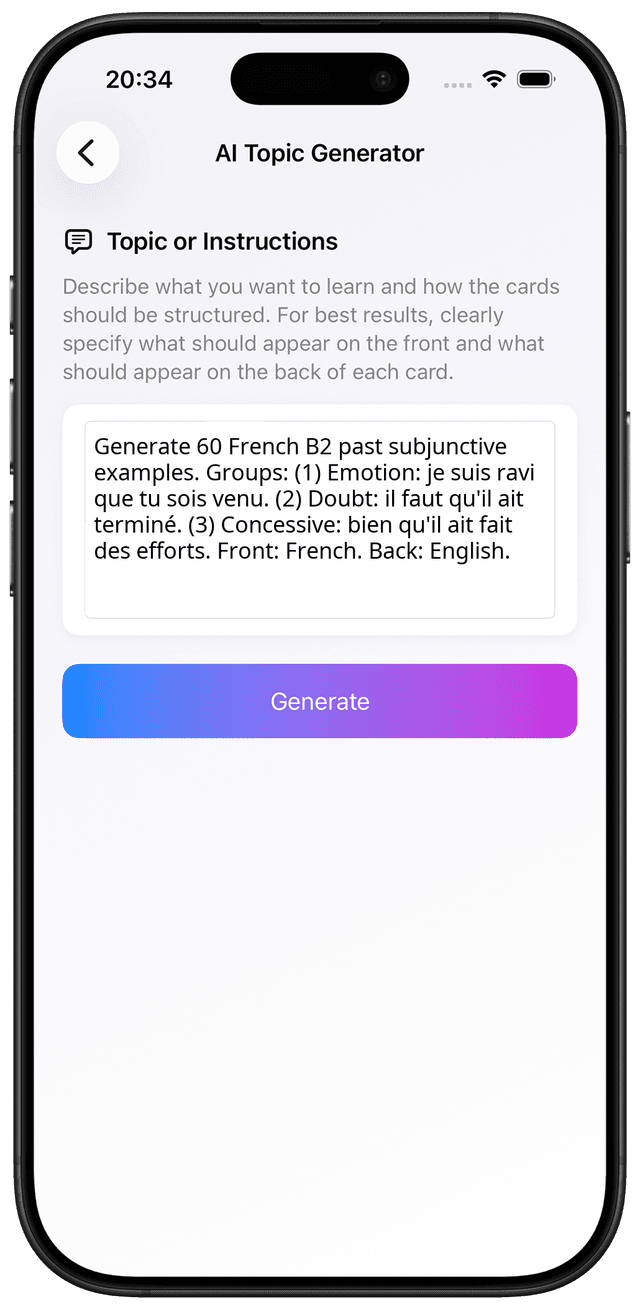
You know the present subjunctive from B1. The past subjunctive (subjonctif passé) adds a second layer: it lets you express completed actions in dependent clauses. Je suis content qu'il soit venu (I am glad he came) uses the past subjunctive, not the present. French uses this form far more than Spanish or Italian equivalents, so it appears regularly in formal speech and written French.
Formation is based on the present subjunctive of avoir or être plus the past participle: que tu aies fini, qu'elle soit partie. The choice of auxiliary follows the same rules as the passé composé. The tricky part is recognising the trigger: any verb in the present subjunctive can be upgraded to the past subjunctive when the subordinate event is complete before the main clause.
Why start here? The past subjunctive is one of the clearest markers between B1 and B2 French. DELF B2 writing tasks regularly require it in opinion essays and formal letters.
The strategy: This deck pairs subjunctive trigger phrases with past-tense contexts so you absorb when to use passé over present rather than relying on grammar lookups under pressure.
Generate 60 French B2 past subjunctive (subjonctif passé) examples. Three groups: (1) Emotion triggers: je suis ravi que tu sois venu, il regrette qu'elle soit partie, nous sommes surpris qu'il ait réussi. (2) Doubt and necessity in retrospect: il faut qu'il ait terminé avant demain, je doute qu'il ait dit cela. (3) Concessive clauses: bien qu'il ait fait des efforts, pour qu'elle soit arrivée si tôt. Front: French sentence. Back: English + trigger label.
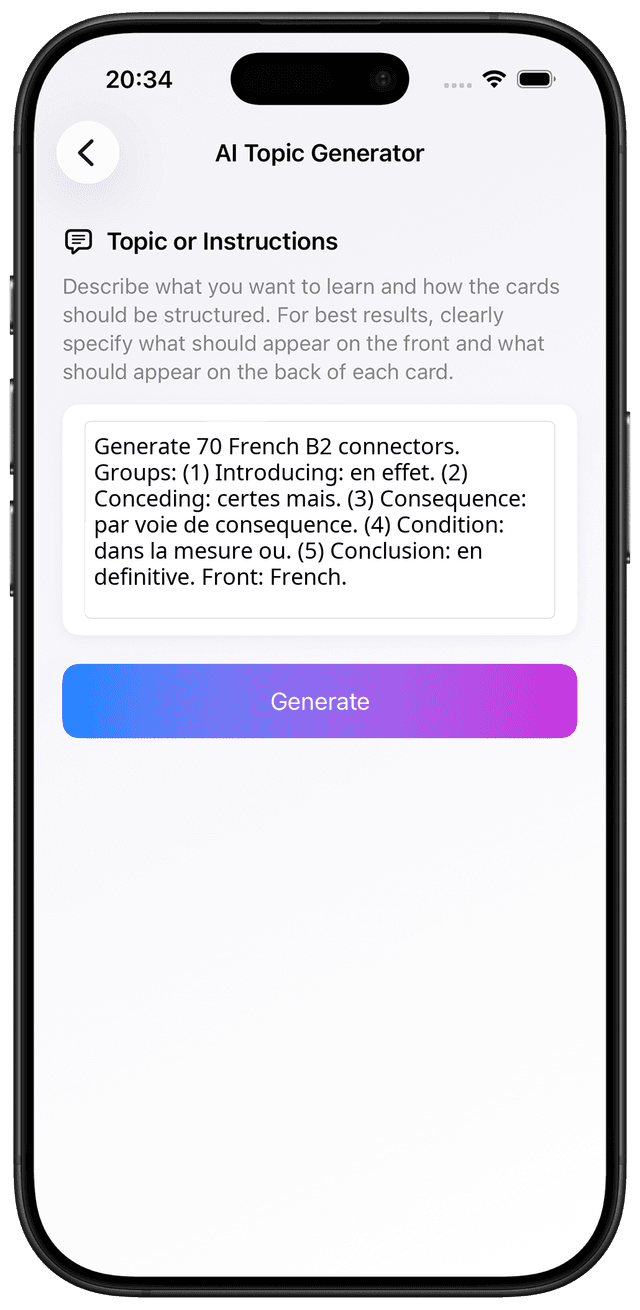
B2 writing and speaking tasks require you to build an argument, not just state one. French has a specific set of connectors for B2-level discourse: introducing a claim, conceding a counterargument, signalling a consequence, and closing with a synthesis. The connectors at this level go well beyond B1 basics like cependant and par exemple.
DELF B2 essay tasks are scored partly on cohesion. Examiners can tell immediately whether a candidate controls these structures or is improvising. Phrases like or, en effet, par voie de conséquence, il n'en demeure pas moins que, and dans la mesure où separate competent B2 writers from B1 learners who have picked up extra vocabulary.
Why this second? Once you have the past subjunctive, argumentation connectors are the vocabulary layer most visible in DELF B2 writing and speaking tasks. Together they cover the bulk of what examiners look for.
The strategy: Each card pairs the connector with a full example sentence so you learn it in context, not in isolation.
Generate 70 French B2 connectors and argumentation phrases. Groups: (1) Introducing: or, en effet, il convient de noter que, force est de constater que. (2) Conceding: certes...mais, il n'en demeure pas moins que, quoi qu'il en soit, tout en reconnaissant que. (3) Consequence: par voie de conséquence, c'est pourquoi, aussi (inverted), il s'ensuit que. (4) Condition: dans la mesure où, à condition que (+subj), pourvu que. (5) Conclusion: en définitive, tout bien considéré, en guise de conclusion. Front: connector + sentence. Back: English + function label.
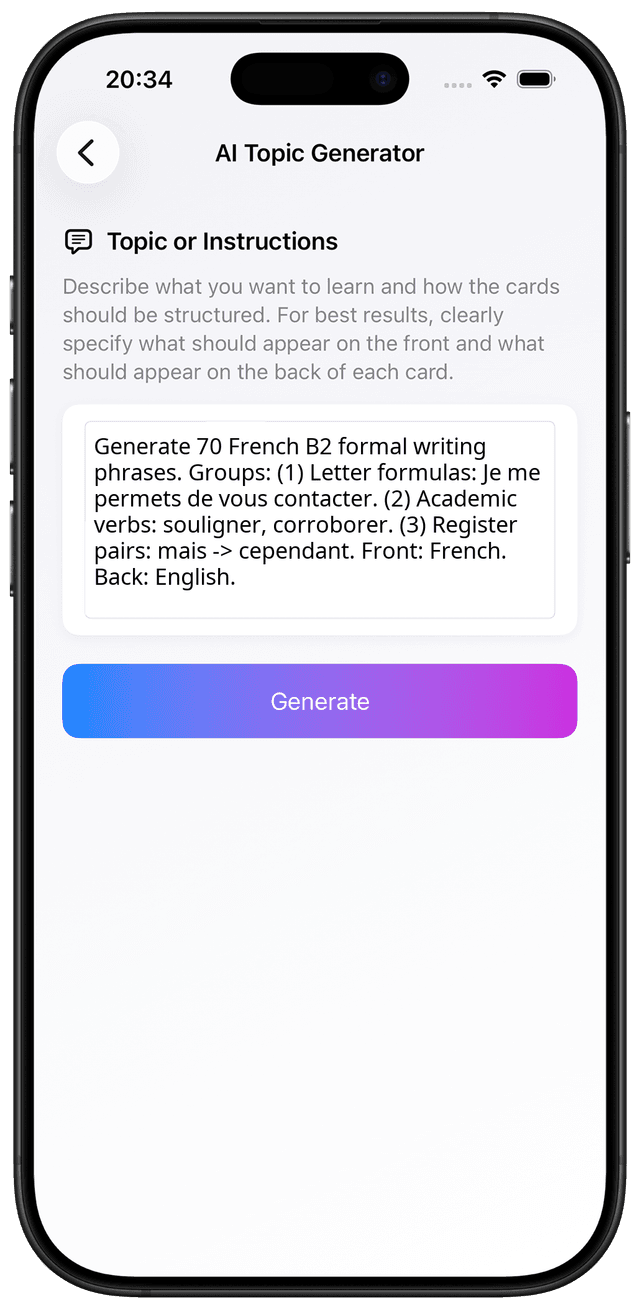
At B2 the written register matters. Formal letters, reports, opinion essays, and administrative correspondence follow conventions that differ sharply from spoken French. Phrases you would never say aloud appear constantly in formal writing, and knowing which ones to use changes your DELF score noticeably.
French formal writing has its own stock phrases: Je me permets de vous contacter au sujet de..., Veuillez trouver ci-joint..., Dans l'attente de votre réponse, Je vous prie d'agréer... These are not optional polish, they are expected conventions. Missing them signals a B1 register in a B2 task. Academic verbs like souligner, étayer, corroborer, and mettre en exergue are equally important for essay writing.
Why this phase? DELF B2 requires a formal letter and an opinion essay. Both tasks are scored partly on register appropriateness. This phase covers the stock phrases and academic verbs that make both tasks feel under control.
The strategy: The deck covers formal correspondence formulas, academic verbs with example sentences, and register-shift pairs showing the colloquial word alongside its formal equivalent.
Generate 70 French B2 words and phrases for formal written French. Groups: (1) Letter openings and closings: Je me permets de vous contacter, Veuillez trouver ci-joint, Dans l'attente de votre réponse, Je vous prie d'agréer l'expression de mes salutations distinguées. (2) Academic verbs: souligner, étayer, corroborer, mettre en exergue, s'avérer, préconiser. (3) Register-shift pairs: mais -> cependant, beaucoup de -> un grand nombre de, je pense -> il me semble que. (4) Hedging: il semblerait que (+subj), selon toute vraisemblance, dans une certaine mesure. Front: French phrase. Back: English + register label.
DELF B2 reading and listening passages cover social and political topics: inequality, environmental policy, education reform, economic issues, immigration, and technology. You need vocabulary that lets you understand these texts without constant dictionary stops and produce commentary on them in writing and speech.
French political vocabulary has its own register. La laicite, les partis de gouvernement, le scrutin proportionnel, la fracture sociale, and les sans-papiers are not interchangeable with everyday words. French media also uses nominalisation extensively: la hausse (rise) rather than augmenter, la chute (fall) rather than tomber, le recul (setback) rather than reculer.
Why society and politics? B2 authentic texts are almost always on social topics. DELF B2 listening extracts come from French radio news and current affairs programmes. Building this vocabulary before you sit the exam means you decode context, not individual words.
The strategy: The deck groups 80 words and phrases by theme. Each entry includes a sentence from the type of context you encounter in B2 reading and listening tasks.
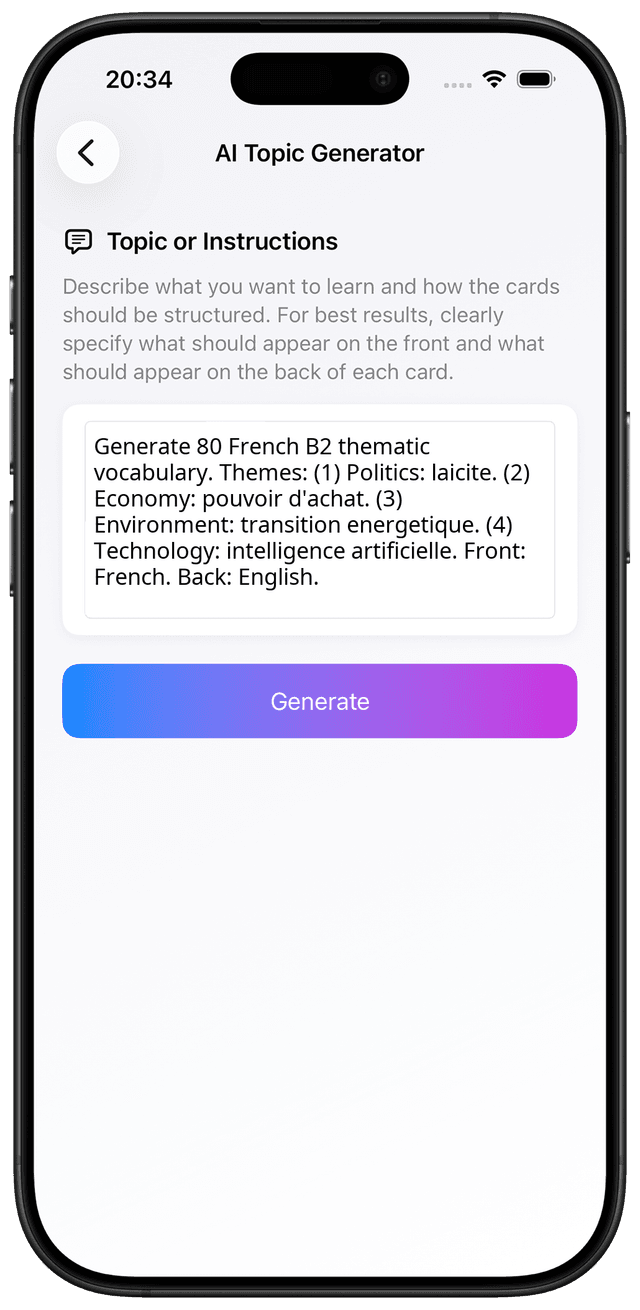
Generate 80 French B2 thematic vocabulary items. Themes: (1) Politics and institutions: la laicite, le scrutin, les partis de gouvernement, le mandat, la fracture sociale, les sans-papiers, la citoyennete. (2) Economy: la mondialisation, le pouvoir d'achat, la precarite, le deficit, la croissance, les inegalites salariales. (3) Environment: la transition energetique, les energies renouvelables, l'empreinte carbone, le rechauffement climatique. (4) Technology: l'intelligence artificielle, la donnee personnelle, le numerique, la desinfo. Front: French. Back: English + theme label.
Native French speakers do not speak in textbook French. They use set phrases, collocations (word pairings that feel natural to a French ear), and idioms that grammar study alone does not prepare you for. At B2 your vocabulary needs these patterns or your French sounds unnaturally formal even when you are trying to be casual.
Collocations are especially important in French because English-speaker errors often come from translating collocations directly. You take a decision in English but you prendre une decision in French. You make an effort in English but you faire un effort. You pay attention in English but you faire attention. Knowing French-specific pairings avoids the false-friend errors that mark a learner at B2.
The goal: Close the gap between textbook French and the French you actually hear in films, podcasts, and conversations with native speakers. This phase builds collocations and common idioms alongside their contexts.
The strategy: Each card shows the phrase in a sentence so you learn the collocation in use, not as an isolated pair. This is how native speakers store these patterns.
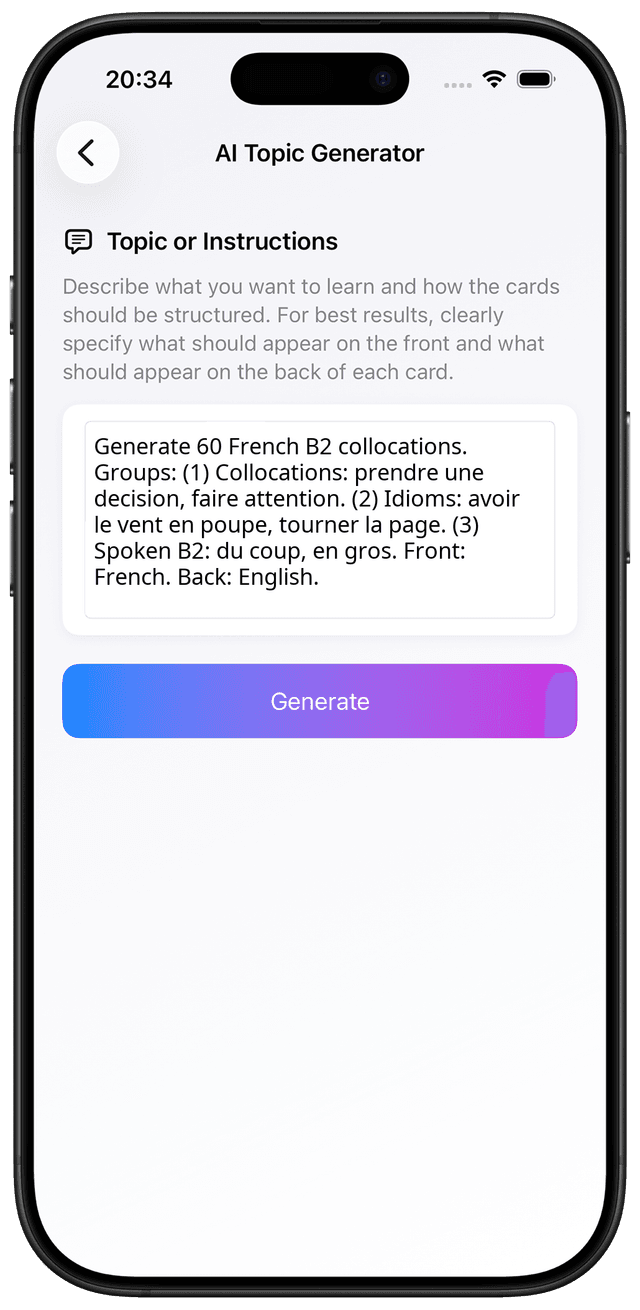
Generate 60 French B2 collocations and idiomatic expressions. Groups: (1) High-frequency verb-noun collocations: prendre une decision, faire attention, mener une enquete, porter plainte, tirer parti de, mettre en doute, remettre en question. (2) Common idioms with meaning: avoir le vent en poupe, faire long feu, jouer un role cle, tourner la page, perdre le fil. (3) Register-aware spoken B2: du coup (spoken filler), il parait que, a vrai dire, ca dit quelque chose, en gros. Front: French phrase + sentence. Back: English + register note.
At B2 you should be able to follow a France Inter radio documentary, read an opinion piece in Le Monde, and understand a podcast on a topic you care about without stopping every few minutes. The vocabulary gap blocking this is usually not grammar but exposure to the specific lexical fields in French-language media.
French news language uses structures rarely found in conversation: the passive with se voir, nominalisations (la hausse des prix rather than les prix ont augmente), and impersonal constructions (il est prevu que, il ressort que). These patterns appear constantly in B2 listening comprehension texts. Recognising them matters as much as knowing the individual words.
The goal: Give you enough domain vocabulary in politics, economics, and culture that authentic French media becomes accessible rather than exhausting. Past this threshold, your French grows faster because you can learn directly from native content.
The strategy: This deck covers vocabulary from the three authentic media registers B2 learners encounter most: political news, economic reporting, and cultural commentary.
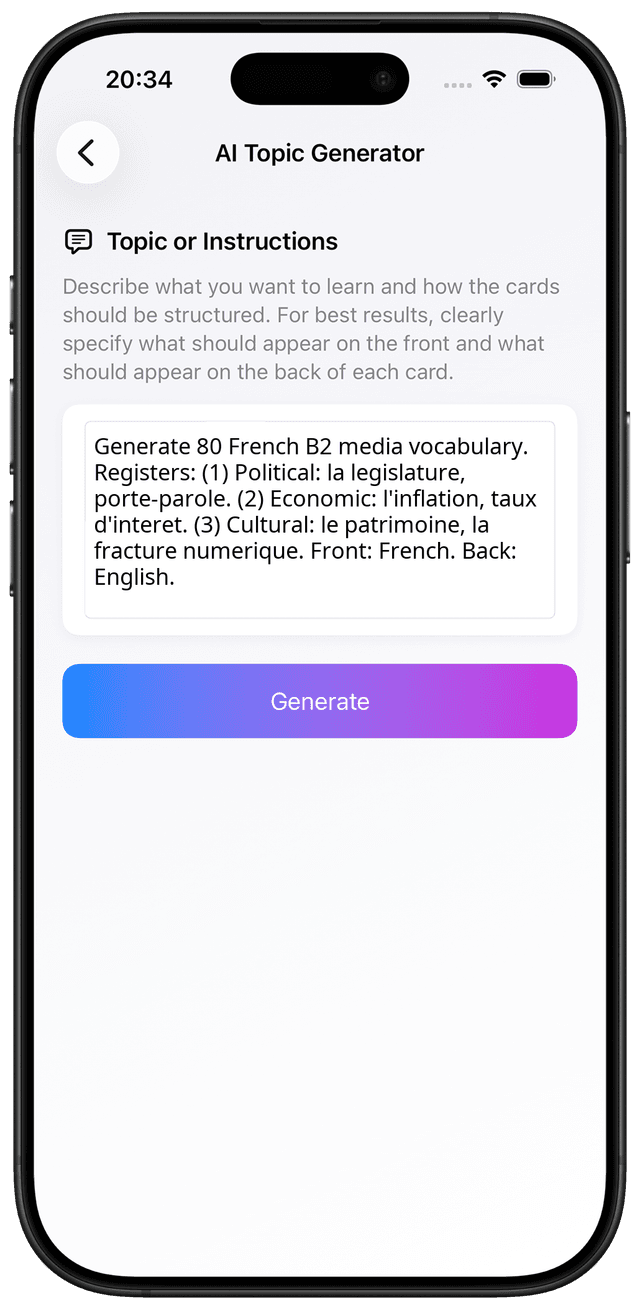
Generate 80 French B2 vocabulary items for authentic media comprehension. Registers: (1) Political and institutional: la legislature, le gouvernement de coalition, le porte-parole, la reforme, l'amendement, le projet de loi, le Senat, le vote de confiance. (2) Economic reporting: l'inflation, le taux d'interet, le marche du travail, la recession, la relance economique, le deficit budgetaire. (3) Cultural commentary: le patrimoine, l'identite culturelle, la diversite linguistique, le phenomene social, la tendance, la fracture numerique. Front: French term + news-style example sentence. Back: English equivalent.
At B2 you can handle most real-world situations in French. The final phase covers the grammar structures that separate genuine B2 from inflated B1: the past conditional for unrealised hypotheticals, the passive voice, impersonal constructions with infinitives and subjunctive, and complex relative clauses using qui, que, dont, and lequel.
The past conditional (j'aurais voulu, il serait venu) is one of the most reliable B2 markers in French. Si j'avais su, je serais venu expresses a past hypothetical that did not happen, and it requires the pluperfect in the si clause and the past conditional in the result clause. This structure appears in DELF B2 writing tasks and in formal spoken French.
The B2 milestone: With this phase done, your B2 French vocabulary and grammar are solid. You can follow a French news broadcast, write a structured opinion essay, discuss complex social topics, and sit DELF B2 without reaching for a dictionary at every sentence. That is a real threshold. C1 builds directly on these foundations by extending your idiomatic range and genre control.
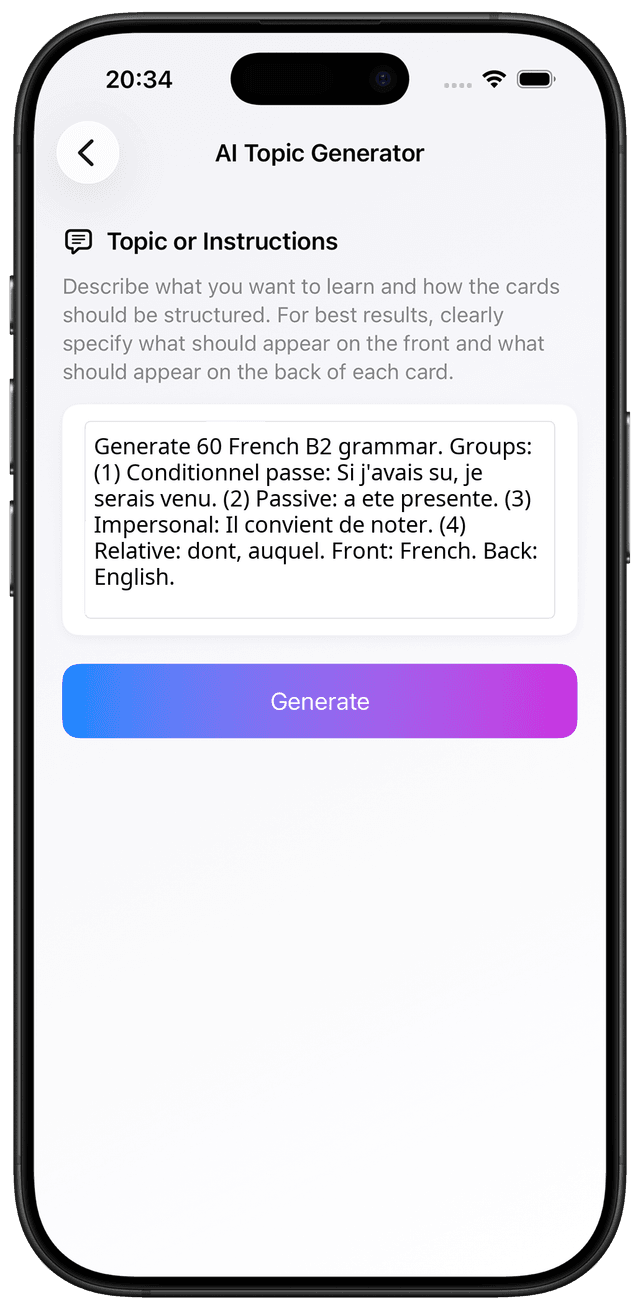
Generate 60 French B2 advanced grammar structures as example sentences. Groups: (1) Past conditional (conditionnel passe): Si j'avais su, je serais venu; Il aurait voulu te parler; Nous n'aurions pas fait ca. (2) Passive voice: Le rapport a ete presente hier, Les mesures seront approuvees par le Parlement. (3) Impersonal constructions: Il est prevu que (+subj), Il ressort de cette etude que, Il convient de souligner que. (4) Complex relative clauses: La personne dont je vous parle, L'outil grace auquel, La raison pour laquelle. Front: French sentence. Back: English + structure label.
At B2 the vocabulary is less predictable than A1-B1 core words. You encounter academic registers, political language, and idiomatic phrases that do not follow simple patterns. Spaced repetition handles this well: cards you find difficult appear more often, cards you know well drop back. You spend time where it counts, not on words you already know.
B2 builds on B1 and prepares you for C1. Use the links below to move between levels or return to the full French guide.
Build your French B2 vocabulary with AI-generated decks and spaced repetition that adapts to what you actually find difficult. Free to download. No account required. Start with the phase that covers your biggest gap.