
Spaced repetition explained
Why reviewing at the right interval locks in advanced French C1 vocabulary
You have B2 French. You can follow French news, write a structured essay, and hold a conversation on almost anything without reaching for a dictionary mid-sentence. C1 is where you stop sounding like a very good learner and start sounding convincing. The gap is mostly about register control, syntactic complexity, and the idiomatic patterns that native speakers reach for without thinking.
This guide covers all of it in seven phases. Each phase targets a specific C1 gap, from the soutenu register vocabulary that signals C1 writing to the dissertation-style argumentation structures that DALF C1 examiners score explicitly. The phases follow the order that DALF C1 preparation rewards most.
Each phase includes a ready-to-use AI prompt. Copy it into MindCards and you get a focused deck for that topic within seconds. The app's spaced repetition algorithm then schedules each card at the right interval so you retain more with less time reviewing.
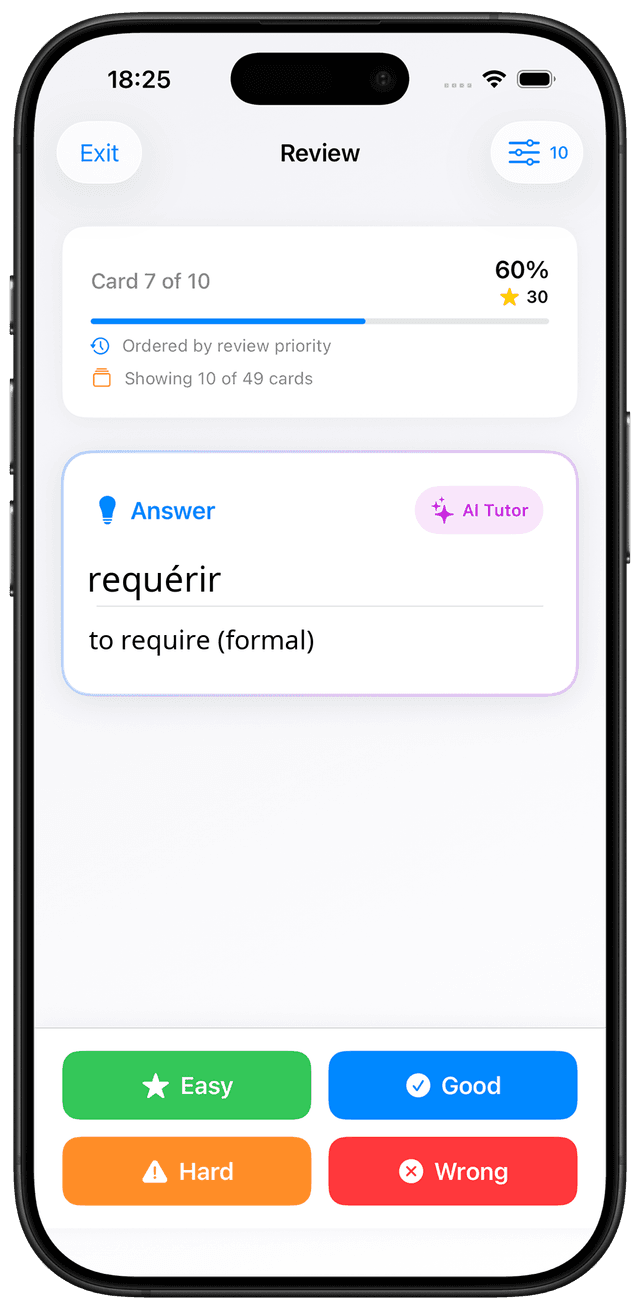
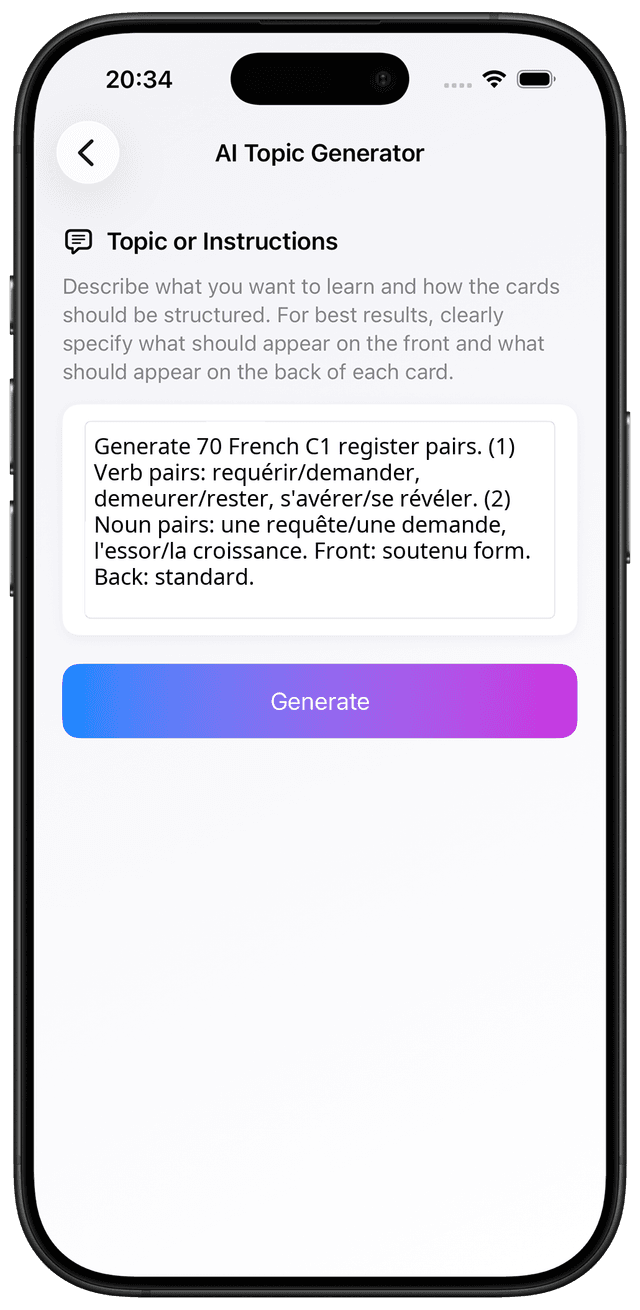
At C1, register is no longer optional polish. French has three distinct registers: soutenu (elevated formal), standard (educated everyday), and familier (informal). A C1 speaker switches between them deliberately and spots immediately when a text is operating at an elevated register. DALF C1 writing tasks are scored on this ability.
Soutenu vocabulary includes verbs like requérir instead of demander, demeurer instead of rester, and s'avérer instead of se révéler. Nouns shift too: une requête instead of une demande, un demeure instead of une maison (in literary contexts). These are not rare words in C1 French texts. They are expected.
Why start here? Register control is the most visible C1 marker in DALF writing and oral tasks. It appears in every section of the exam and is explicitly scored. Getting it right from the start of this guide sets the right tone for everything that follows.
The strategy: Each card pairs the soutenu form with its standard equivalent, so you build register awareness rather than just adding to your word list.
Generate 70 French C1 register pairs. Three groups: (1) Verb register pairs: requérir/demander, demeurer/rester, s'avérer/se révéler, préconiser/recommander, susciter/provoquer, omettre/oublier. (2) Noun register pairs: une requête/une demande, l'essor/la croissance, la conjoncture/la situation. (3) Full soutenu sentences alongside standard equivalents. Front: soutenu form. Back: standard equivalent + example sentence.
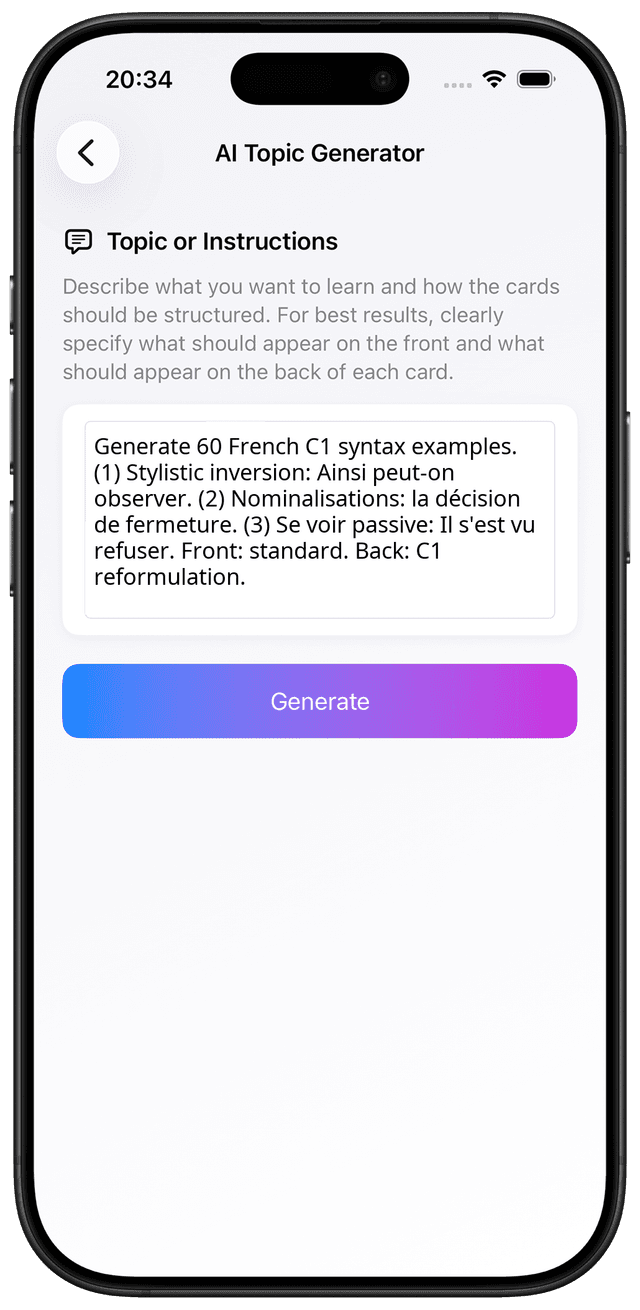
C1 written French uses syntactic structures that rarely appear in spoken language or B2 texts. Stylistic inversion after adverbs like ainsi, aussi, and à peine is standard in formal essays. Nominalisations are everywhere in press releases, academic writing, and official documents. The passive with se voir plus infinitive appears constantly in French news and institutional language.
Stylistic inversion looks like this: Ainsi peut-on observer que... or À peine eut-il parlé que... These are not optional flourishes. In a DALF C1 essay, their absence signals B2 writing; their presence signals C1. Nominalisations convert verbs to noun phrases: instead of le gouvernement a décidé de fermer, you write la décision gouvernementale de fermeture. Both compress information and signal formal register simultaneously.
Why this second? After register vocabulary, complex syntax is the second major differentiator between B2 and C1 writing. These structures are widely used in DALF model answers and in authentic French administrative and press texts.
The strategy: Cards show the base sentence alongside the C1 syntactic reformulation, so you learn to produce these structures, not just recognise them.
Generate 60 French C1 complex syntax examples. Groups: (1) Stylistic inversion after adverbs: Ainsi peut-on observer que, À peine était-il arrivé que, Aussi faut-il noter que, Encore faut-il préciser que. (2) Nominalisations: la décision de fermeture, l'augmentation du coût, la mise en oeuvre du projet. (3) Se voir + infinitive passive: Il s'est vu refuser, Elle s'est vue contrainte de. Front: standard sentence. Back: C1 reformulation + structure label.
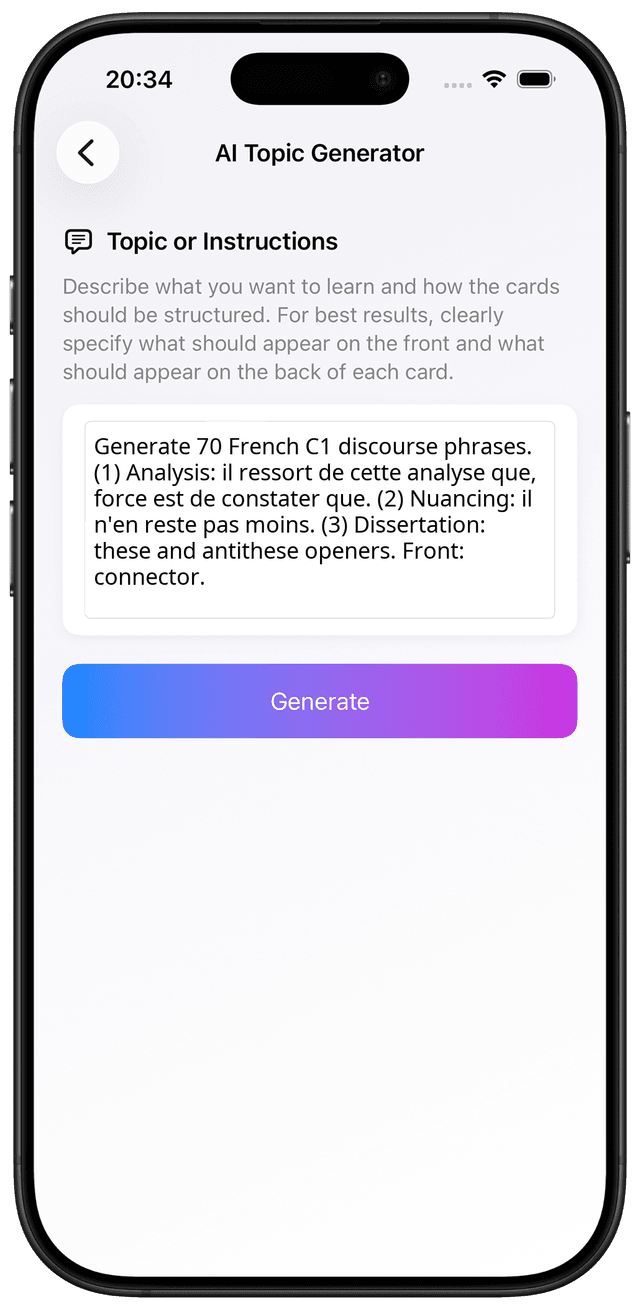
B2 argumentation uses connectors like cependant, néanmoins, and par conséquent. C1 argumentation has a different toolkit. Phrases like il ressort de cette analyse que, force est de constater que, il n'en reste pas moins que, and quoi qu'il en soit signal a more controlled, academic register. DALF C1 writing assessors look for this level of discourse management.
C1 argumentation also involves a specific structure for the French-style dissertation: thèse, antithèse, and synthèse. This format appears in DALF C1 writing tasks and in French higher education generally. Knowing how to open a thèse section (Il est courant de considérer que...), introduce the antithèse (Cependant, il convient de nuancer cette perspective en...), and close with a synthèse (En définitive, si l'on s'en tient aux faits...) is tested directly.
Why argumentation now? DALF C1 writing counts for a significant portion of the overall score. Mastering C1 connectors and the dissertation structure before the vocabulary-focused phases means your practice writing already operates at C1 level.
The strategy: Cards pair each connector or discourse phrase with a complete example sentence from a dissertation-style context so you absorb function alongside form.
Generate 70 French C1 discourse and argumentation phrases. Groups: (1) Introducing analysis: il ressort de cette analyse que, force est de constater que, il y a lieu de s'interroger sur, l'examen de cette question révèle que. (2) Nuancing: il n'en reste pas moins que, quoi qu'il en soit, pour autant que l'on puisse en juger. (3) Dissertation structure: thèse openers, antithèse transitions, synthèse closings. Front: connector + sentence. Back: English + discourse function.
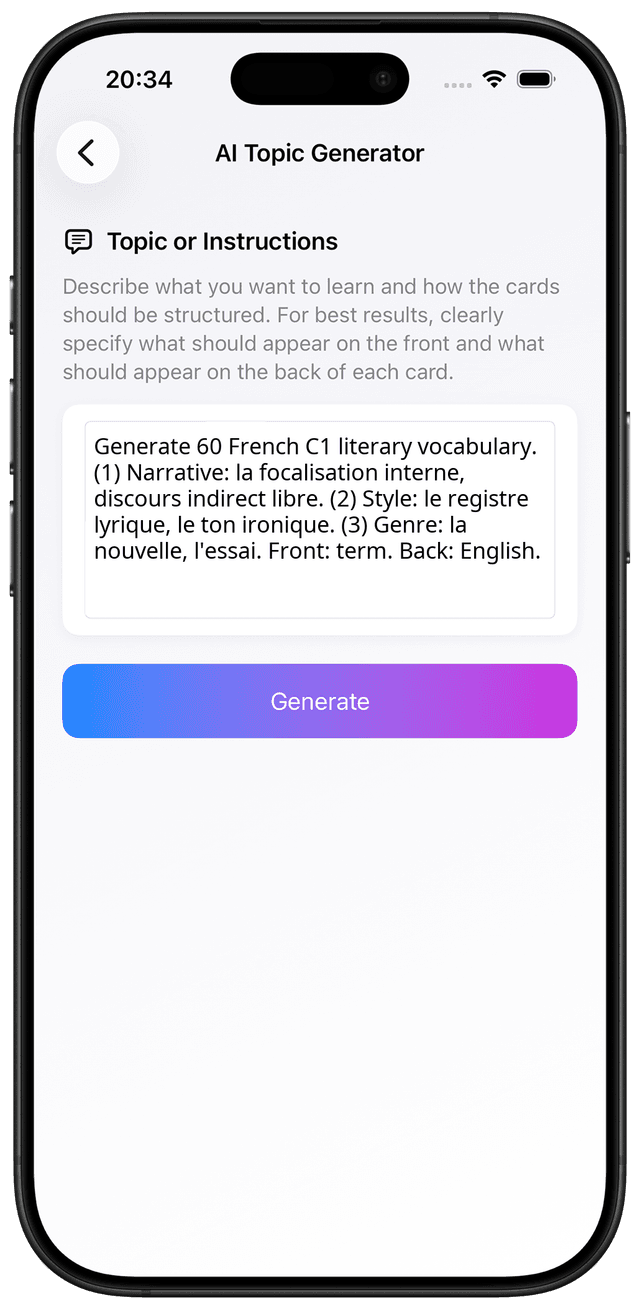
French C1 is not only formal and academic. The DALF C1 comprehension tasks include literary and cultural texts where literary vocabulary and stylistic figures appear. French literary language uses specific terms for narrative technique (la focalisation interne, le discours indirect libre), for style (le registre lyrique, le ton ironique), and for literary genres (la nouvelle, le roman épistolaire, l'essai).
Literary vocabulary matters even for non-literature candidates because French DALF C1 reading texts frequently come from essayists, journalists writing with literary influence, and public intellectuals. A writer like Albert Camus, Patrick Modiano, or Annie Ernaux will appear in a comprehension task. Knowing what discours indirect libre means or recognising le ton ironique changes how accurately you respond to comprehension questions.
Why literary vocabulary? DALF C1 reading comprehension requires you to identify tone, style, and narrative technique in French texts. This vocabulary is tested implicitly through questions about how a text is written, not only what it says.
The strategy: Cards cover both the terms themselves and example passages illustrating each device, so you can identify them in authentic texts rather than just define them abstractly.
Generate 60 French C1 literary vocabulary items. Groups: (1) Narrative technique: la focalisation interne, focalisation zéro, le narrateur omniscient, le discours indirect libre, le monologue intérieur. (2) Style and tone: le registre lyrique, le ton ironique, le style soutenu, la métaphore filée, l'hyperbole. (3) Genre terms: la nouvelle, le roman épistolaire, l'essai, le récit autobiographique, le conte philosophique. Front: term. Back: English definition + example from a French literary text.
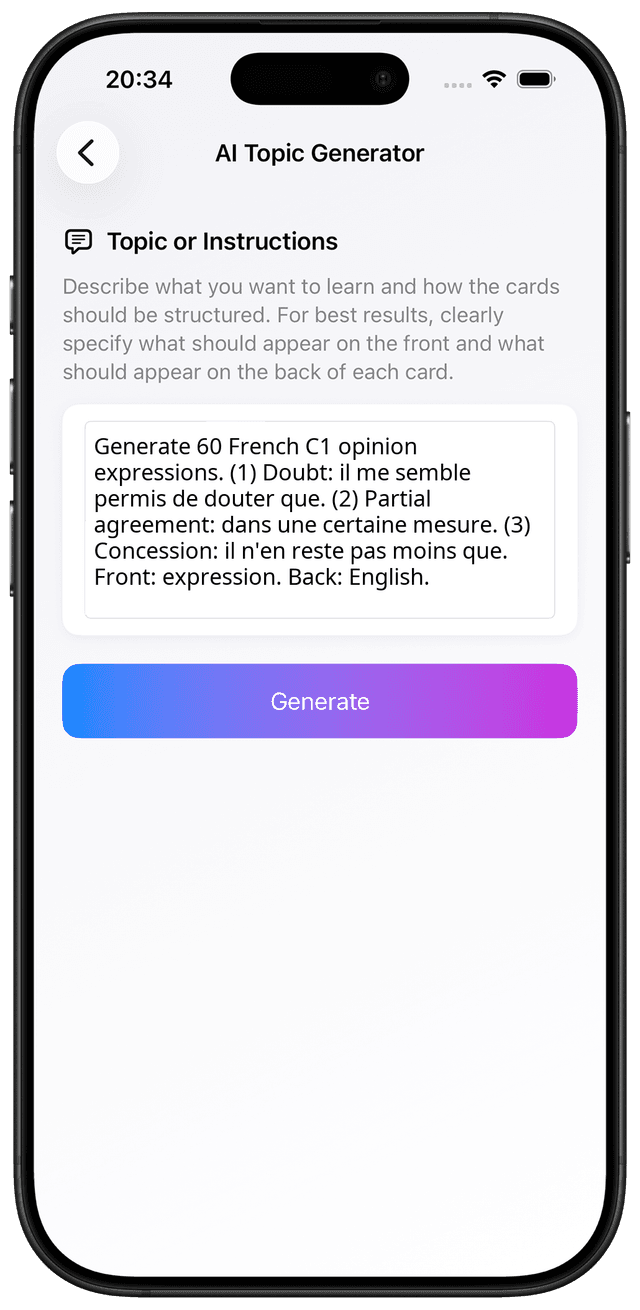
C1 speakers do not state opinions flatly. They hedge, qualify, and nuance. French has a specific vocabulary for this that goes beyond B2 structures. Phrases like il me semble permis de douter que, on peut légitimement se demander si, sans vouloir remettre en cause, and à supposer même que express the measured, careful tone that DALF C1 oral and written tasks reward.
Conceding a point without abandoning your argument is something C1 speakers do fluently and B1 speakers often cannot. In French you can qualify, hedge, and push back without sounding evasive. Expressions like dans une certaine mesure, sous réserve de, moyennant quoi, and nonobstant do this work. You will not find them at B2 level.
Why nuanced opinion language? DALF C1 oral production is scored on nuance and complexity of expression. Flat, unqualified claims score at B2. Measured qualifications with appropriate lexis score at C1. This phase builds the exact vocabulary the oral examiners listen for.
The strategy: Cards show the expression in a complete example sentence that illustrates the degree of qualification, not just a dictionary gloss.
Generate 60 French C1 nuanced opinion and qualification expressions. Groups: (1) Measured doubt: il me semble permis de douter que, on peut légitimement se demander si, il est difficile d'affirmer avec certitude que. (2) Partial agreement: dans une certaine mesure, pour autant, sous réserve de, sans vouloir remettre en cause. (3) Concession with position maintained: il n'en reste pas moins que, quand bien même, nonobstant, cela étant dit. Front: expression + full sentence. Back: English + function label.
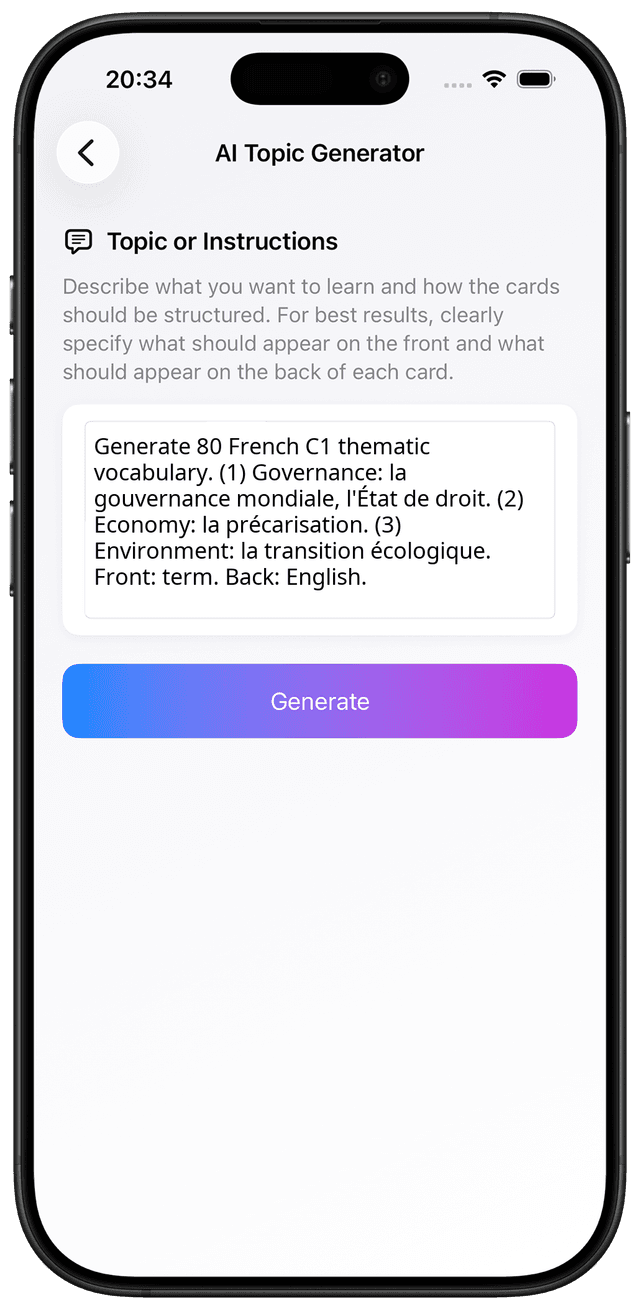
DALF C1 reading and listening texts come from Le Monde, France Culture, Les Échos, and similar sources. The thematic vocabulary in these outlets goes beyond B2 social topics. Issues like la gouvernance mondiale, le développement durable dans les politiques publiques, la fracture numérique, les transformations du marché du travail, and le débat autour de la laïcité require specific lexis to discuss at C1 level.
French public discourse has its own conceptual vocabulary. La République and its values, la politique de la ville, l'économie sociale et solidaire, and le service public are not just vocabulary items but frameworks for understanding how French society talks about itself. A candidate who controls this vocabulary can engage with the texts rather than decoding them word by word.
Why advanced thematic vocabulary? DALF C1 listening comprehension includes extracts from France Culture programmes, Le Monde podcasts, and expert interviews. Building this vocabulary before you practice comprehension means you follow argument and nuance, not just the main facts.
The strategy: Cards group vocabulary by thematic area with sentence-level examples from the type of authentic source where each item appears most often.
Generate 80 French C1 advanced thematic vocabulary items. Areas: (1) Governance and institutions: la gouvernance mondiale, l'État de droit, la séparation des pouvoirs, la transparence démocratique, le principe de subsidiarité. (2) Economy and labour: les transformations du marché du travail, l'économie sociale et solidaire, la précarisation, les inégalités structurelles. (3) Environment and policy: la transition écologique, le développement durable, les politiques publiques environnementales. (4) Culture and identity: la fracture numérique, l'exception culturelle française, la laïcité. Front: French term + sentence. Back: English + domain.
Past B2, the grammar and vocabulary count are rarely the issue. What gives away an advanced learner is the absence of idioms, set phrases, and collocations that native speakers reach for without thinking. At C1 you need to be producing these, not just understanding them when you hear them.
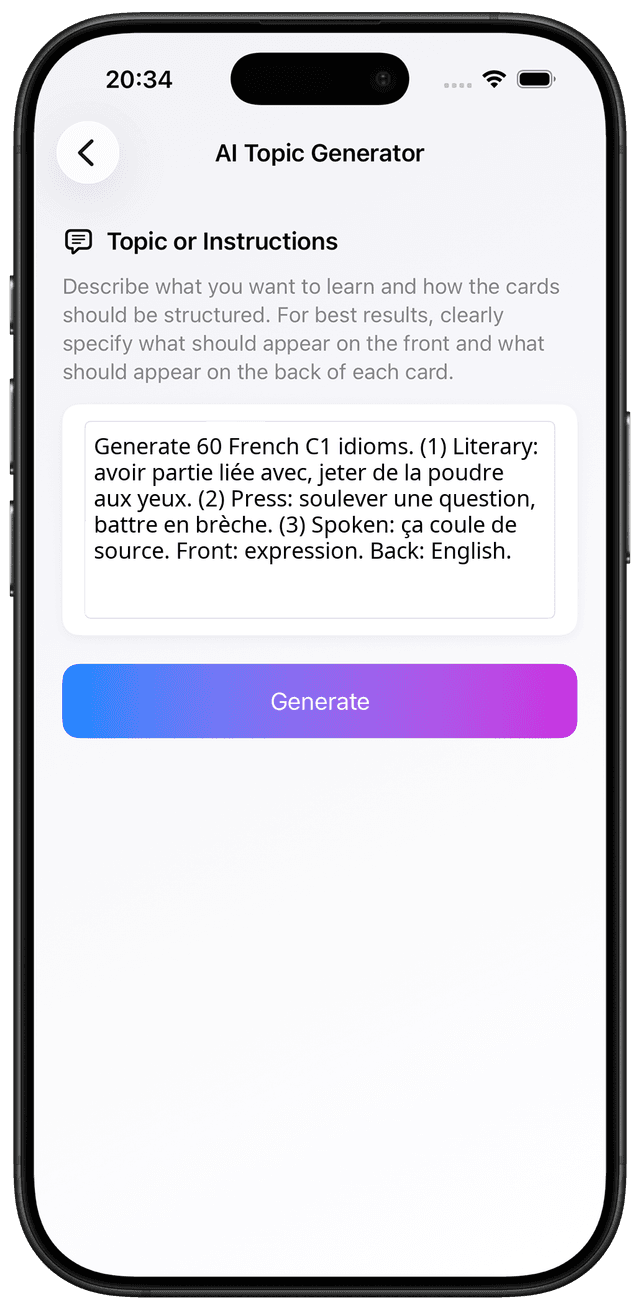
French C1 idioms include expressions from literary and cultural registers as well as everyday speech: avoir partie liée avec (to be closely connected with), jeter de la poudre aux yeux (to create a false impression), tenir le haut du pavé (to be at the top), prendre le taureau par les cornes (to tackle something head-on), and avoir le vent en poupe (to be doing well). These appear in journalism, essays, and public speech.
The C1 milestone: With this phase complete, your C1 French covers all the ground DALF tests: formal register, complex syntax, dissertation-style argumentation, literary comprehension, nuanced qualification, advanced thematic vocabulary, and idiomatic fluency. You can read a Le Monde editorial, write a structured academic essay, and hold a conversation on any topic without reaching for simpler words. C2 builds from here by extending your range and tightening your production control.
Generate 60 French C1 idiomatic expressions and collocations. Groups: (1) Literary/formal idioms: avoir partie liée avec, jeter de la poudre aux yeux, tenir le haut du pavé, prendre le taureau par les cornes. (2) Press and public speech collocations: soulever une question, trancher un débat, faire fi de, peser le pour et le contre, battre en brèche. (3) Spoken C1 expressions: ça coule de source, c'est une autre paire de manches, mettre les points sur les i. Front: expression + example sentence. Back: English + register label.
At C1, vocabulary is less predictable than at lower levels. Register variants, literary terms, and advanced collocations do not follow simple patterns and appear less frequently, so passive exposure alone takes too long. Spaced repetition handles this well: cards you find difficult appear more often, cards you know drop back. You spend time where it counts.
C1 builds on B2 and represents near-native fluency. C2 takes that to mastery. Use the links below to move between levels or return to the full French guide.
Build your French C1 vocabulary with AI-generated decks and spaced repetition that adapts to what you actually find difficult. Free to download. No account required. Start with the phase that covers your biggest gap.