
Spaced repetition explained
Why reviewing at the right interval locks in European Portuguese B1 vocabulary
You have the A2 grammar. You can place a reflexive verb after the verb the Portugal way, navigate the Preterito Perfeito Composto, and order a galao without panic. Now comes the part where pt-PT really diverges from anything Brazilian textbooks taught you: the Conjuntivo mood, the proclisis triggers, the mesoclitic forms in news writing, and the formal register you need for a visit to the Camara Municipal or for the CAPLE DIPLE B1 exam.
B1 in European Portuguese covers around 1,500 words and structures, but they are not all equally useful. This guide focuses on what actually shows up: the Conjuntivo trigger phrases that Portuguese speakers reach for in everyday conversation, the clitic placement rules that mark a learner as Portugal-trained, the connectors used in Portuguese press and government writing, and the idiomatic spoken Portuguese you hear in Lisbon and Porto.
Each phase below includes a ready-to-use AI prompt. Copy it into MindCards to build a focused deck around real B1 European Portuguese grammar and vocabulary. Spaced repetition schedules each card just before you would forget it, so you retain more in less time at your desk.
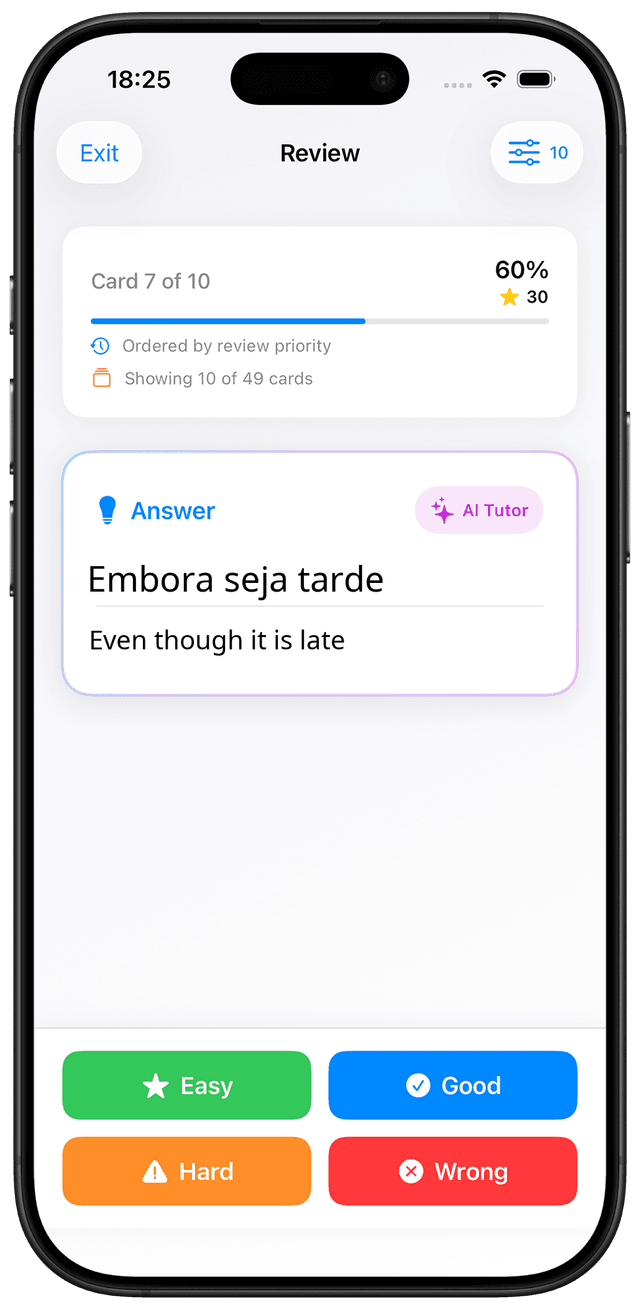
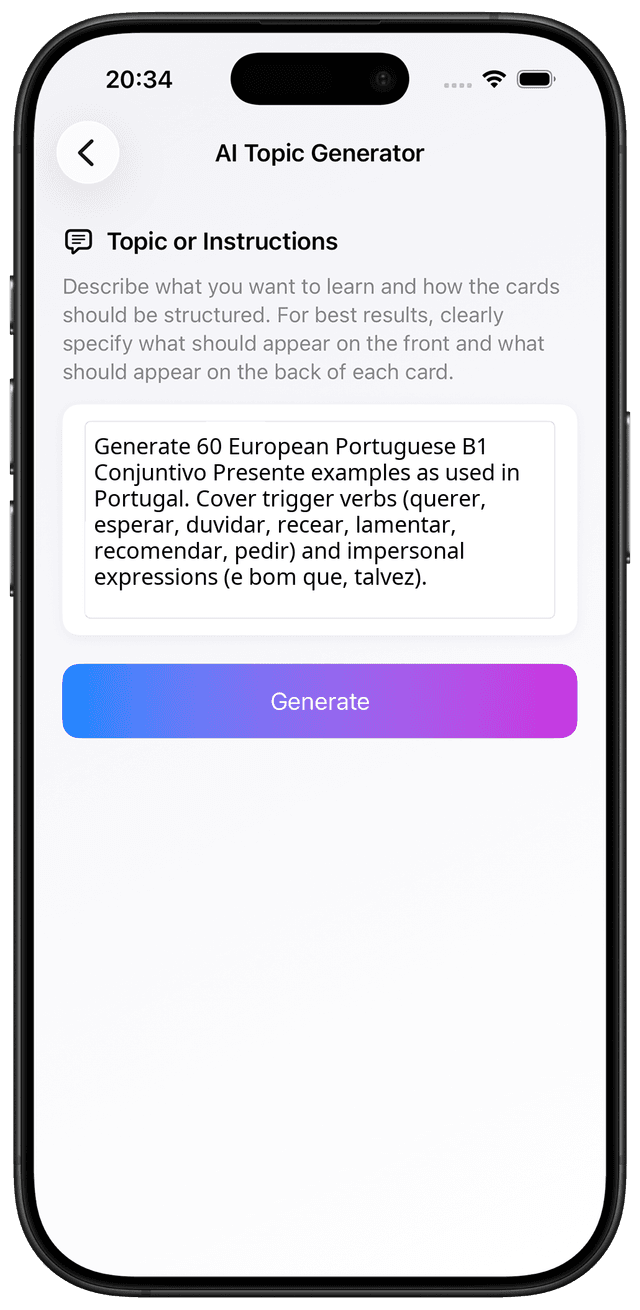
In Portugal it is called the Conjuntivo, not the Subjuntivo as Brazilians say. Same mood, different name and a slightly different feel in practice. You hit it everywhere at B1 in pt-PT: Quero que venhas comigo, Espero que chegues a tempo, Talvez ele saiba. The trigger phrases that pull in the Conjuntivo are dense and you will not sound natural without them.
European Portuguese leans on the Conjuntivo more readily in everyday speech than Brazilians do. Phrases like Embora seja tarde, or Caso queiras, or Por mais que tente are common in Portuguese conversation and Portuguese television. The CAPLE DIPLE B1 exam tests this mood in both writing and the structured speaking section, so memorising trigger phrases pays off twice.
Why start here? The Conjuntivo is the dividing line between A2 and B1 in pt-PT. Without it you are stuck describing facts. With it you can express wishes, doubts, and reactions the way Portuguese people actually do.
The strategy: This deck covers 60 trigger phrases plus the irregular Conjuntivo Presente forms that come up most in Portugal: ser (seja), ir (va), ter (tenha), fazer (faca), querer (queira), and saber (saiba).
Generate 60 European Portuguese B1 Conjuntivo Presente examples as used in Portugal. Cover trigger verbs (querer, esperar, duvidar, recear, lamentar, recomendar, pedir), impersonal expressions (e bom que, e provavel que, e pena que, talvez, oxala), and concession triggers (embora, por mais que, ainda que, caso). Include irregular forms: ser -> seja, ir -> va, ter -> tenha, fazer -> faca, querer -> queira, saber -> saiba. Front: Portuguese sentence (pt-PT). Back: English + trigger type.
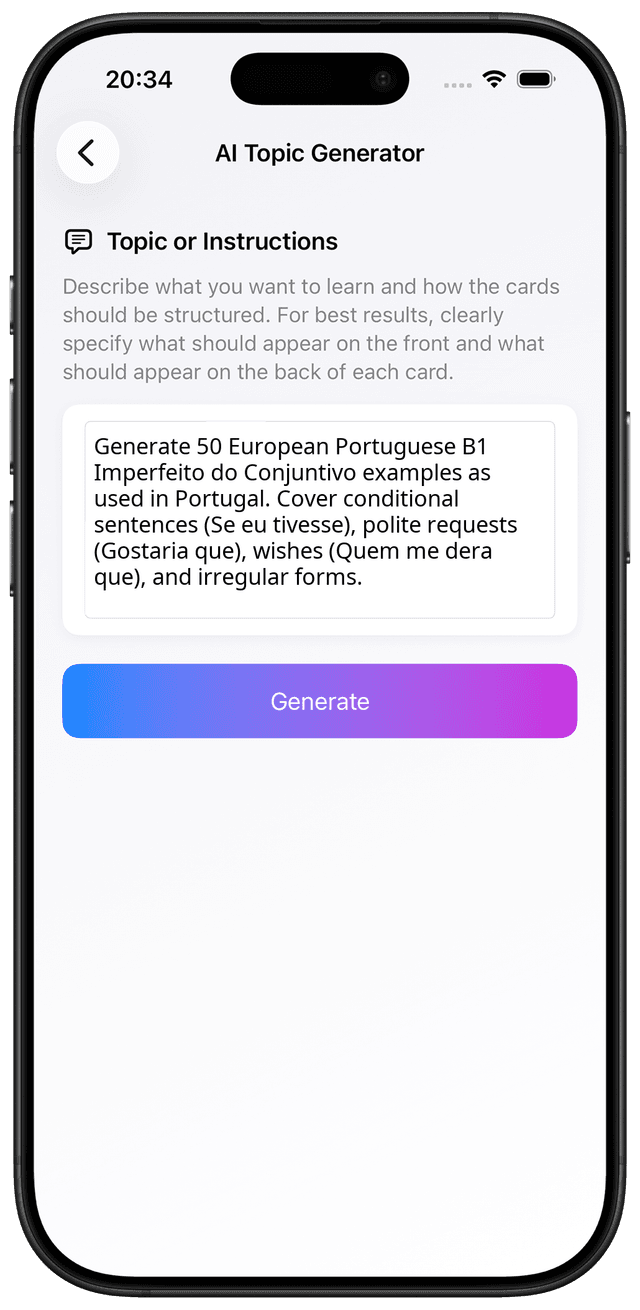
The Imperfeito do Conjuntivo handles wishes, regrets, and the second half of conditional sentences. Se eu tivesse tempo, ia contigo. Quem me dera que pudesses ficar. Gostaria que viesses jantar. In Portugal these forms appear in everyday speech, not just on paper. Portuguese friends will say Quem me dera in a casual chat about wishful thinking without a second thought.
What makes pt-PT distinctive here: the construction Quem me dera que + Imperfeito do Conjuntivo. It has no direct Brazilian equivalent in casual speech. You also see Se calhar paired with the Conjuntivo or the Indicativo depending on certainty: Se calhar fosse melhor (more tentative) versus Se calhar e melhor (more direct). Calibrating between the two is part of sounding Portuguese.
Why this next? Conditional and polite-request structures account for a large share of the CAPLE DIPLE B1 writing and speaking grades. They also drive every wish, regret, and hypothetical you want to express.
The strategy: This deck pairs the Imperfeito do Conjuntivo with its trigger structures (Se, Quem me dera, Gostaria que, Embora) so you learn the construction, not isolated verb endings.
Generate 50 European Portuguese B1 Imperfeito do Conjuntivo (past subjunctive) examples as used in Portugal. Cover: conditional sentences (Se eu tivesse, Se fosses comigo, Se ela pudesse), polite requests (Gostaria que, Queria que, Seria bom que), wishes (Quem me dera que, Oxala que), and irregular forms (ser/ir -> fosse, ter -> tivesse, fazer -> fizesse, poder -> pudesse, querer -> quisesse, saber -> soubesse). Front: Portuguese sentence (pt-PT). Back: English + structure note.
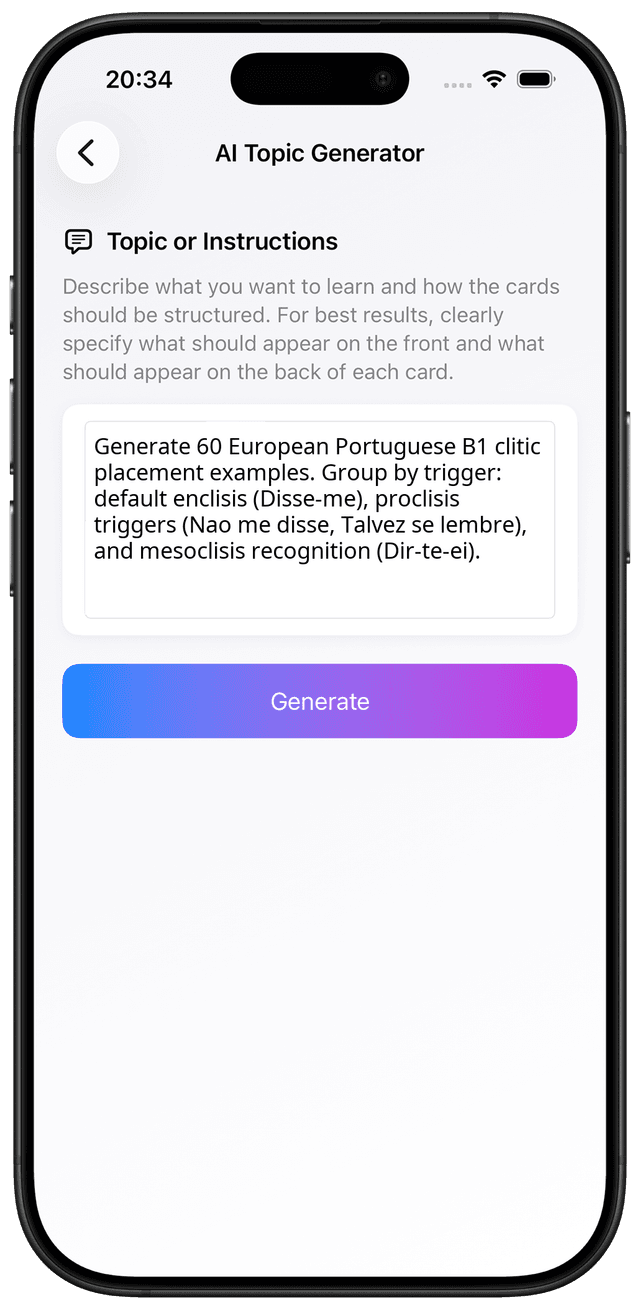
Portuguese clitic placement is one of the most distinctively European features of the language and B1 is where it becomes non-negotiable. In a neutral affirmative sentence the pronoun goes after the verb: Vejo-te amanha. Disse-me a verdade. But trigger words shift the pronoun before the verb: Nao te vejo, Ainda me disseste, Quando te vires, Quem te disse isso. Negation, certain adverbs, conjunctions, and relative pronouns are all proclisis triggers.
Then there is mesoclisis, the form Brazilians abandoned and Portuguese still use in formal writing and careful speech. Dir-te-ei amanha. Far-lhe-ia o favor. The pronoun sits inside the future or conditional verb. You rarely produce these yourself at B1 but you absolutely encounter them in news, formal emails, and the DIPLE reading passages. Recognising them is a B1 skill.
Why this matters: Clitic placement is the single feature that most marks a learner as Portugal-trained or Brazil-trained. Getting it right also unlocks CAPLE DIPLE writing points that Brazilian-trained learners often miss.
The strategy: This deck organises clitics by trigger type: default enclisis, proclisis triggers (nao, nunca, ja, ainda, talvez, quem, que, se), and mesoclisis recognition cards for future and conditional verbs.
Generate 60 European Portuguese B1 clitic placement examples. Group by trigger: default enclisis (Disse-me, Levantei-me, Sente-se), proclisis triggers (Nao me disse, Ainda te vi, Talvez se lembre, Quem te disse, Que me digas, Se o vires), and mesoclisis recognition (Dir-te-ei, Far-lhe-ia, Encontrar-nos-emos). Use only pt-PT placement rules. Front: Portuguese sentence. Back: English + clitic rule label.
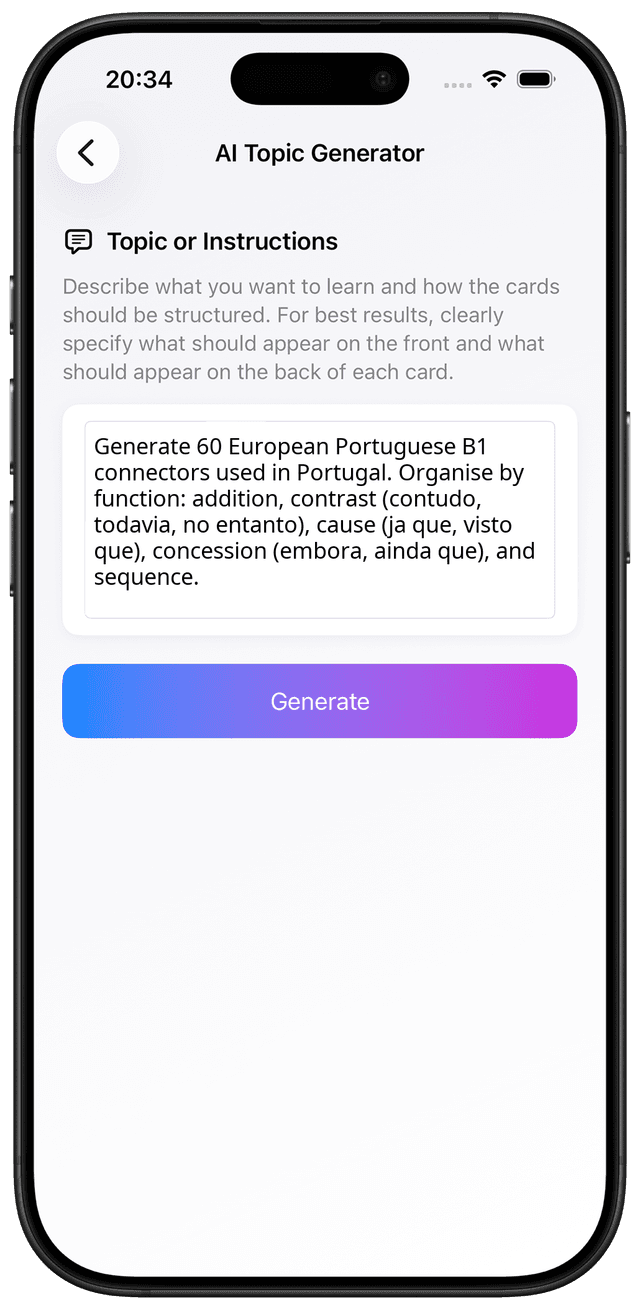
B1 connector vocabulary in pt-PT overlaps with Brazilian usage but diverges in tone and frequency. Apesar de, contudo, todavia, no entanto, porem, ja que, visto que, uma vez que, e portanto are all common in Portuguese spoken and written speech. The Portuguese press uses contudo and porem much more readily than Brazilian outlets do. Knowing which connector fits which register is a B1 skill.
One pt-PT habit worth noting: Portuguese speakers tend to chain conditions with caso instead of se when something feels more hypothetical or polite. Caso precise de ajuda, diga. Caso seja possivel, gostariamos de remarcar. Brazilians would lean on Se in both cases. Picking up caso is a small move that makes your Portuguese sound less Brazilian-trained.
Why this matters: CAPLE DIPLE B1 writing graders look for connector range. Two essays with the same content score very differently based on how the writer glues ideas together.
The strategy: This deck groups connectors by function (addition, contrast, cause, concession, sequence) and tags each one with a register note for Portugal usage.
Generate 60 European Portuguese B1 connectors and cohesion markers as used in Portugal. Organise by function. Addition: alem disso, ademais, igualmente. Contrast: contudo, todavia, no entanto, porem, apesar de. Cause: ja que, visto que, uma vez que, dado que, devido a. Concession: embora, ainda que, mesmo que, conquanto. Sequence: em primeiro lugar, de seguida, posteriormente, por fim. Also include caso versus se for conditionals. Front: connector in sentence (pt-PT). Back: English + function and register label.
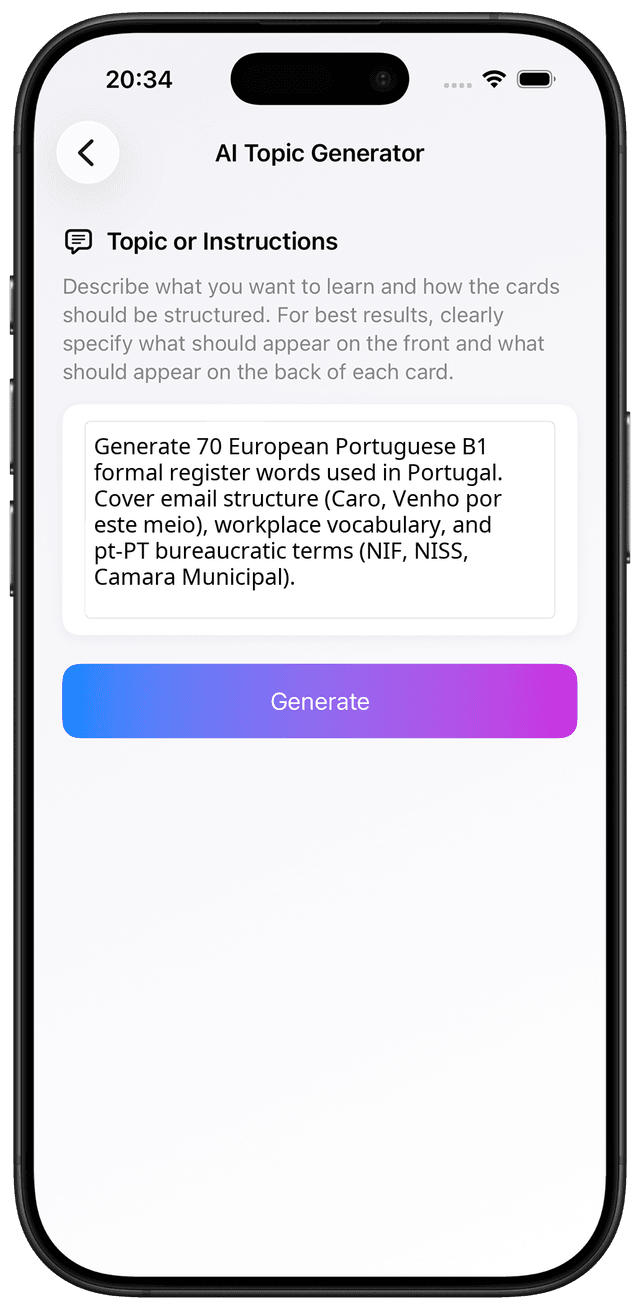
Formal pt-PT has its own flavour. Emails open with Caro(a) or Exmo(a) Senhor(a), not Oi. Requests use Venho por este meio solicitar or Agradecia que. Closings are Com os melhores cumprimentos or Com elevada consideracao, not Atenciosamente as in Brazil. The bureaucratic vocabulary you meet at the Servico de Estrangeiros e Fronteiras, the Camara Municipal, or Financas is a world unto itself: NIF, NISS, Cartao de Cidadao, Conservatoria, finanças, autoridade tributaria, comprovativo de morada.
Portuguese formal writing tends toward longer sentences and more subordination than Brazilian writing. A B1 DIPLE candidate is expected to write a formal email or short letter on demand. Getting the closing right matters: Com os melhores cumprimentos is the safe default for any pt-PT formal email and signals you trained in Portugal, not in Brazil.
Why formal register at B1? CAPLE DIPLE B1 always includes a formal writing task. Anyone living in Portugal will also hit bureaucratic Portuguese the first time they renew a residence permit.
The strategy: This deck covers email structure, formal request patterns, and the bureaucratic terms you will hear at any Portuguese government counter.
Generate 70 European Portuguese B1 formal register words and phrases as used in Portugal. Cover: email structure (Caro, Exmo Senhor, Venho por este meio solicitar, Agradeco a sua atencao, Com os melhores cumprimentos), workplace vocabulary (reuniao, prazo, relatorio, orcamento, proposta), pt-PT bureaucratic terms (NIF, NISS, Cartao de Cidadao, Conservatoria, Camara Municipal, Financas, comprovativo de morada, SEF, atestado), and formal connectors. Front: Portuguese (pt-PT). Back: English + register label.
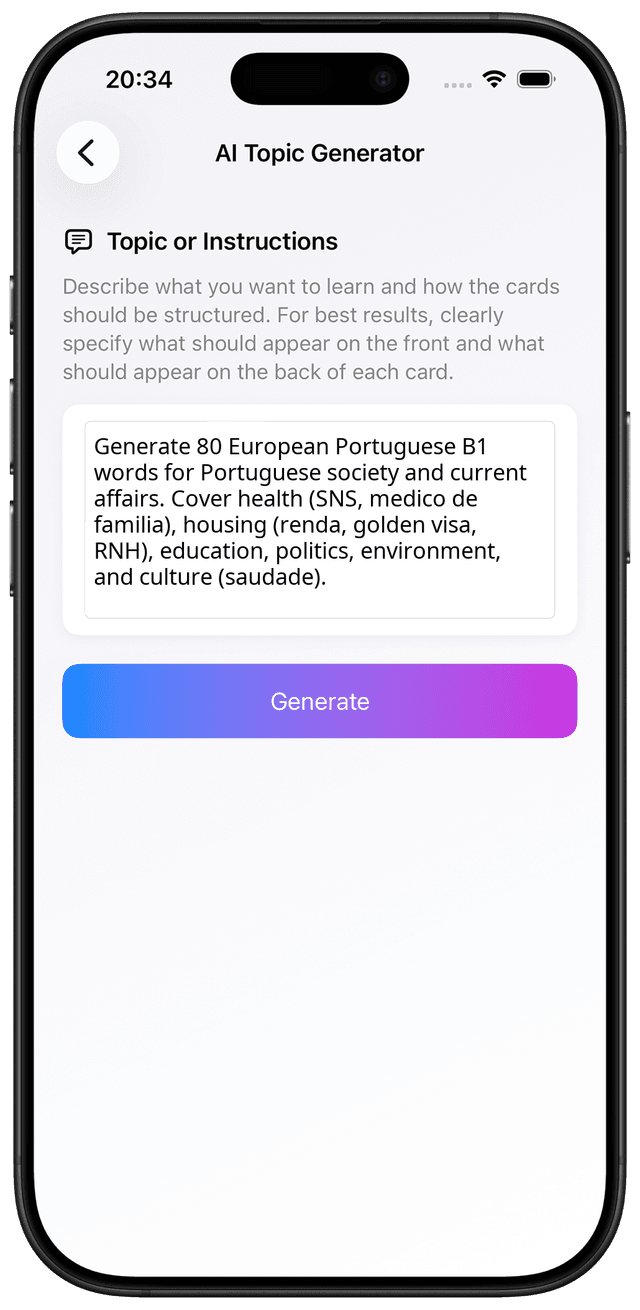
B1 reading and listening tasks in CAPLE DIPLE pull from Portuguese newspapers, RTP news, and Antena 1 radio. The vocabulary you meet there is specific to Portugal: SNS (Servico Nacional de Saude), IRS, IMI, RNH, golden visa, habitacao, salario minimo nacional, emigracao, the historic preocupacao with the baixa natalidade. Topics like climate, housing, healthcare, and education show up in nearly every DIPLE reading section.
Portuguese has rich vocabulary around concepts that do not always translate cleanly. Saudade is the famous one. But there is also desenrascanco (improvised problem-solving, a national virtue), a sebenta (rough lecture notes), pendurar a chuteira (retire from football, used metaphorically too), and a sandes (a Portuguese sandwich, not a Brazilian one). At B1 you start using these without thinking.
Why this matters: B1 is where you stop sounding like a learner and start sounding like someone who lives in Portugal and follows the news. This deck builds the lexical base for that shift.
The strategy: This deck groups vocabulary by domain (health, housing, education, politics, environment, culture) using terms specific to Portugal, not generic Lusophone vocabulary.
Generate 80 European Portuguese B1 words and phrases for Portuguese society and current affairs. Cover: health (SNS, centro de saude, medico de familia, urgencia, listas de espera), housing (renda, arrendamento, alojamento local, golden visa, RNH, IMI, habitacao acessivel), education (escola publica, exame nacional, faculdade, ensino superior, bolsa de estudo), politics (Assembleia da Republica, primeiro-ministro, autarquias, freguesia), environment (incendios florestais, seca, transicao energetica), culture (saudade, desenrascanco, fado, festas populares). Front: Portuguese term plus short context sentence (pt-PT). Back: English plus domain label.
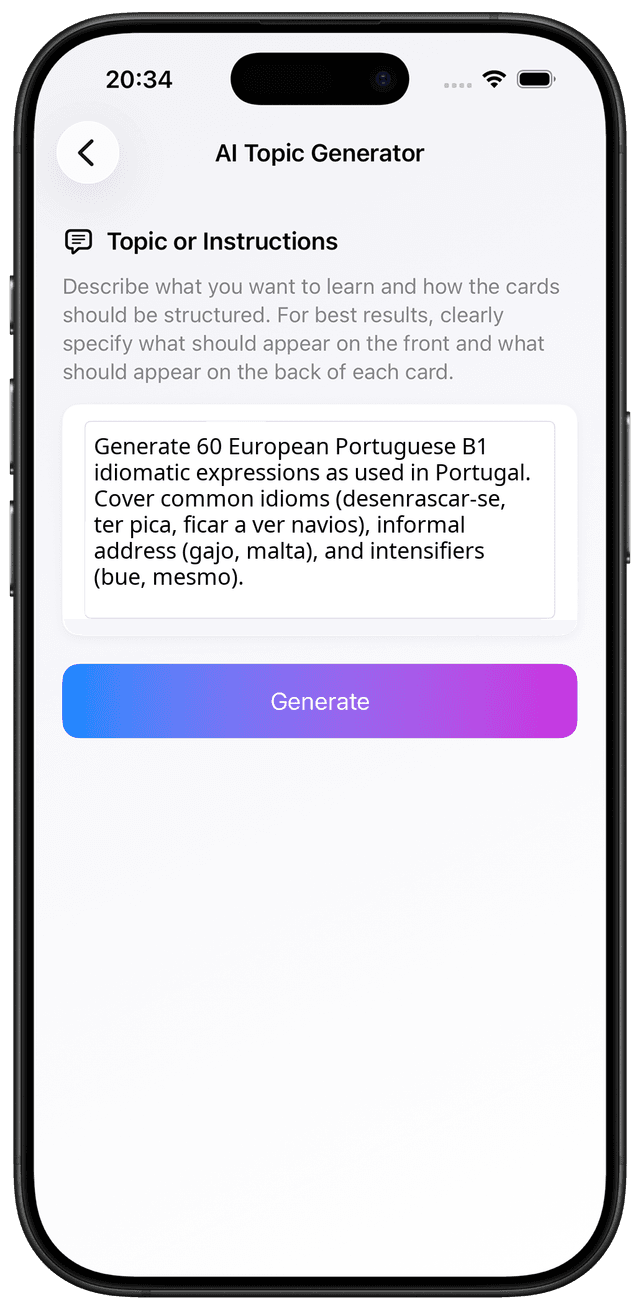
The closing piece of B1 in pt-PT is sounding Portuguese in casual conversation, not just correct. Daily speech is full of expressions you will not find in textbooks: estar a fixe (to be cool), ir dar uma volta (to go for a stroll), ter pica (to have drive or attitude), gajo and gaja (informal for guy and girl, common in Lisbon), bue (very, in younger Lisbon speech), porreiro (great, classic informal Portuguese), and the famously Portuguese desenrascar-se (to get by, to figure things out).
Regional variation is real in Portugal too. Lisbon speech uses gajo and bue more freely. Porto speech keeps tu forms even in slightly formal contexts. The Alentejo drags vowels and uses ainda for emphasis. CAPLE DIPLE does not test regional dialects directly, but the listening section uses speakers from across Portugal. Recognising informal Portuguese is what turns textbook Portuguese into the language you actually need on the ground.
The milestone: With this phase, your B1 European Portuguese vocabulary is complete. You can handle the Conjuntivo, place clitics the Portugal way, connect ideas with pt-PT register awareness, write a formal email to the Camara Municipal, follow the SNS news, and crack a joke with a friend in casual Lisbon Portuguese. That is the full B1 picture for pt-PT.
Generate 60 European Portuguese B1 idiomatic expressions and natural speech as used in Portugal. Cover: common idioms (desenrascar-se, ir dar uma volta, ter pica, dar uma vista de olhos, ficar a ver navios, estar feito ao bife), informal address (gajo, gaja, malta, pessoal), agreement and reaction words (esta bem, claro que sim, pois e, ai sim, vai-te catar in playful contexts), informal intensifiers (bue, muita, super, mesmo, com tudo), and Portugal-specific fillers (la, pa, sabes). Front: Portuguese expression. Back: English meaning plus usage and register note.
B1 pt-PT involves a lot of form-plus-context pairs: Conjuntivo triggers, clitic placement rules, register tags. These are exactly the kind of items where active recall and spaced repetition do real work. MindCards schedules reviews at the interval where your brain is about to forget, which is when retrieval practice locks in the strongest.
B1 sits between the A2 grammar foundation and the C1 fluency level. Use the links below to move between levels or return to the full Portuguese guide.
Build your European Portuguese B1 vocabulary with AI-generated decks and spaced repetition that adapts to what you actually struggle with. Free to download. No account required. Start with any phase that fits where you are right now.