
Spaced repetition explained
Why reviewing at the right interval locks in European Portuguese A2 vocabulary
You have the A1 foundation. Now build something you can actually use in a real conversation in Lisbon or Porto. At A2, the jump that matters most is the past tense: specifically, how European Portuguese handles the Preterito Perfeito Composto (tenho falado, tenho ido) for recent and ongoing past actions. That form is specific to Portugal and sets European Portuguese apart from Brazilian from the first time you try to tell a story.
A2 covers roughly 1,000 words and structures, and they are not all equally useful. This guide focuses on what actually comes up: the past tense forms that Portuguese people use every day, the reflexive verb placement that differs from Brazilian Portuguese, and the opinion phrases that make your speech sound natural rather than textbook-flat.
Each phase below includes a ready-to-use AI prompt. Copy it into MindCards to get a focused deck built around real European Portuguese grammar and vocabulary. Spaced repetition then schedules each card just before you are about to forget it, so you keep more with less time sitting at a desk.
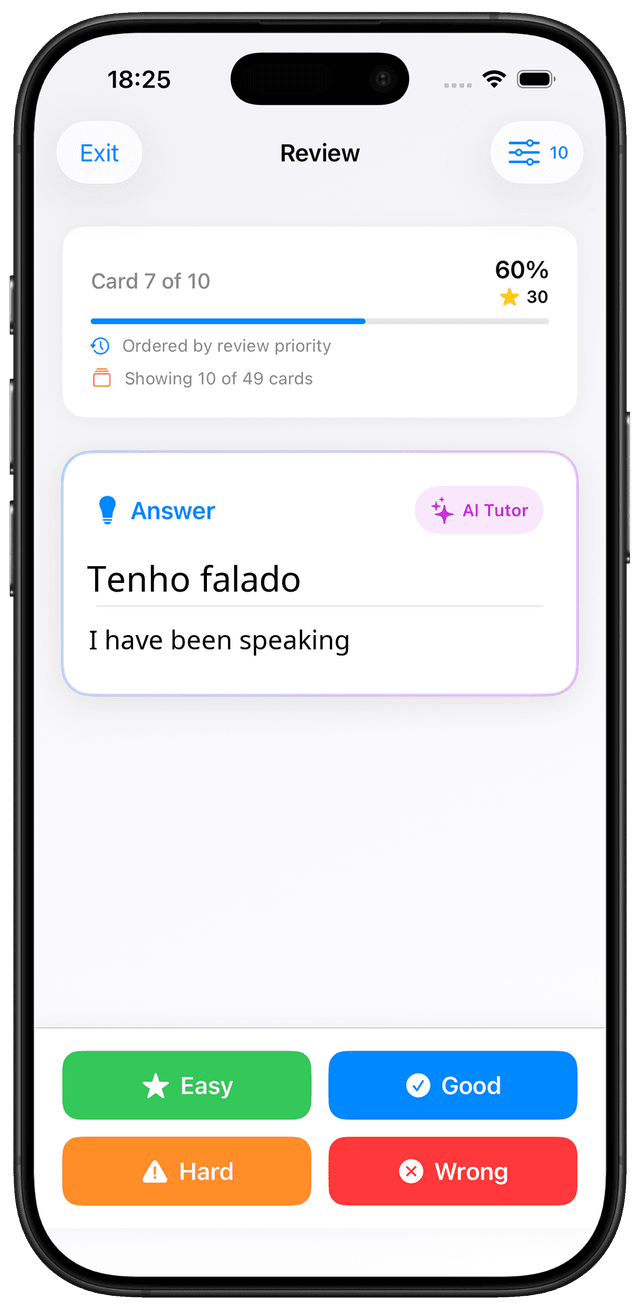
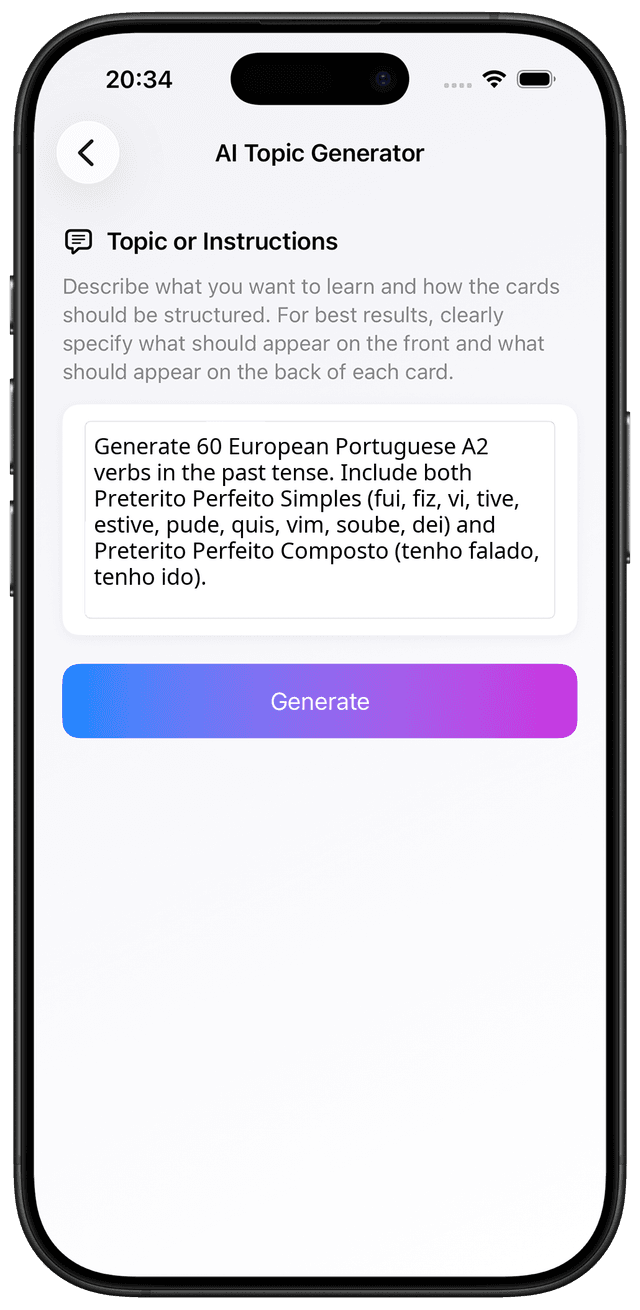
One of the clearest differences between European and Brazilian Portuguese shows up right at A2: how the past tense works. In Portugal, tenho falado (Preterito Perfeito Composto) is the standard form for describing actions that started in the past and continue into the present, or for recent repeated actions. Brazilians almost never use this form in everyday speech. If you come from Brazilian Portuguese resources, this phase will feel new.
The irregular simple past forms matter just as much. Fui (ser/ir), fiz (fazer), vi (ver), tive (ter), and estive (estar) come up constantly in Portuguese conversation. Learn them as complete pairs, not as rule derivations.
Why start here? Almost every A2 grammar topic in European Portuguese assumes you can place events in the past. This is also the first thing that separates an A1 speaker from an A2 speaker in real conversation in Lisbon.
The strategy: This deck covers 60 high-frequency verbs in both the Preterito Perfeito Simples and the Preterito Perfeito Composto, with example sentences grounded in everyday situations in Portugal.
Generate 60 European Portuguese A2 verbs in the past tense. Include both Preterito Perfeito Simples (fui, fiz, vi, tive, estive, pude, quis, vim, soube, dei) and Preterito Perfeito Composto (tenho falado, tenho ido) as used in Portugal. Front: infinitive + correct past tense form (eu). Back: English + example sentence in European Portuguese.
The Imperfeito handles background scenes, repeated habits, and ongoing states in the past. In Portugal, this tense appears constantly in storytelling and personal accounts. Time markers guide which tense to use: sempre, normalmente, quando era crianca, and antigamente all signal the Imperfeito. Ontem, naquele momento, de repente, and de uma vez point toward the Perfeito Simples.
A good sentence to feel the contrast in European Portuguese: Eu estava a ver televisao quando o telefone tocou. That construction, estar a + infinitive as the progressive form, is specific to European Portuguese and appears naturally in Imperfeito contexts. Brazilian Portuguese uses estar + gerund instead.
Why the Imperfeito next? At A2, you need both tenses to tell a story. Exams like DELF and everyday conversations both require combining them.
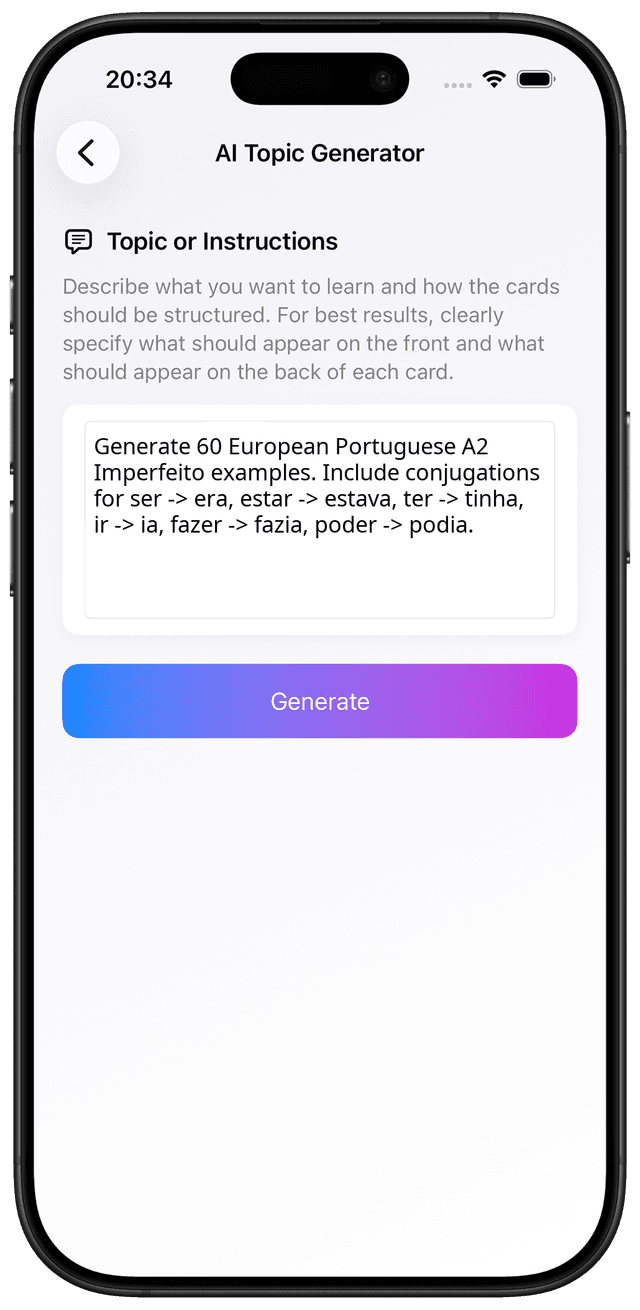
The strategy: This deck covers Imperfeito conjugations for core verbs, common time markers in European Portuguese, and contrast sentence pairs so you can choose the right tense by feel.
Generate 60 European Portuguese A2 Imperfeito examples. Include conjugations for ser -> era, estar -> estava, ter -> tinha, ir -> ia, fazer -> fazia, poder -> podia. Add 20 sentences with time markers (sempre, todo o dia, antigamente, quando era crianca, normalmente). Add 10 contrast pairs with Preterito Perfeito Simples. Use European Portuguese progressive form: estava a ver. Front: Portuguese sentence. Back: English + tense label with note.
European Portuguese places reflexive pronouns after the verb in affirmative main clauses: levanta-se, chama-se, sente-se. This clitic placement is one of the most consistent ways European Portuguese differs from Brazilian Portuguese, where speakers drop the pronoun before the verb in casual speech. Getting this right will make you sound like you actually learned Portuguese in Portugal, not from a Brazilian app.
Daily routine verbs are the foundation: levantar-se, deitar-se, vestir-se, sentar-se, lembrar-se, and chamar-se appear in almost every personal description and health conversation at A2 level. After them come feeling and social verbs that round out what you can say about yourself and others.
Why reflexive verbs matter: Introductions, daily routines, and health descriptions all rely on these forms. They show up in almost every A2-level spoken task in European Portuguese.
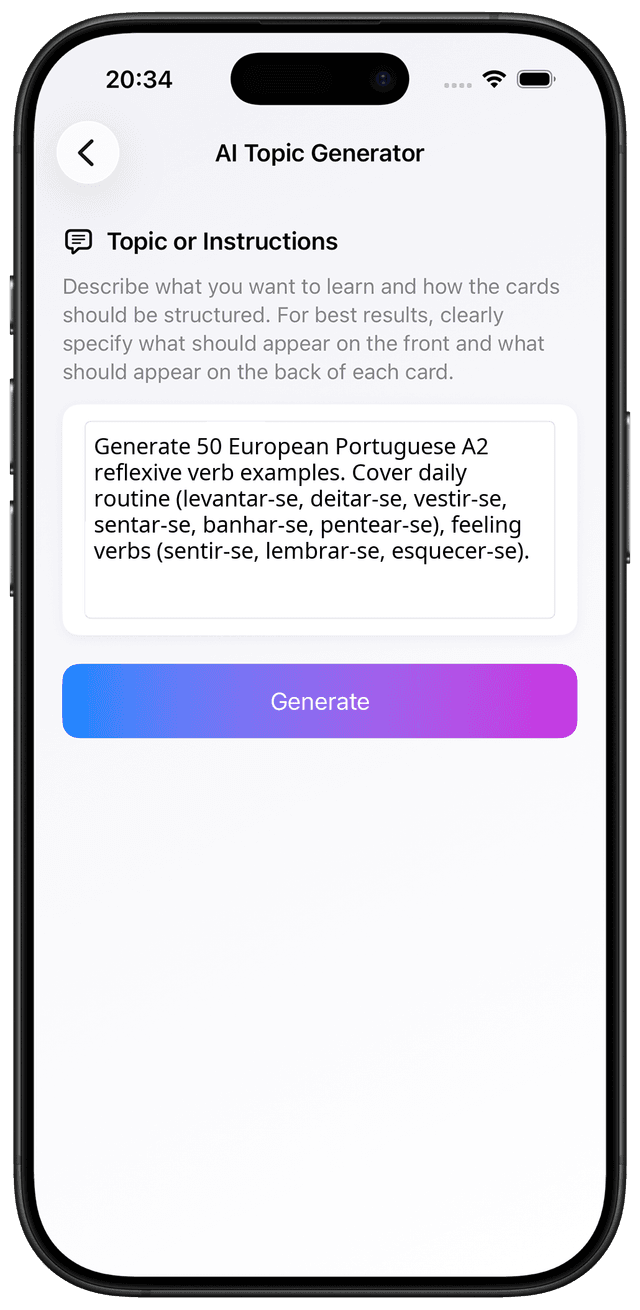
The strategy: This deck covers 50 high-frequency reflexive verbs with post-verb clitic placement as used in European Portuguese, with 10 sentences in the Preterito Perfeito Simples to practice the past form.
Generate 50 European Portuguese A2 reflexive verb examples. Cover daily routine (levantar-se, deitar-se, vestir-se, sentar-se, banhar-se, pentear-se), feeling and state verbs (sentir-se, lembrar-se, esquecer-se, preocupar-se), and social verbs (chamar-se, encontrar-se, despedir-se). Use post-verb clitic placement as used in European Portuguese (levanta-se, nao se lembra). Add 10 Preterito Perfeito Simples sentences. Front: Portuguese. Back: English + clitic placement note.
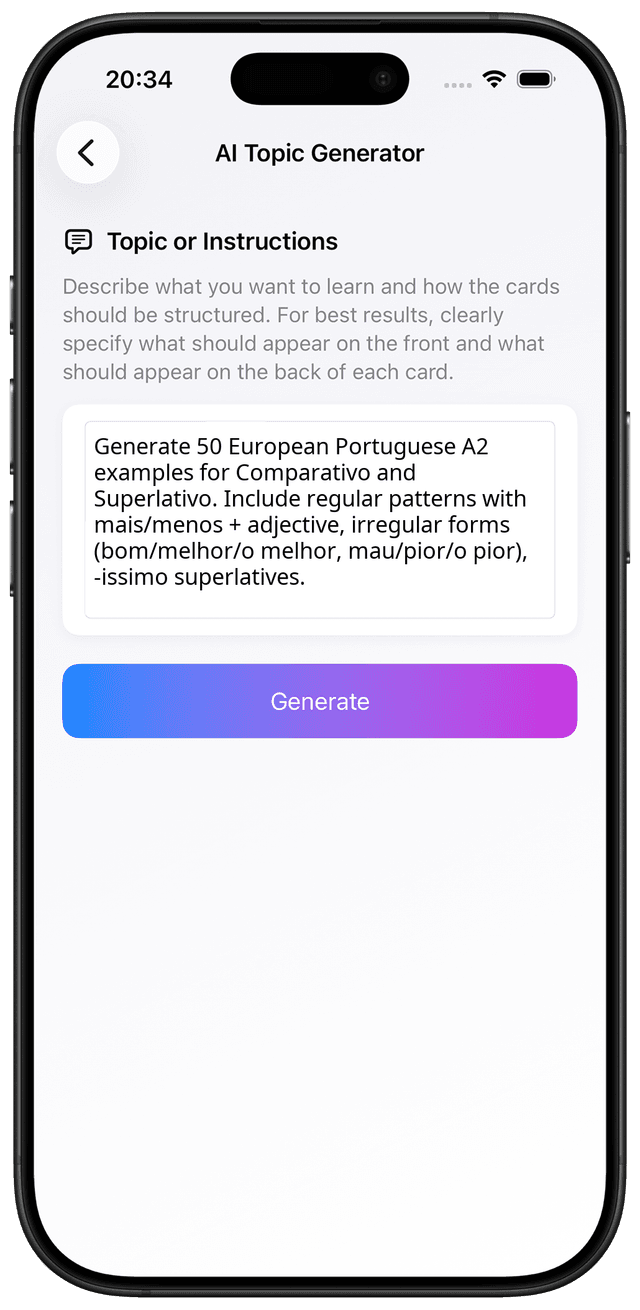
European Portuguese uses mais and menos before adjectives for comparatives, and irregular forms for the most common adjectives: bom becomes melhor, mau becomes pior. The Superlativo Absoluto is common in Portugal too, and the -issimo suffix (rapidissimo, facilissimo) appears in both formal and informal registers. In Portugal, the constructed superlative tends to sound more natural than piling up muito bom in formal speech.
Opinion markers in European Portuguese have a slightly more formal tone than in Brazil. Acho que, Na minha opiniao, and Prefiro are shared, but Portuguese speakers also use Parece-me que and Concordo plenamente more readily in everyday speech.
Why add opinions now? After past tenses and reflexive verbs, expressing views and reactions is the next A2 skill. DELF A2 speaking tasks test exactly this.
The strategy: This deck combines comparative and superlative patterns with opinion vocabulary used in Portugal, so you can evaluate, contrast, and recommend in one connected batch.
Generate 50 European Portuguese A2 examples for Comparativo and Superlativo. Include regular patterns with mais/menos + adjective, irregular forms (bom/melhor/o melhor, mau/pior/o pior), -issimo superlatives, and 20 opinion phrases as used in Portugal (Acho que, Na minha opiniao, Parece-me que, Prefiro, Concordo, Discordo, O que eu aprecio e). Front: Portuguese sentence. Back: English + pattern label.
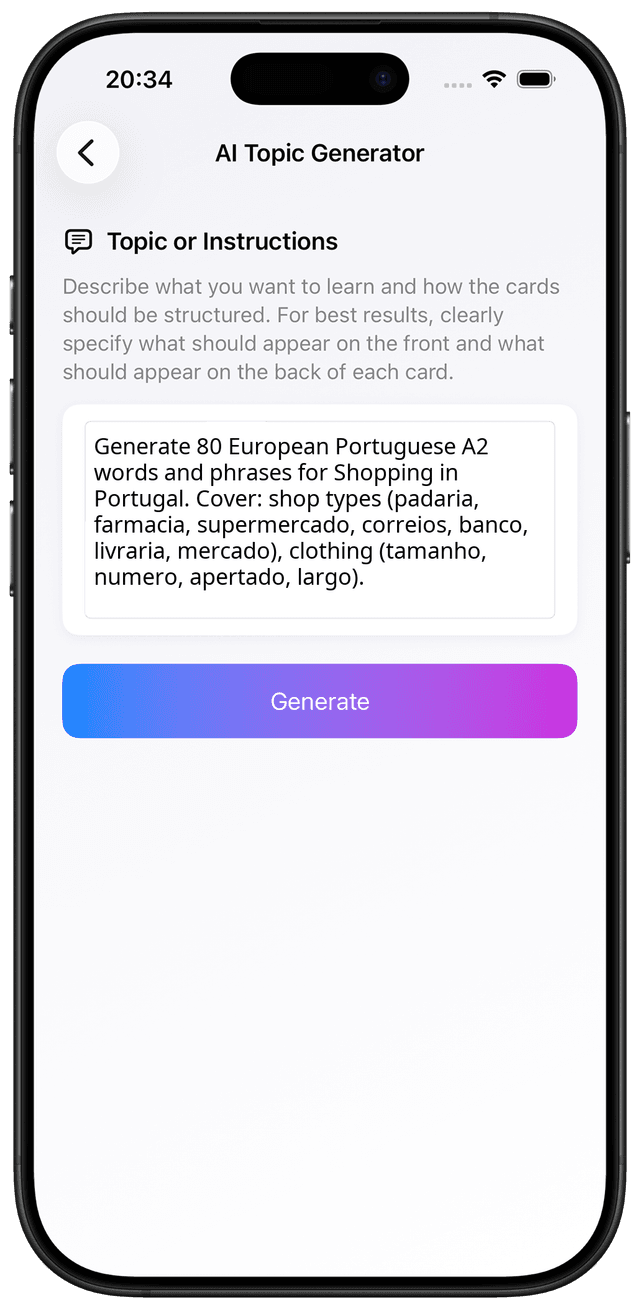
Shopping in Portugal has its own vocabulary that A1 never covers fully. Portuguese use talao de compras for receipts, not nota fiscal (the Brazilian term). Prices are in euros and payment by multibanco (ATM card) is as common as cash. Supermarkets like Continente and Pingo Doce have their own vocabulary around weekly promos and loyalty cards.
One thing that surprises many learners: in Portugal, bargaining is far less common than in Brazil. Vocabulary around fixed prices, exchanges (troca), and returns (devolucao) matters more in a Portuguese shopping context. The question Tem desconto de estudante? is genuinely useful in Portuguese cities.
Why this is tested: Shopping and services are core A2 topics in DELF exams and are directly useful for anyone living in or visiting Portugal.
The strategy: This deck mixes shop vocabulary, payment terms, and service phrases specific to Portugal so you can handle transactions confidently.
Generate 80 European Portuguese A2 words and phrases for Shopping and Services in Portugal. Cover: shop types (padaria, farmacia, supermercado, correios, banco, livraria, mercado), clothing and sizes (tamanho, numero, apertado, largo, cabina de provas), payment terms (preco, desconto, promocao, talao de compras, multibanco, pagar em dinheiro, troca, devolucao), and service phrases (Tem no tamanho 40?, Quanto custa?, Posso trocar isto?, Aceita cartao?). Front: Portuguese. Back: English.
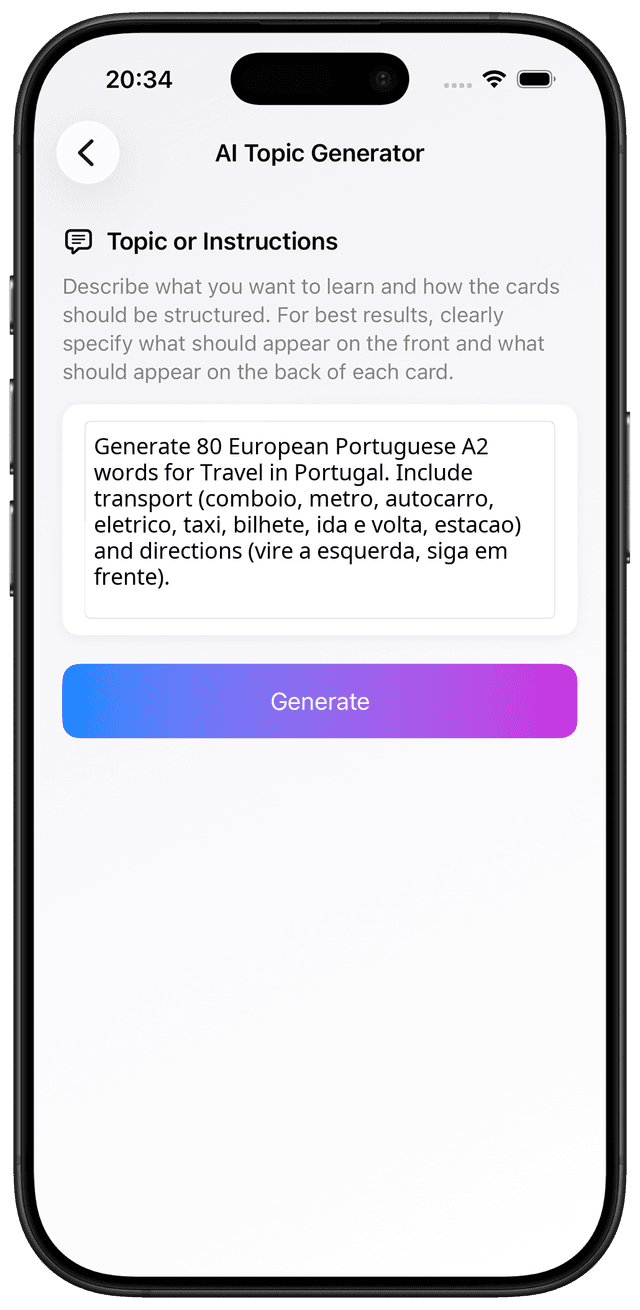
Getting around Portugal means knowing transport that simply does not exist in Brazil. The comboio (train) network between Lisbon, Porto, and the Algarve is a major part of how people travel. The autocarro (bus) handles local routes and smaller towns. In Lisbon, the metro and the iconic eletrico (tram) are both part of daily life. None of these terms match what Brazilian Portuguese speakers learn.
Directions in European Portuguese are straightforward but worth drilling. Vire a esquerda, siga em frente, fique na direita, and fica ao lado do are all standard. In practice, Portuguese people also give landmarks: fica perto da Se (near the cathedral) or logo apos o semaforo (just past the traffic light).
Why travel vocabulary matters: Travel is a core A2 topic in DELF and transfers directly to navigating Portugal by train, bus, and foot.
The strategy: This deck covers comboio, metro, autocarro, accommodation, and directions so you can get from the estacao to the hotel without looking up every other word.
Generate 80 European Portuguese A2 words and phrases for Travel and Directions in Portugal. Include: transport vocabulary (comboio, metro, autocarro, eletrico, taxi, bilhete, ida e volta, atraso, estacao, paragem), accommodation (reservar quarto, quarto individual, quarto duplo, pequeno-almoco incluido, recepcao, fazer check-out), directions (vire a esquerda, siga em frente, fique na direita, ao lado do, ao fundo da rua), and travel problems (O comboio atrasou, Perdi a mala, Onde fica a estacao de metro mais proxima?). Front: Portuguese. Back: English.
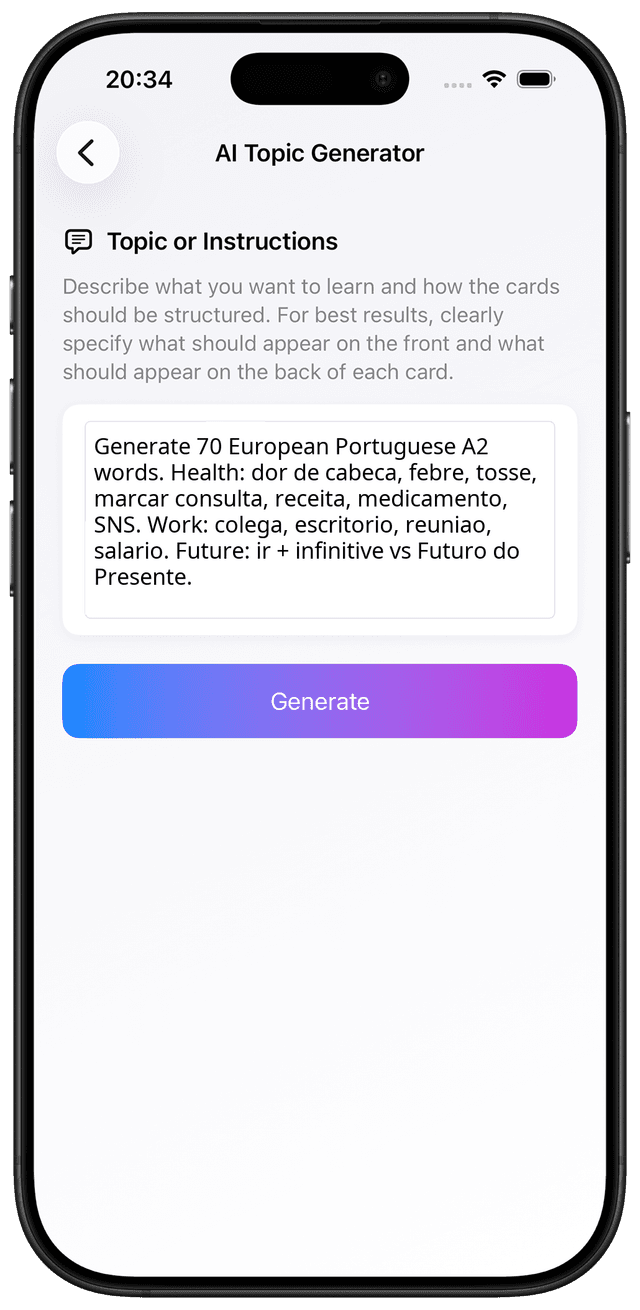
Health vocabulary in Portugal has its own specifics. The farmacia is on most streets and the farmaceutico can advise on minor ailments. The SNS (Servico Nacional de Saude) is the public health system and comes up in any conversation about accessing healthcare in Portugal. Knowing how to describe sintomas to a farmaceutico is a practical skill from day one.
For the future, European Portuguese uses the Futuro do Presente (falarei, comerei) far more readily than Brazilian Portuguese speakers do. In Portugal, this form appears in everyday spoken registers, not just formal writing. The ir + infinitive form (vou falar) also exists but does not dominate spoken language the way it does in Brazil. This deck covers both so you can recognise and use either.
The milestone: With this phase, your A2 European Portuguese vocabulary is complete. You can describe past events with the Perfeito and Imperfeito, handle reflexive verb placement the Portuguese way, navigate shopping and travel in Portugal, and talk about plans using both the Futuro do Presente and ir + infinitive. That is the full A2 picture.
Generate 70 European Portuguese A2 words and phrases across three areas. Health: symptoms and appointments in Portugal (dor de cabeca, febre, tosse, no medico, marcar consulta, receita, medicamento, alergia, SNS, farmacia). Work: job vocabulary (colega, escritorio, reuniao, fim do dia, pedir demissao, salario, tempo inteiro, meio tempo). Future: 20 sentences comparing ir + infinitive and Futuro do Presente as used in Portugal. Front: Portuguese. Back: English + category label.
MindCards uses spaced repetition and active recall to help you retain A2 vocabulary faster and for longer. The Preterito Perfeito Composto, reflexive verb clitics, and Imperfeito all involve form-plus-meaning pairs that respond well to retrieval practice.
A2 sits between the A1 foundation and the B1 fluency level. Use the links below to move between levels or return to the full Portuguese guide.
Build your European Portuguese A2 vocabulary with AI-generated decks and spaced repetition that adjusts to what you actually struggle with. Free to download. No account required. Start with any phase that suits where you are right now.