
Spaced repetition explained
Spacing reviews across days is one of the most reliable ways to retain Korean vocabulary at the advanced level.
TOPIK II Level 5 is a professional credential. Reading passages at this level assume you can handle long academic texts without much help, listening tracks are dense and fast, and the writing section expects arguments that hold together in formal academic Korean.
Most people who have cleared Level 4 find they plateau at Level 5 not because their grammar is weak but because their vocabulary does not reach the register Level 5 demands. The words that carry academic and analytical Korean are specific, and they do not come from everyday conversation.
This guide covers seven phases of vocabulary targeted at what Level 5 actually tests. Use the prompts below to generate decks in MindCards. The app handles your review schedule so you focus on learning the words, not planning when to study them.
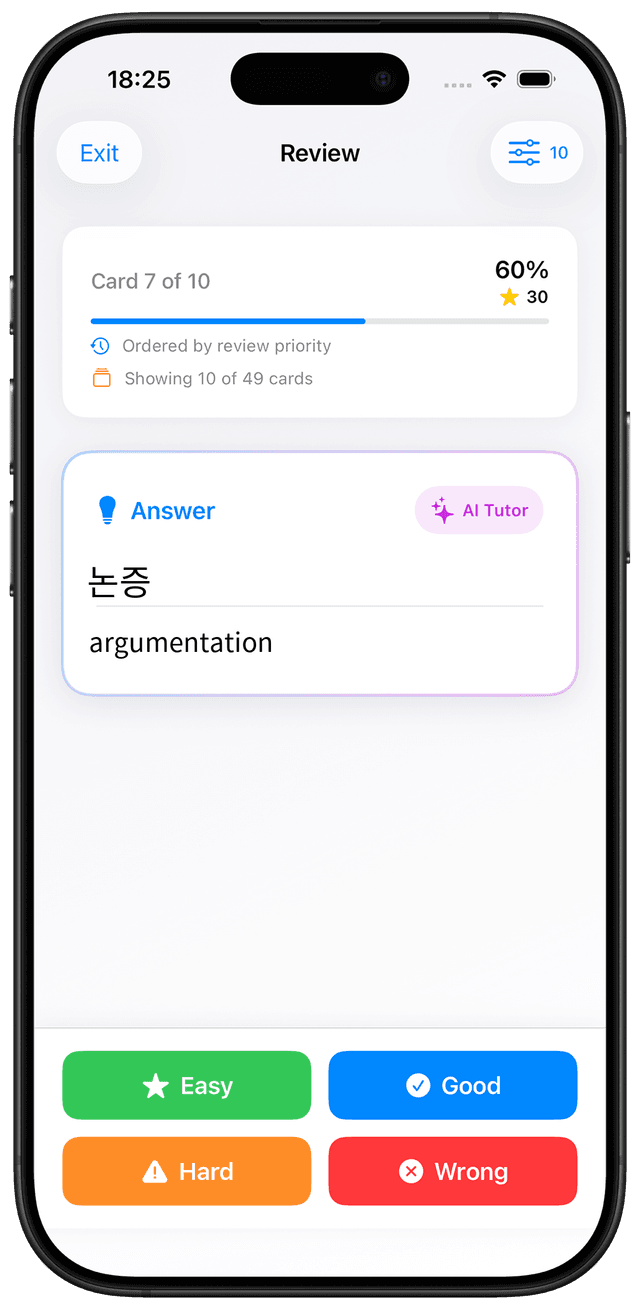
Level 5 starts where Level 4 leaves off, and the jump is noticeable. Reading passages run longer, the vocabulary carries more register and nuance, and writing tasks expect organized arguments you can sustain in formal Korean.
Why start here? These are the words that appear across all three sections of Level 5 exams. Getting them into active memory first means later phases build on a solid base rather than a fragmented one.
The strategy: Pair each word with a sentence that shows it in context. At this level, register matters as much as meaning. The same concept can use different words depending on the formality of the text.
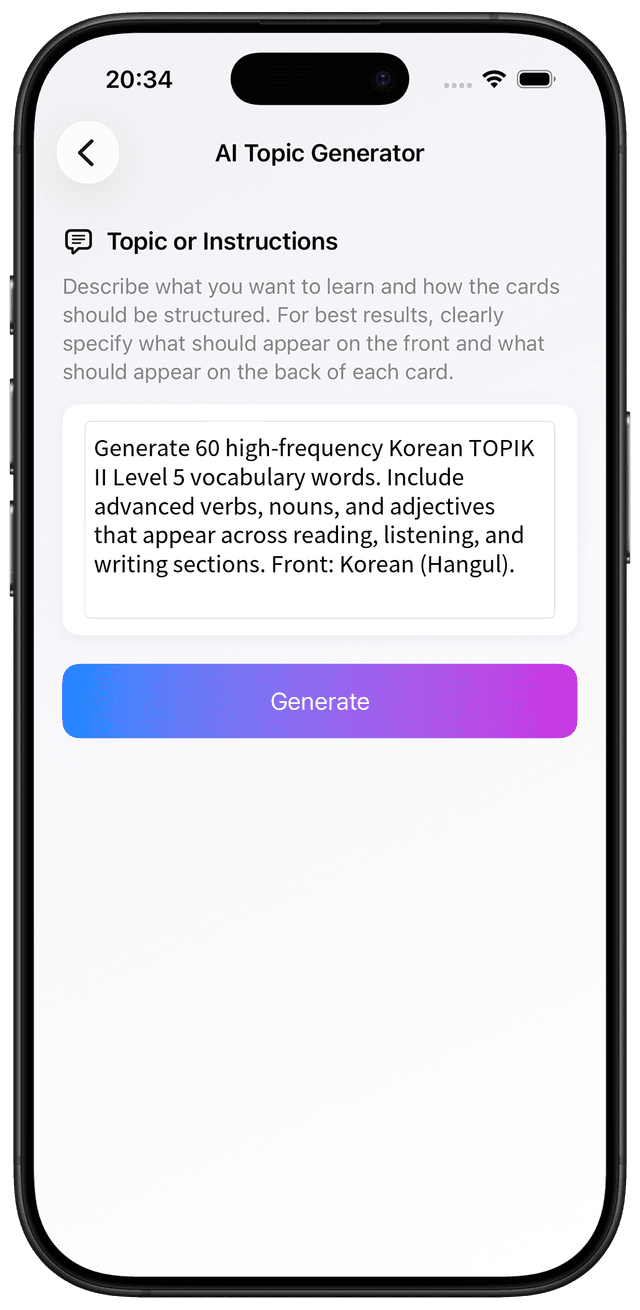
Generate 60 high-frequency Korean TOPIK II Level 5 vocabulary words. Include advanced verbs, nouns, and adjectives that appear across reading, listening, and writing sections. Front: Korean (Hangul). Back: English with part of speech and one example sentence showing register.
Level 5 reading passages pull from university-level essays, research papers, and in-depth commentary. The vocabulary operates at a level of abstraction that requires more than dictionary definitions.
Why now? Many candidates who clear Level 4 find Level 5 reading passages slow and difficult because they are reading each abstract noun at word level rather than grasping the argument as a whole. This phase addresses that gap directly.
The strategy: For each abstract noun, study it inside a sentence showing how it relates to surrounding ideas. Abstract vocabulary without context is nearly impossible to retain at this level.
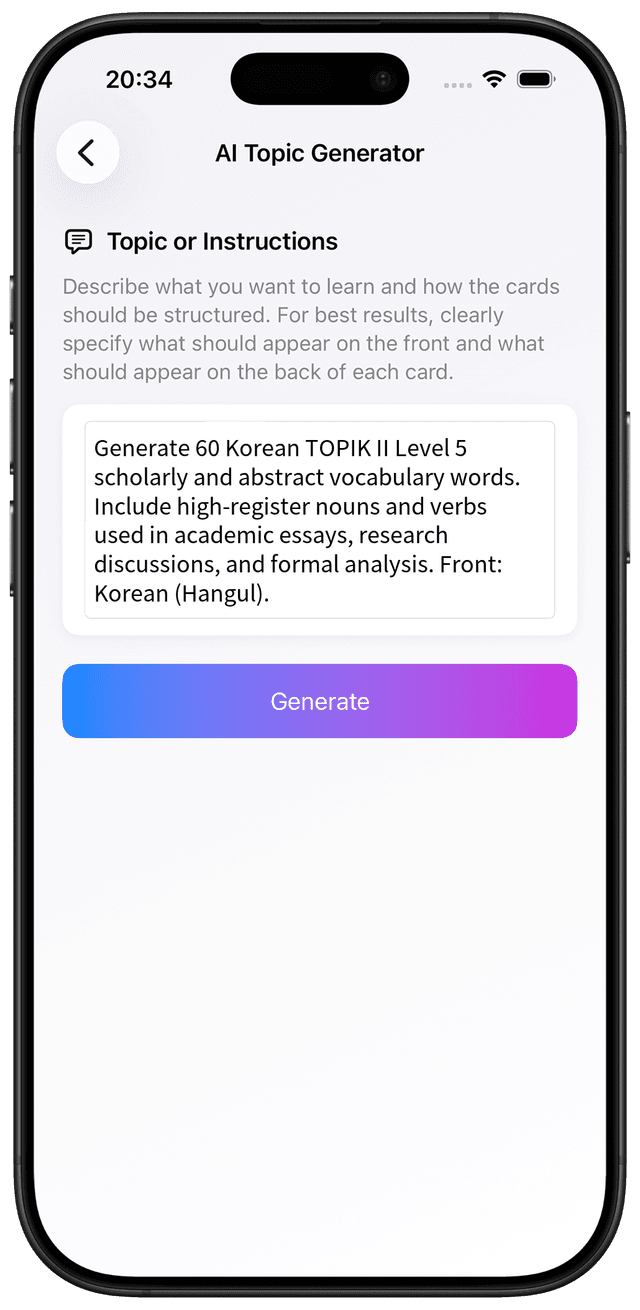
Generate 60 Korean TOPIK II Level 5 scholarly and abstract vocabulary words. Include high-register nouns and verbs used in academic essays, research discussions, and formal analysis. Front: Korean (Hangul). Back: English with formal usage note and example sentence.
TOPIK II Level 5 reading and listening passages often present complex arguments with stated and unstated assumptions. This phase targets the vocabulary writers use to build, challenge, and qualify arguments.
Why this next? Level 5 reading questions frequently ask you to identify a writer's claim, distinguish it from supporting evidence, or recognize a concession. Without the vocabulary for how arguments are structured, you read content without tracking logic.
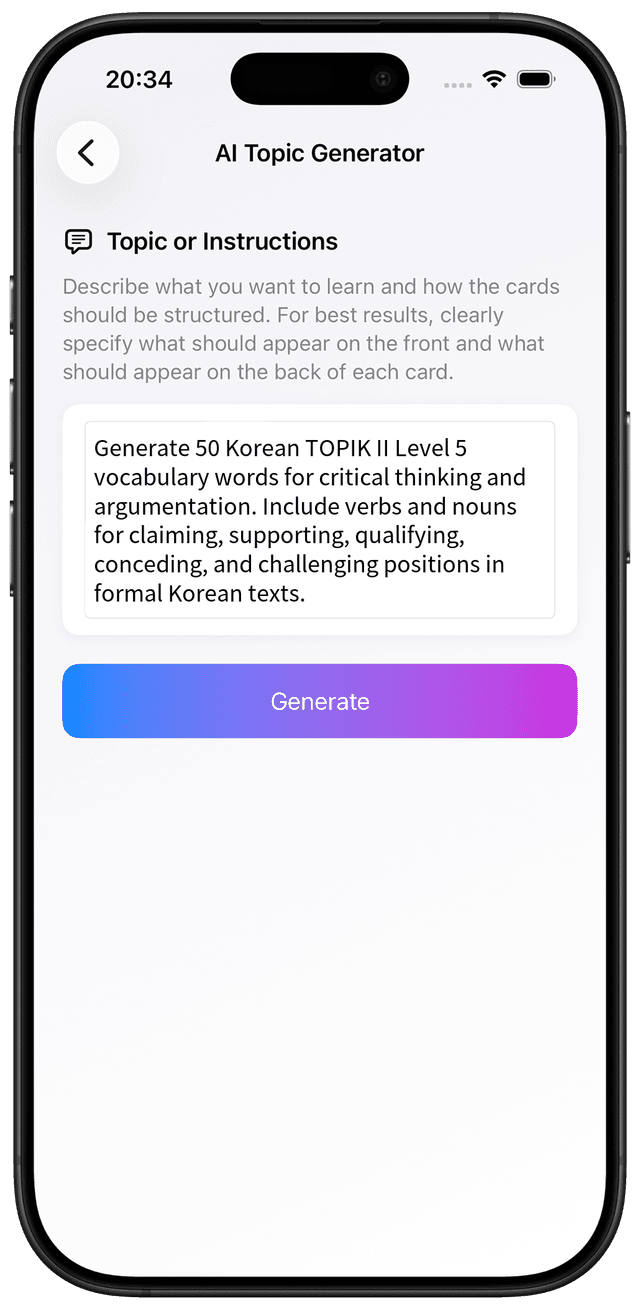
Generate 50 Korean TOPIK II Level 5 vocabulary words for critical thinking and argumentation. Include verbs and nouns for claiming, supporting, qualifying, conceding, and challenging positions in formal Korean texts. Front: Korean (Hangul). Back: English with argumentation context note.
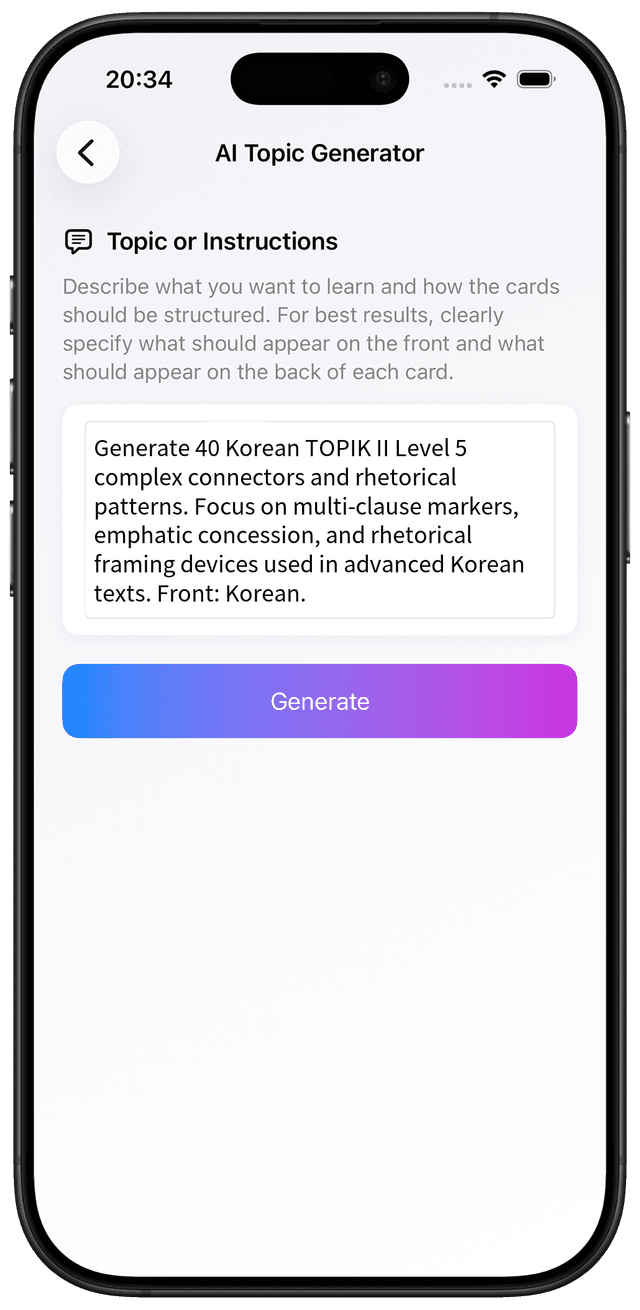
Level 5 texts use connectors that carry nuanced logical weight. This phase focuses on multi-clause markers (ㄹ수록, 는 한, 고야말로), emphatic concession patterns (다 하더라도), and rhetorical framing devices that signal the writer is making a larger structural point.
Why this matters: At Level 5, a single connector can determine whether a reading question answer is A or B. These are not decorative transitions; they carry the logical skeleton of the passage.
The strategy: Study each connector with two or three example sentences at different levels of topic complexity. You need to recognize the logical function, not just the translation.
Generate 40 Korean TOPIK II Level 5 complex connectors and rhetorical patterns. Focus on multi-clause markers, emphatic concession, and rhetorical framing devices used in advanced Korean texts. Front: Korean. Back: English meaning plus two example sentences showing logical function.
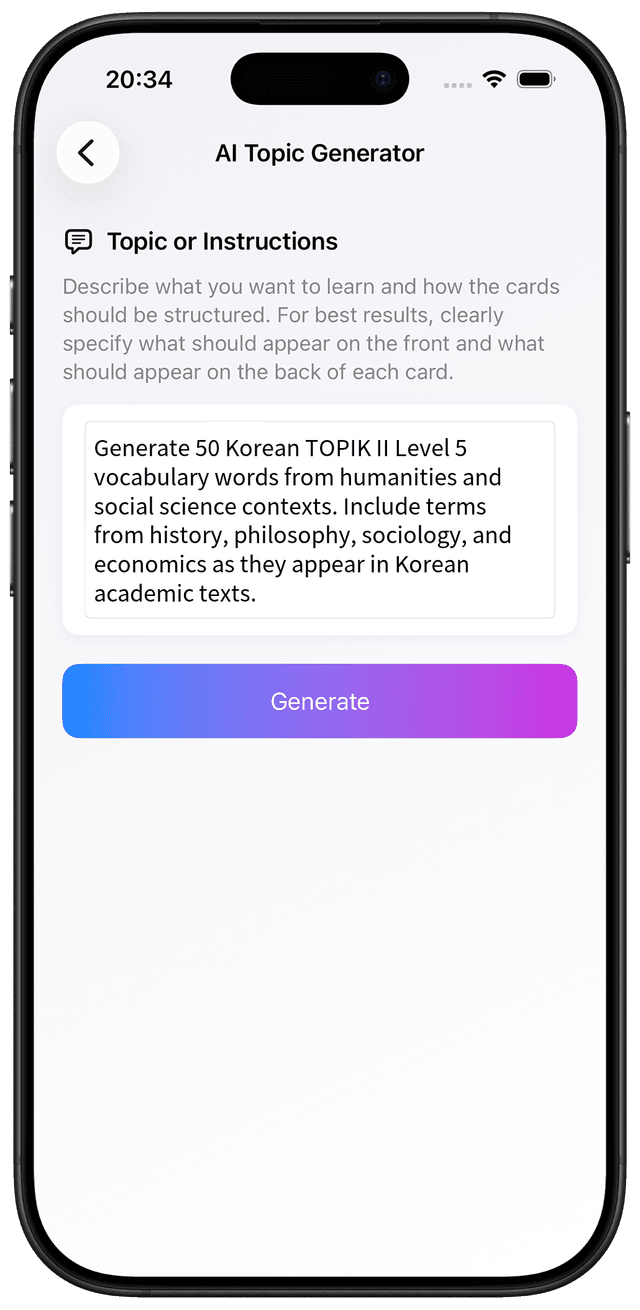
TOPIK II Level 5 reading includes texts from history, philosophy, sociology, economics, and cultural studies. This phase covers the vocabulary those disciplines rely on in Korean academic writing.
Goal: Read a humanities or social science passage at Level 5 without stopping to look up field-specific terms. The words here are not narrow jargon; they are the general academic vocabulary that Korean humanities writing shares across subjects.
Generate 50 Korean TOPIK II Level 5 vocabulary words from humanities and social science contexts. Include terms from history, philosophy, sociology, and economics as they appear in Korean academic texts and TOPIK II reading passages. Front: Korean (Hangul). Back: English with academic context note.
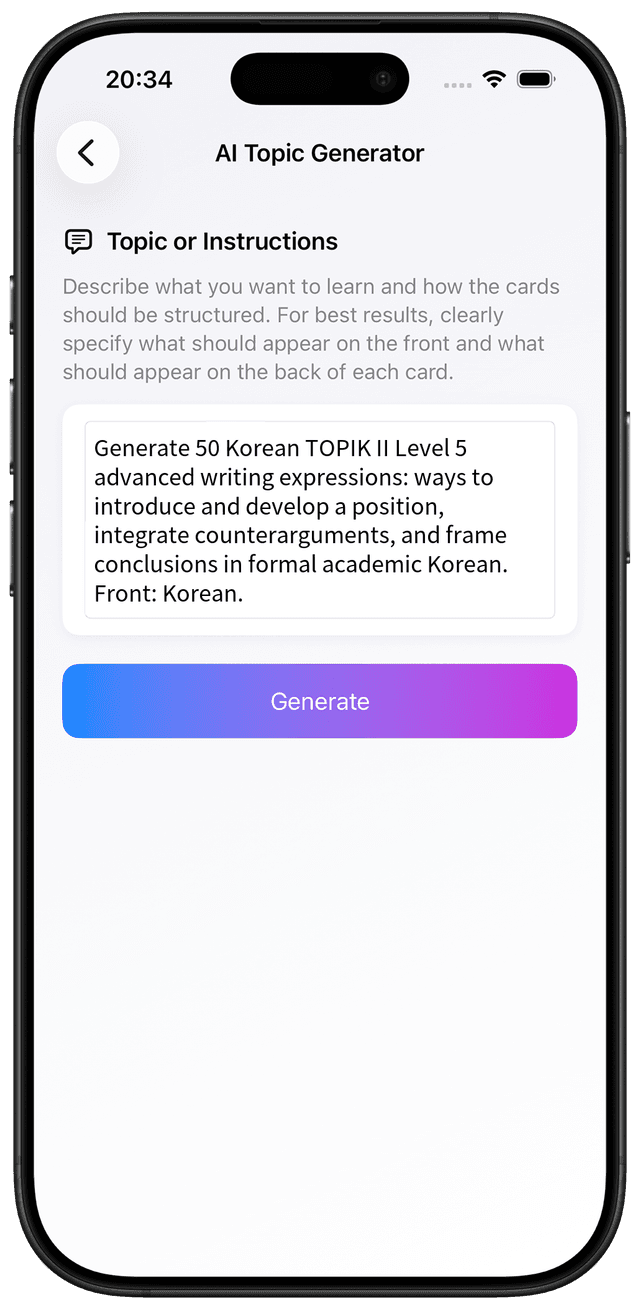
The TOPIK II writing section at Level 5 expects more than an organized essay. Scorers want arguments that engage with the prompt at a conceptual level, written in a register that reads as native academic Korean.
Why now? At Level 5, writing vocabulary needs to be automatic. You are managing argument structure and register simultaneously under time pressure. If the expressions are not in automatic recall, they do not come out cleanly in the exam.
The strategy: For each expression, write one complete paragraph using it. At this level, production practice is the only way to build the fluency the writing section demands.
Generate 50 Korean TOPIK II Level 5 advanced writing expressions: ways to introduce and develop a position, integrate counterarguments, frame conclusions, and maintain formal academic register throughout a Level 5 essay response. Front: Korean. Back: English with example use in a TOPIK II Level 5 writing answer.
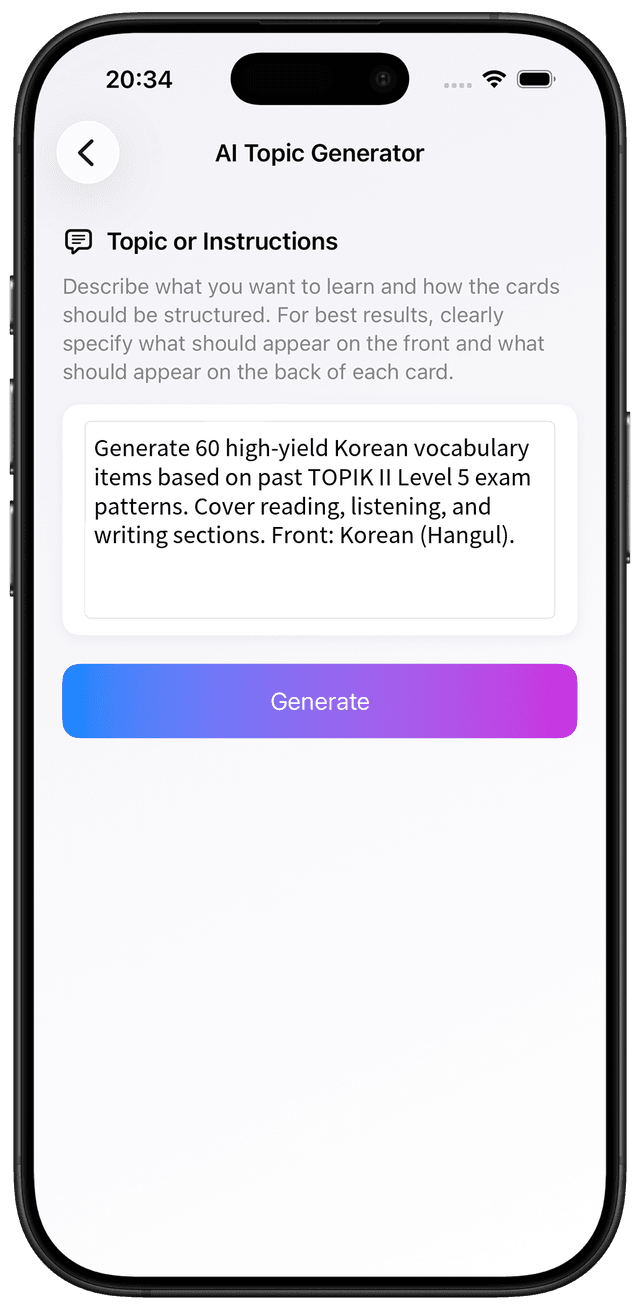
The final phase targets vocabulary that comes up most often in TOPIK II Level 5 past exams. All three sections are covered: reading passages, listening dialogues, and writing prompts.
Milestone: After this phase, your vocabulary covers the core of what Level 5 tests across all sections. Keep your decks in daily rotation in the weeks before exam day. Ten minutes every day compounds faster than longer sessions spaced further apart.
Generate 60 high-yield Korean vocabulary items based on past TOPIK II Level 5 exam patterns. Cover reading, listening, and writing sections. Front: Korean (Hangul). Back: English with part of speech and the exam section where it most commonly appears.
MindCards uses active recall and spaced repetition so vocabulary sticks as something you can produce under pressure, not just recognize when you see it in a passage.
Keep your decks in daily rotation. Even ten minutes a day adds up across the weeks before your exam.
Build your TOPIK II vocabulary with smart flashcards, AI deck generation, and spaced repetition built for real exam readiness at Level 5 and beyond.