
Spaced repetition explained
Spacing reviews across days is one of the most reliable ways to retain Korean vocabulary at the upper-intermediate level.
Level 4 is the first level where the exam stops giving you the benefit of the doubt. Reading passages are longer and more abstract, listening tracks move faster, and the writing prompts expect organized arguments, not just correct sentences.
Most people who have cleared Level 3 find that their vocabulary is still the main bottleneck at Level 4. Grammar is manageable. The words that carry the academic and opinion-writing register are what slow you down.
This guide covers seven phases of vocabulary targeted at what Level 4 actually tests. Use the prompts below to generate decks in MindCards. The app manages your review schedule so you can focus on the words rather than planning when to study them.
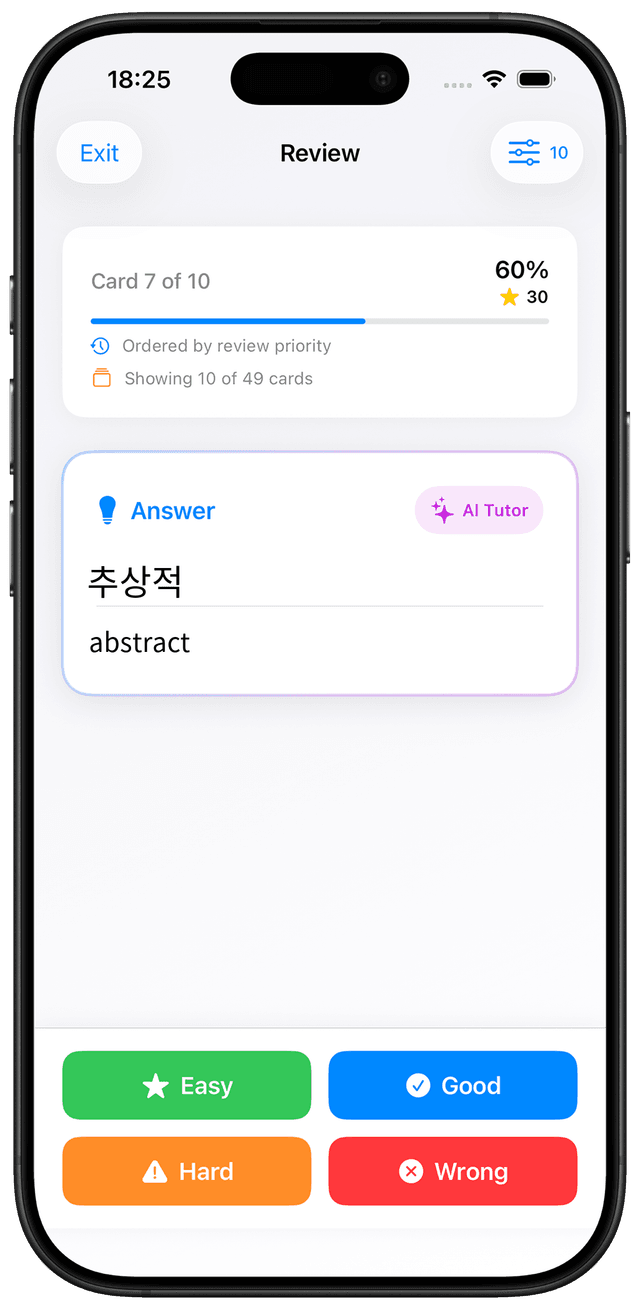
Start with the words that show up across all sections of Level 4. These are a step above Level 3 in abstraction and register, showing up in longer reading passages, faster listening tracks, and more demanding writing prompts.
Why start here? Level 4 passages assume you can handle both everyday formal Korean and topic-specific vocabulary without stopping. These core words cover the overlap between the two.
The strategy: Learn each word in a short sentence showing actual usage. Level 4 vocabulary tends to carry nuance that a bare definition misses.
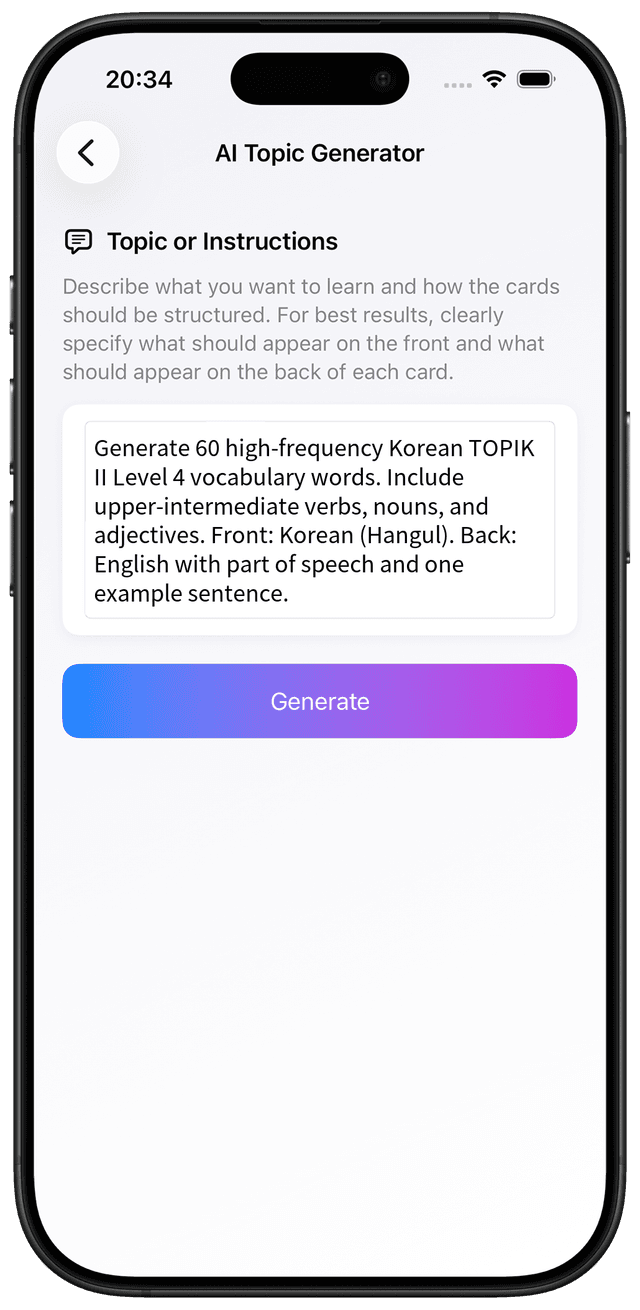
Generate 60 high-frequency Korean TOPIK II Level 4 vocabulary words. Include upper-intermediate verbs, nouns, and adjectives that appear across reading, listening, and writing sections. Front: Korean (Hangul). Back: English with part of speech and one example sentence.
Level 4 reading passages frequently deal in abstract ideas: justice, efficiency, tradition, contradiction. This phase covers vocabulary for ideas rather than concrete objects or actions.
Why now? Abstract vocabulary is where many learners plateau at Level 3. The words look familiar, but when you try to use them in writing or explain them back in Korean, the meaning gets slippery.
The strategy: Pair each abstract noun with a concrete example sentence on the back of the card. Seeing the word used in context is what makes it stick.
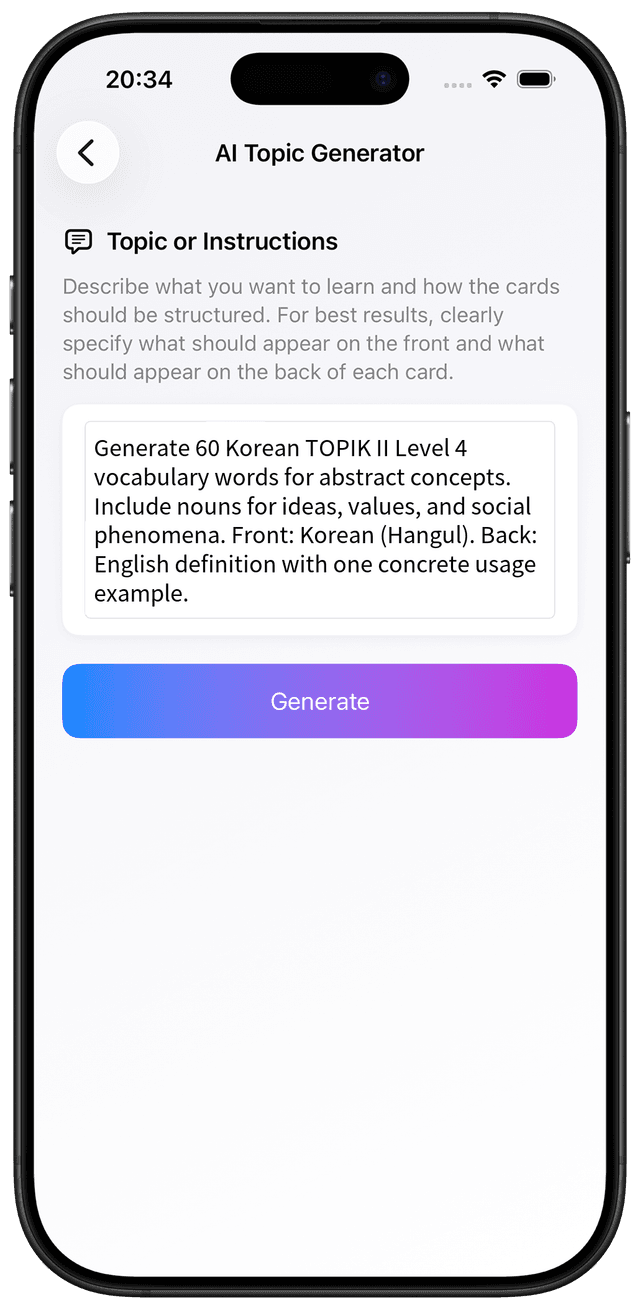
Generate 60 Korean TOPIK II Level 4 vocabulary words for abstract concepts. Include nouns for ideas, values, social phenomena, and theoretical constructs that appear in academic reading passages. Front: Korean (Hangul). Back: English definition with one concrete usage example.
TOPIK II Level 4 reading passages often come from newspaper editorials, essays, and opinion pieces. This phase targets the vocabulary writers use when they argue a position, address counterarguments, or frame a social issue.
Why this next? Understanding a writer's stance is one of the most common Level 4 question types. If you cannot read the evaluative layer of a passage, you are working from meaning alone, not position.
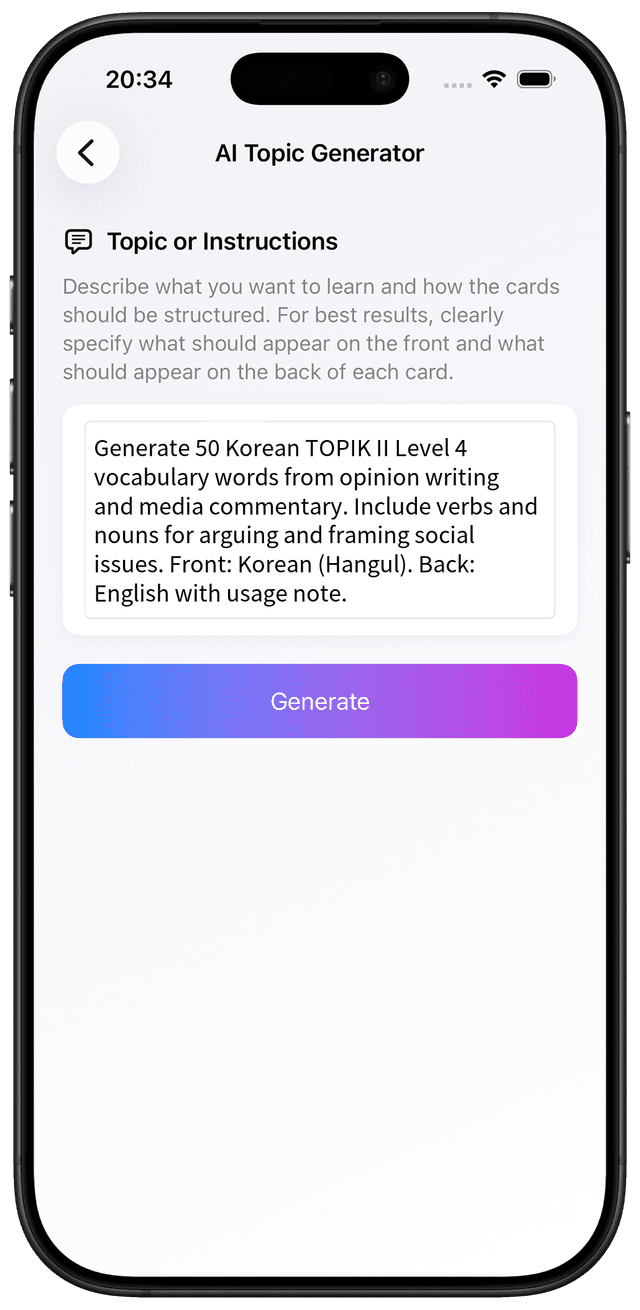
Generate 50 Korean TOPIK II Level 4 vocabulary words used in opinion writing, editorials, and media commentary. Include verbs and nouns for arguing, evaluating, contrasting positions, and framing social issues. Front: Korean (Hangul). Back: English with usage note.
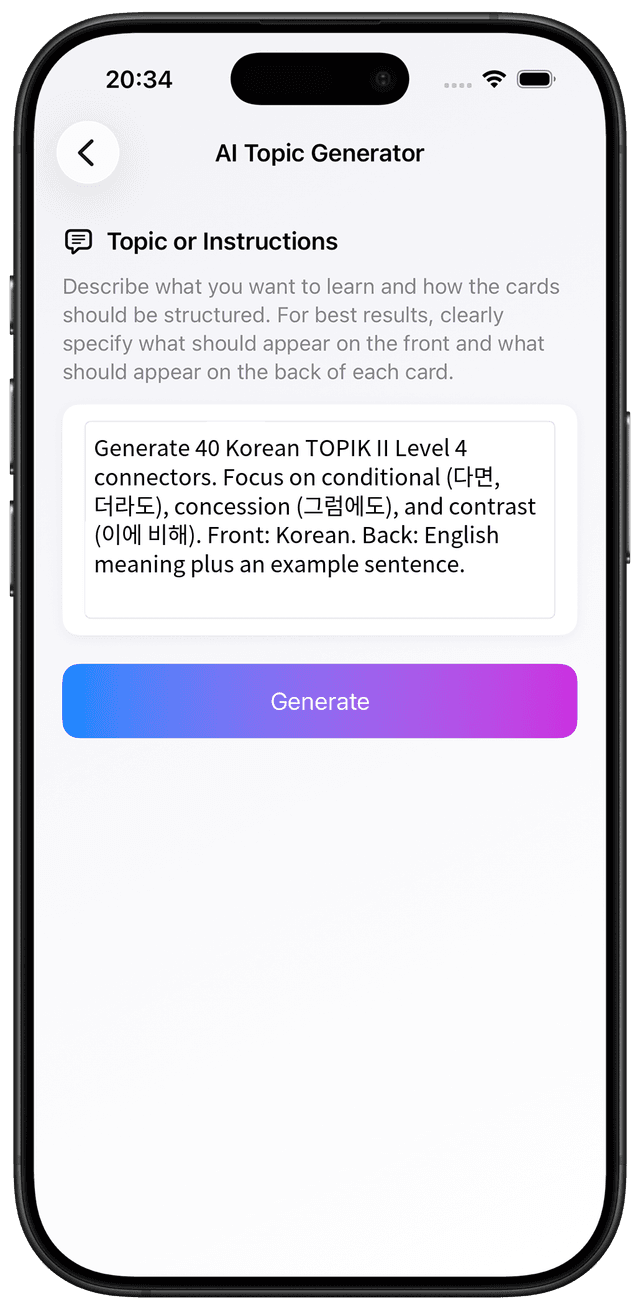
Level 4 texts use connectors with more precision than Level 3. This phase focuses on markers that signal conditional reasoning (다면, 더라도), concession (그럼에도 불구하고), and rhetorical contrast (그에 반해, 이에 비해).
Why this matters: Level 4 reading questions often ask you to identify an implicit relationship between two parts of a passage. The connector is frequently the only signal of that relationship.
The strategy: Study each connector with at least two contrasting example sentences. Seeing what comes before and after it helps more than a translation alone.
Generate 40 Korean TOPIK II Level 4 connectors and discourse markers. Focus on conditional (다면, 더라도), concession (그럼에도 불구하고), and rhetorical contrast (이에 비해). Front: Korean. Back: English meaning plus two example sentences showing how it connects clauses.
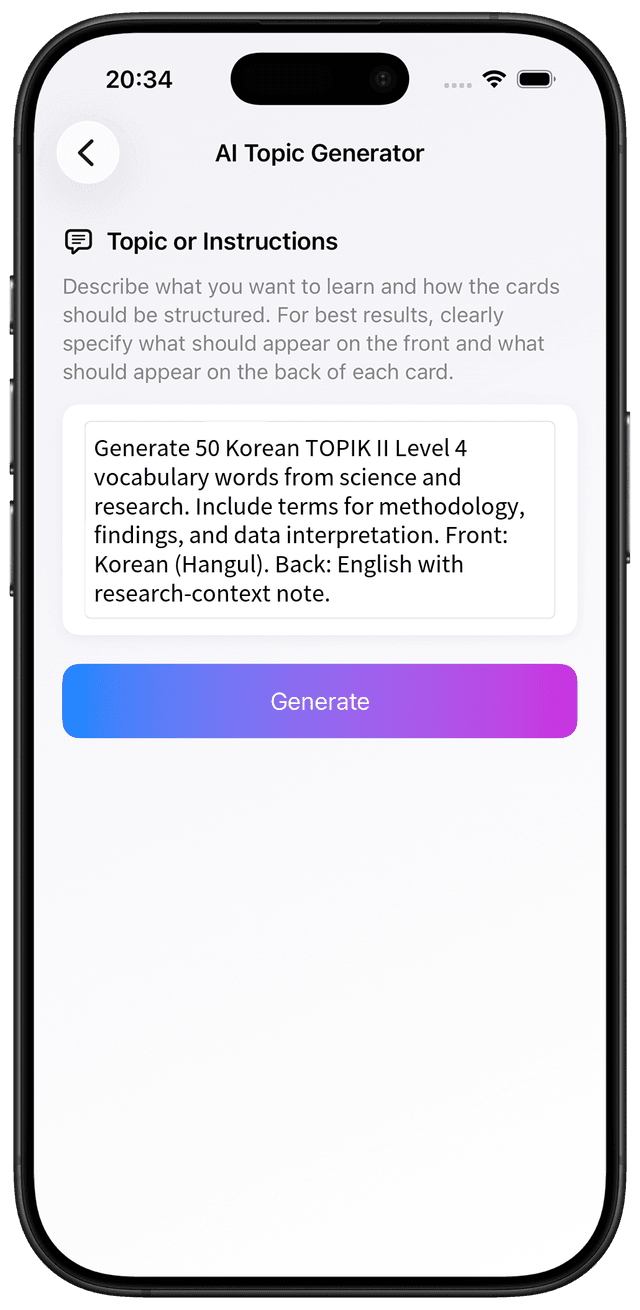
TOPIK II Level 4 reading includes texts from science journalism, research summaries, and technology articles. This phase targets the vocabulary those texts rely on: terms for methodology, findings, hypotheses, and implications.
Goal: Read a science or technology passage at Level 4 speed without stopping on field-specific vocabulary. The words here are not discipline-specific jargon but the general academic vocabulary science writing shares across subjects.
Generate 50 Korean TOPIK II Level 4 vocabulary words from science, technology, and research contexts. Include terms for methodology, findings, data interpretation, and general academic science writing. Front: Korean (Hangul). Back: English with research-context note.
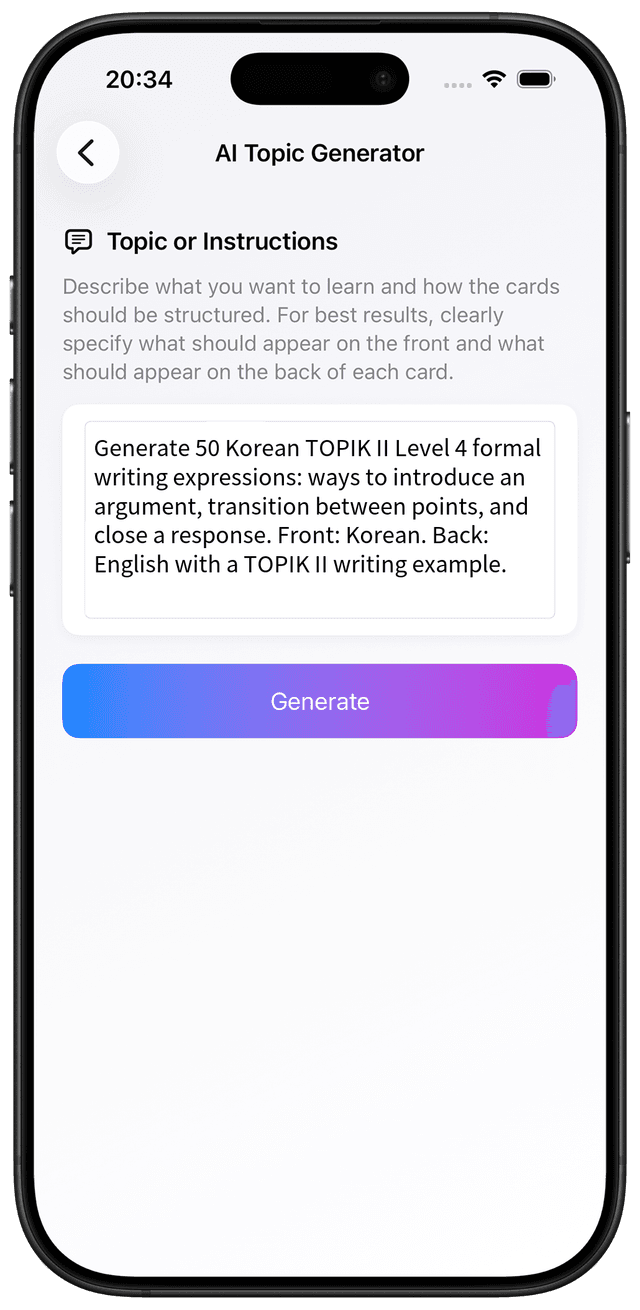
The TOPIK II writing section at Level 4 expects more than grammatically correct sentences. Scorers want organized arguments, appropriate register, and vocabulary that reads as formal written Korean. This phase covers those areas.
Why now? Writing vocabulary needs active recall, not passive recognition. You have to produce these expressions under time pressure in the exam, so the goal is fluency, not familiarity.
The strategy: Write one short paragraph using each expression you study. Production practice during review is what builds the automatic access the writing section demands.
Generate 50 Korean TOPIK II Level 4 formal writing expressions: ways to introduce an argument, transition between points, concede a counterargument, and close a response in formal written Korean. Front: Korean. Back: English explanation with example use in a TOPIK II writing answer.
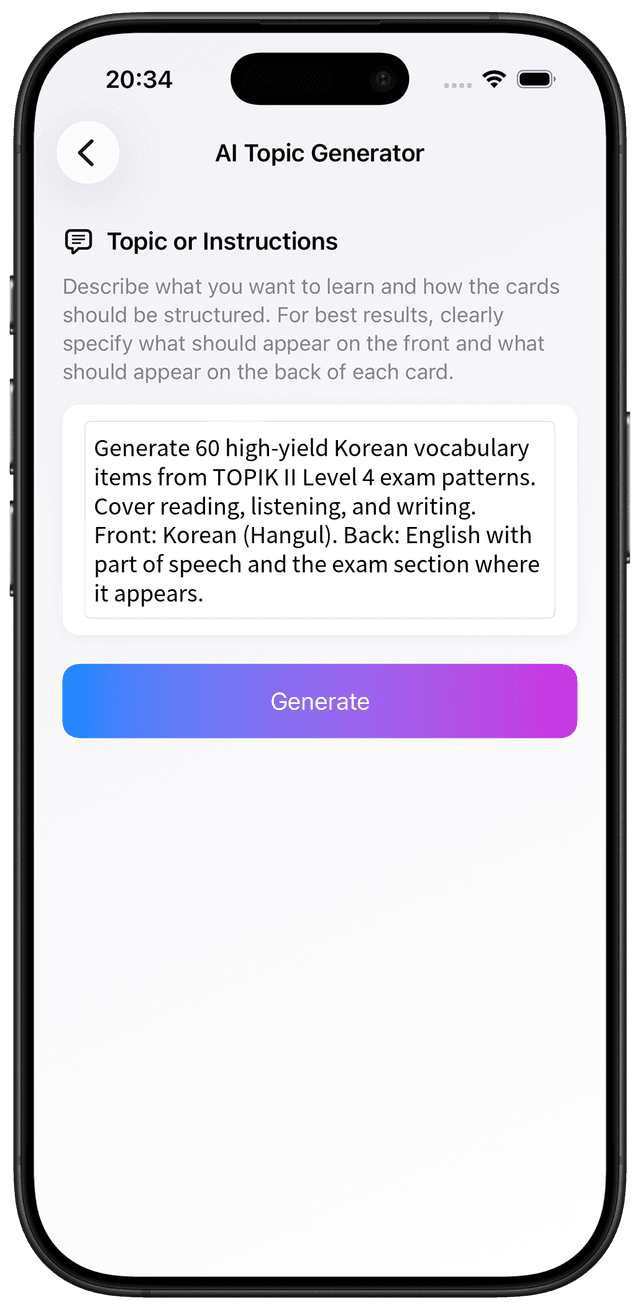
The final phase uses vocabulary from past TOPIK II Level 4 exam materials, covering all three sections: reading, listening, and writing. These are the words that appear most often and carry the most question weight.
Milestone: After this phase, your vocabulary base covers the core of what Level 4 tests. Keep your decks in daily rotation in the weeks before exam day. Ten minutes a day compounds faster than longer sessions spaced further apart.
Generate 60 high-yield Korean vocabulary items from past TOPIK II Level 4 exam patterns. Cover reading, listening, and writing sections. Front: Korean (Hangul). Back: English with part of speech and exam section where it most commonly appears.
MindCards uses active recall and spaced repetition so vocabulary sticks as something you can produce under pressure, not just recognise when you see it in a passage.
Keep your decks in daily rotation. Even ten minutes a day adds up across the weeks before your exam.
Build your TOPIK II vocabulary with smart flashcards, AI deck generation, and spaced repetition built for real exam readiness at Level 4 and beyond.