
Spaced repetition explained
Spacing your reviews across days is one of the most effective things you can do for Korean vocabulary retention at the intermediate level.
TOPIK II starts at Level 3. The jump from TOPIK I is real: passages get longer, vocabulary turns more abstract, and there is a writing section that tests whether you can produce Korean under time pressure.
Most people stall at this transition not because of grammar, but because their vocabulary is too thin for intermediate texts. This guide targets the word groups that come up most in TOPIK II Level 3 reading, listening, and writing.
Use the prompts below to build decks in MindCards for each phase. The app handles review scheduling automatically so you can focus on learning rather than tracking what to study next.
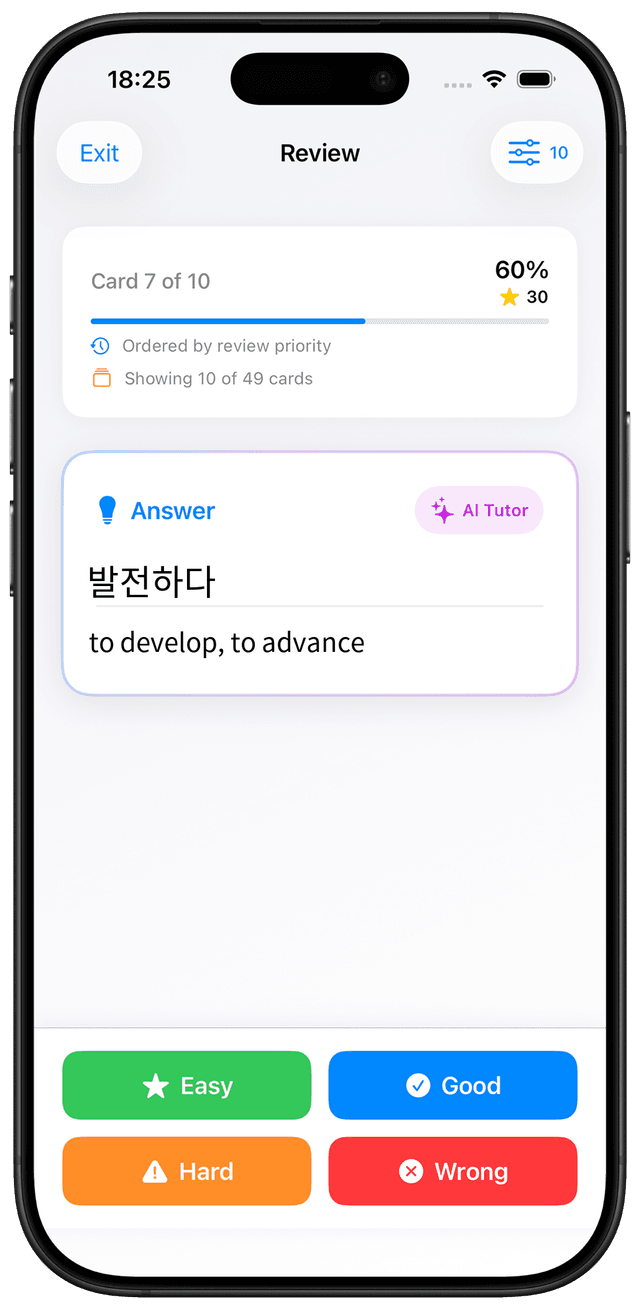
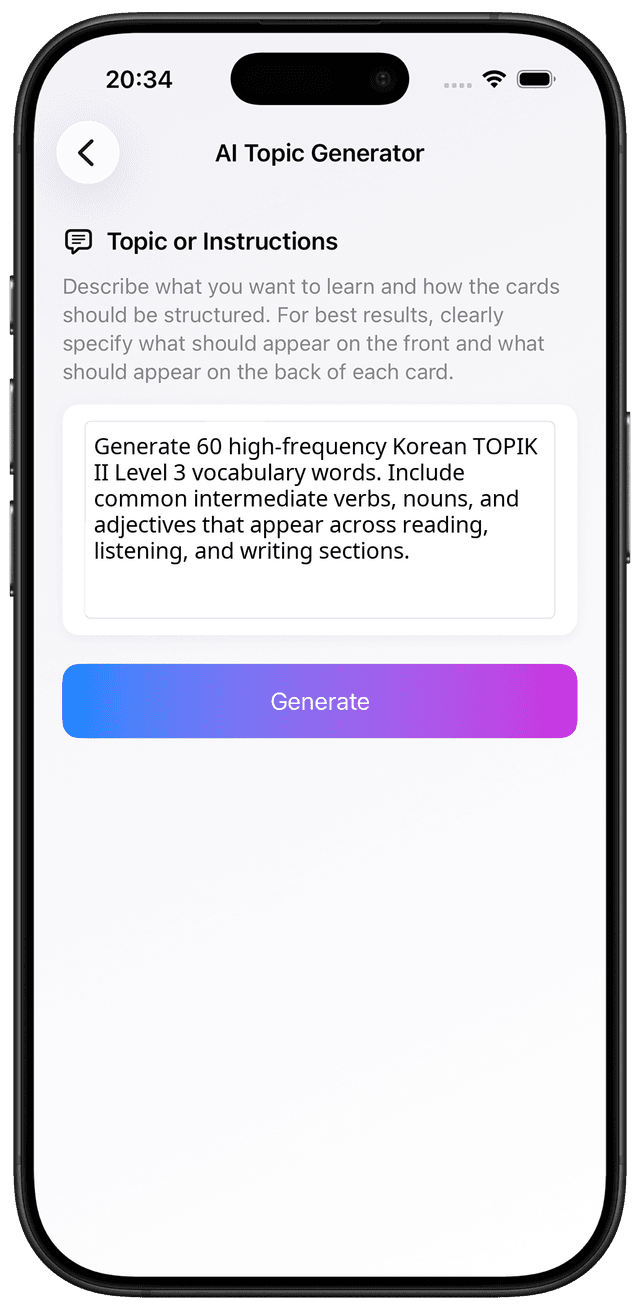
Start with the words that appear across every section of TOPIK II Level 3. These bridge from TOPIK I into intermediate Korean and show up in reading, listening, and writing sections alike.
Why start here? TOPIK II Level 3 passages assume you already know these. Missing them mid-passage disrupts comprehension at the sentence level, not just the word level.
The strategy: Learn each word in context rather than isolation. A short example sentence on the flashcard back makes retention noticeably faster.
Generate 60 high-frequency Korean TOPIK II Level 3 vocabulary words. Include common intermediate verbs, nouns, and adjectives that appear across reading, listening, and writing sections. Front: Korean (Hangul). Back: English with part of speech and one example sentence.
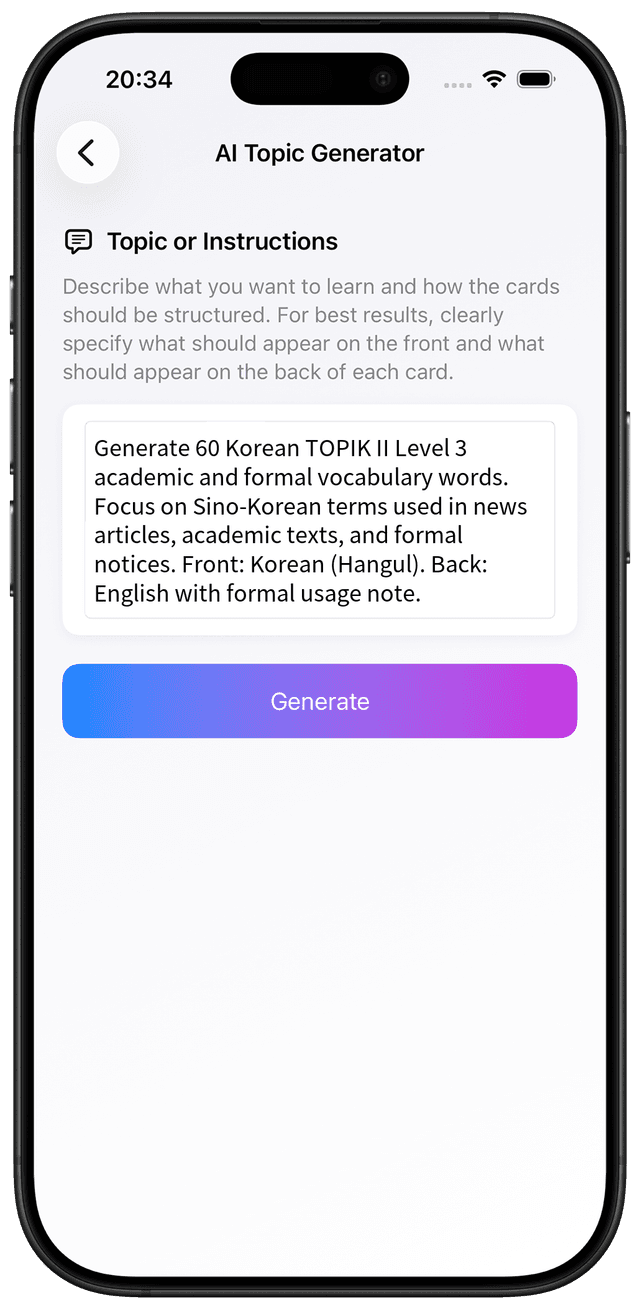
TOPIK II reading texts pull from academic articles, formal announcements, and reports. This phase builds the vocabulary those formal texts require.
Why now? Academic vocabulary in Korean often looks nothing like everyday speech. The same concept uses a Sino-Korean compound in formal writing that you would rarely hear in everyday conversation.
The strategy: Group Sino-Korean compounds by shared root character. Learning a cluster of related words at once cuts total study time compared to memorising each word separately.
Generate 60 Korean TOPIK II Level 3 academic and formal vocabulary words. Focus on Sino-Korean terms used in news articles, academic texts, and formal notices. Front: Korean (Hangul). Back: English with formal usage note.
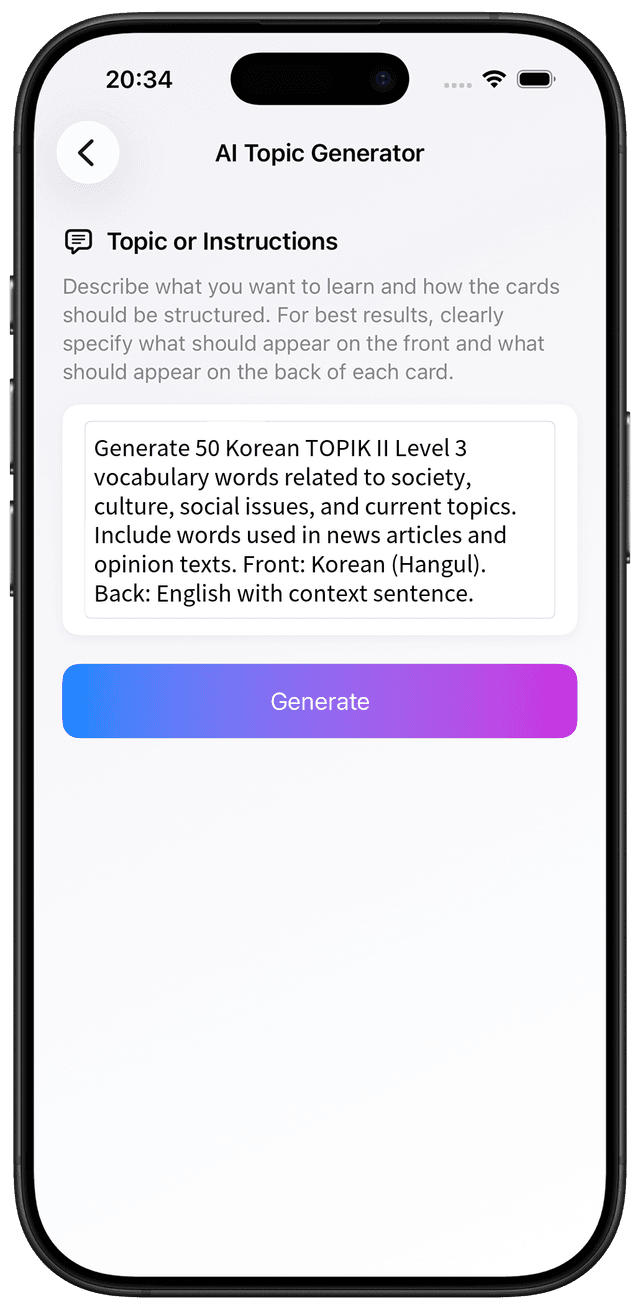
TOPIK II reading and listening regularly cover social issues, cultural commentary, and policy topics. This phase targets vocabulary for discussing communities, trends, environment, and social change.
Why this next? Level 3 reading often asks you to identify a writer's position on a social topic. Without the vocabulary for society and culture, you lose that layer of meaning and end up answering questions from guesswork rather than comprehension.
Generate 50 Korean TOPIK II Level 3 vocabulary words related to society, culture, social issues, and current topics. Include words used in news articles and opinion texts. Front: Korean (Hangul). Back: English with context sentence.
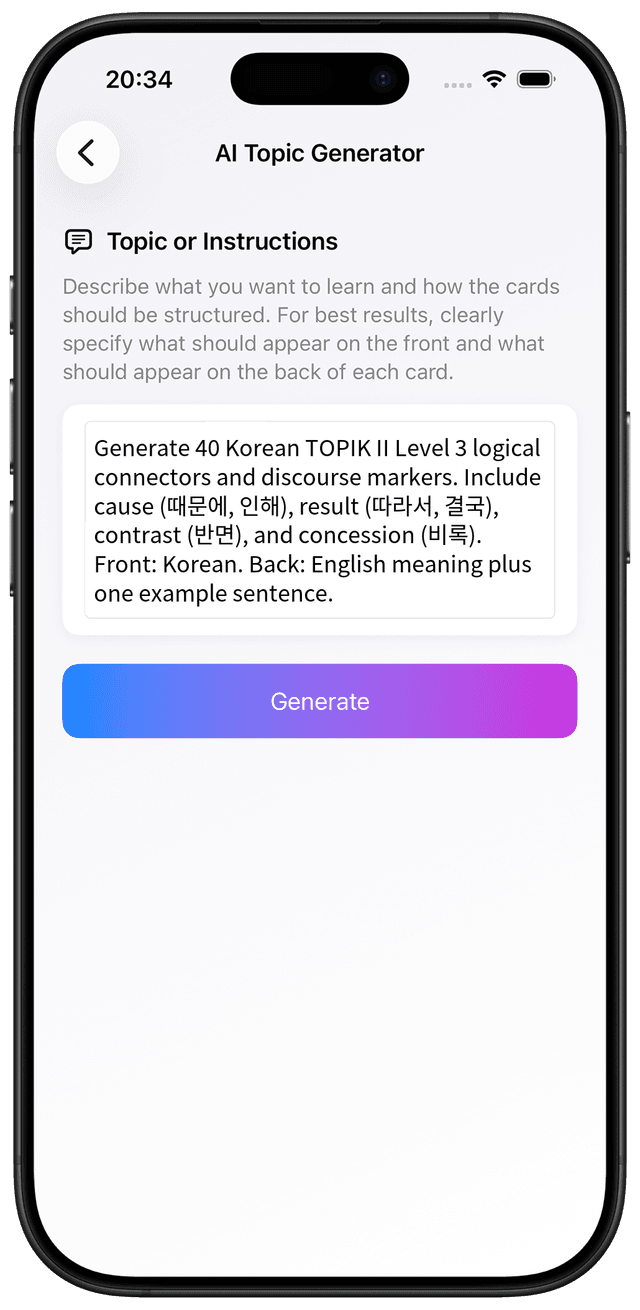
TOPIK II tests whether you can follow an argument from start to finish. This phase covers words that signal cause (때문에, 인해), result (따라서, 결국), contrast (반면, 반대로), and concession (비록, 그럼에도).
Why this matters: Many Level 3 reading questions ask you to identify the reason or result stated in a passage. Knowing these connectors lets you locate the answer instead of re-reading the whole text.
The strategy: Drill connectors in pairs. Learn a cause marker alongside its corresponding result marker so you understand how they work together.
Generate 40 Korean TOPIK II Level 3 logical connectors and discourse markers. Include cause (때문에, 인해), result (따라서, 결국), contrast (반면), and concession (비록). Front: Korean. Back: English meaning plus one example sentence showing how it connects two clauses.
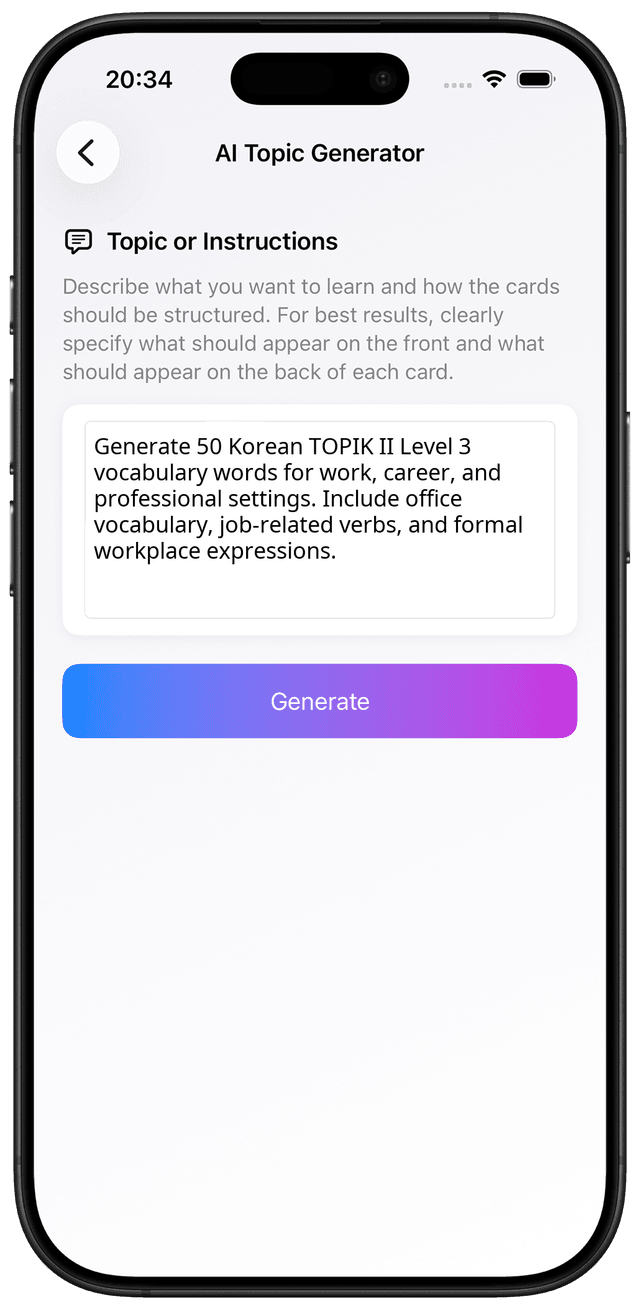
Workplace dialogues and job-related texts appear regularly in TOPIK II. This phase covers the vocabulary for office settings, career topics, and professional interactions that come up in both listening and reading.
Goal: Read or listen to a workplace dialogue or job-related article and follow the gist without stopping. That level of fluency is what Level 3 listening tasks expect from you.
Generate 50 Korean TOPIK II Level 3 vocabulary words for work, career, and professional settings. Include office vocabulary, job-related verbs, and formal workplace expressions. Front: Korean (Hangul). Back: English with professional context note.
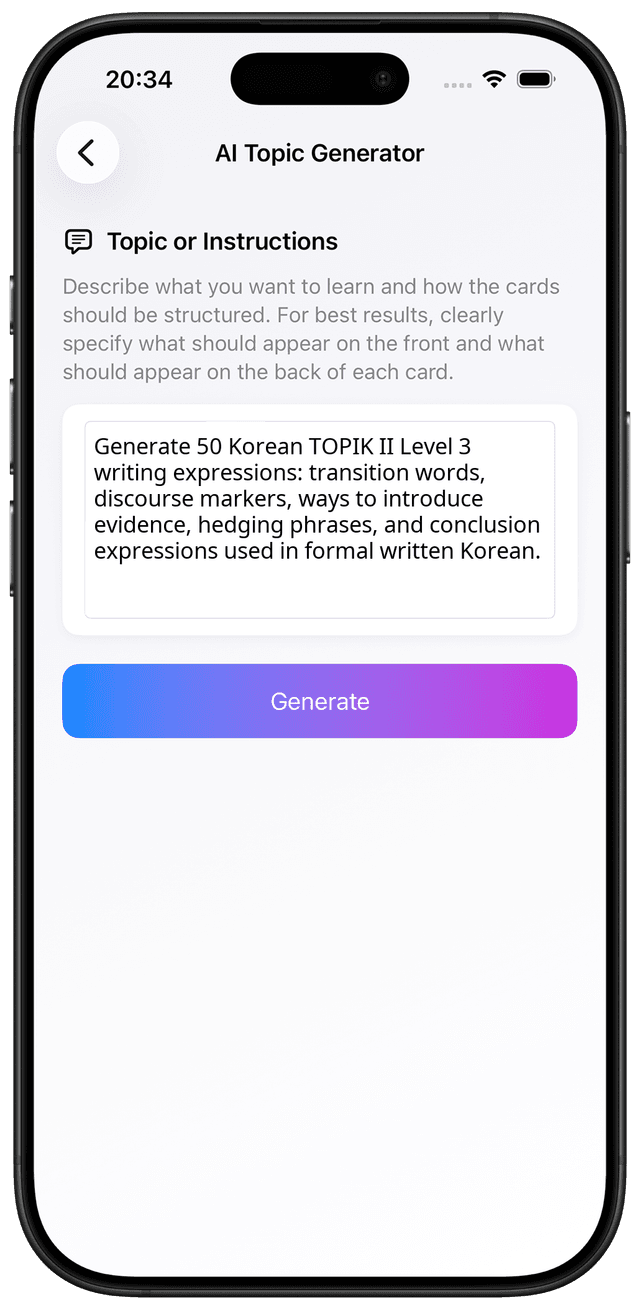
TOPIK II includes short and long writing tasks. This phase targets the vocabulary you need to write clearly under exam conditions: transition phrases, ways to introduce a point, hedging expressions, and conclusion markers.
Why now? Writing vocabulary needs to be active recall, not passive recognition. You have to produce these expressions in real time during the exam, not just recognise them in a passage.
The strategy: Practise writing short sentences with each expression rather than only reading the flashcard. Production practice is what converts recognition into writing fluency.
Generate 50 Korean TOPIK II Level 3 writing expressions: transition words, discourse markers, ways to introduce evidence, hedging phrases, and conclusion expressions used in formal written Korean. Front: Korean. Back: English with explanation of how to use it in a TOPIK II writing response.
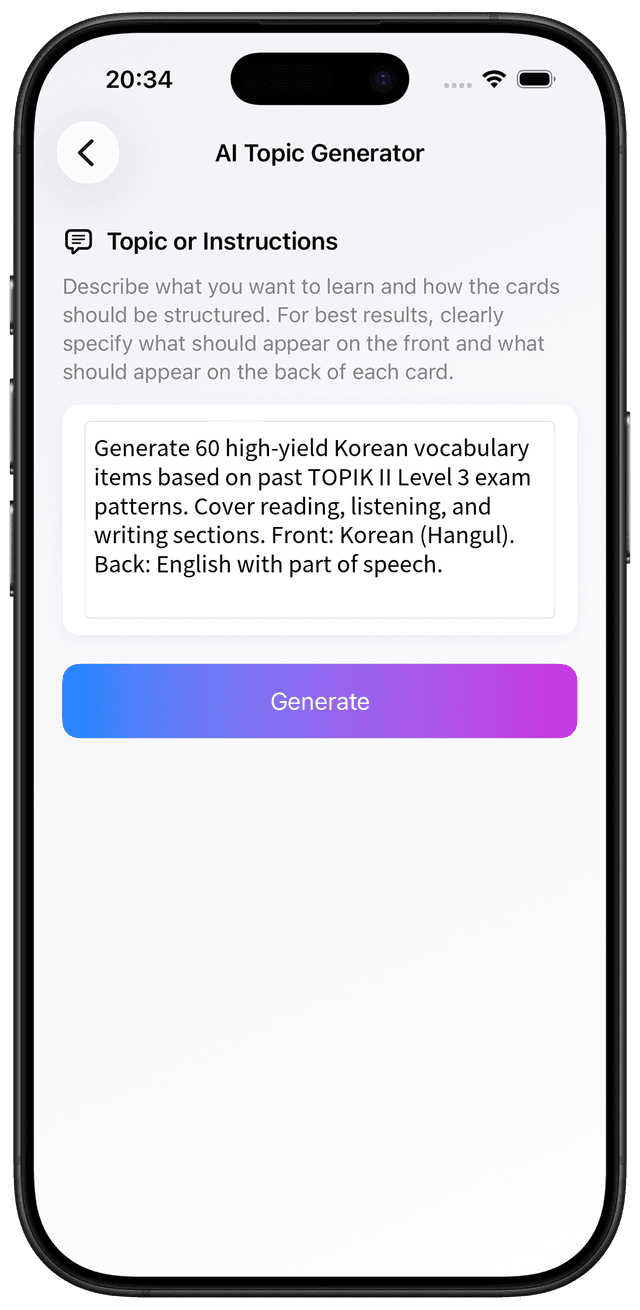
The final phase targets vocabulary that comes up most frequently in past TOPIK II Level 3 exams, drawing from all three sections: reading, listening, and writing.
Milestone: After this phase, your vocabulary base covers the core of what Level 3 tests across every section of the exam. Keep your decks in daily rotation until exam day.
Generate 60 high-yield Korean vocabulary items based on past TOPIK II Level 3 exam patterns. Cover reading, listening, and writing sections. Front: Korean (Hangul). Back: English with part of speech and the exam section where it most commonly appears.
MindCards uses active recall and spaced repetition so the vocabulary you study sticks as something you can actually produce under pressure, not just recognise on a page.
Spacing your reviews across days is one of the most effective things you can do for Korean vocabulary retention at the intermediate level.
Testing yourself on vocabulary consistently beats passive review for how much you remember when it counts in the exam room.
Keep your decks in daily rotation. Even ten minutes a day adds up quickly over a few weeks.
Build your TOPIK II vocabulary with smart flashcards, AI deck generation, and spaced repetition built for real exam readiness at Level 3 and beyond.