
Spaced repetition explained
Why spacing reviews is key to mastering Korean TOPIK I Level 1 vocabulary.
TOPIK I Level 1 tests around 800 high-frequency Korean words: greetings, shopping, school, transport, and daily life. Get these right and the exam's reading and listening sections become much more manageable.
Many learners stall because they memorize disconnected lists. This guide gives you a phase-by-phase path so each study session builds on the last.
MindCards helps you retain vocabulary with spaced repetition and active recall. Use the prompts below to build focused decks and move through Level 1 vocabulary systematically.
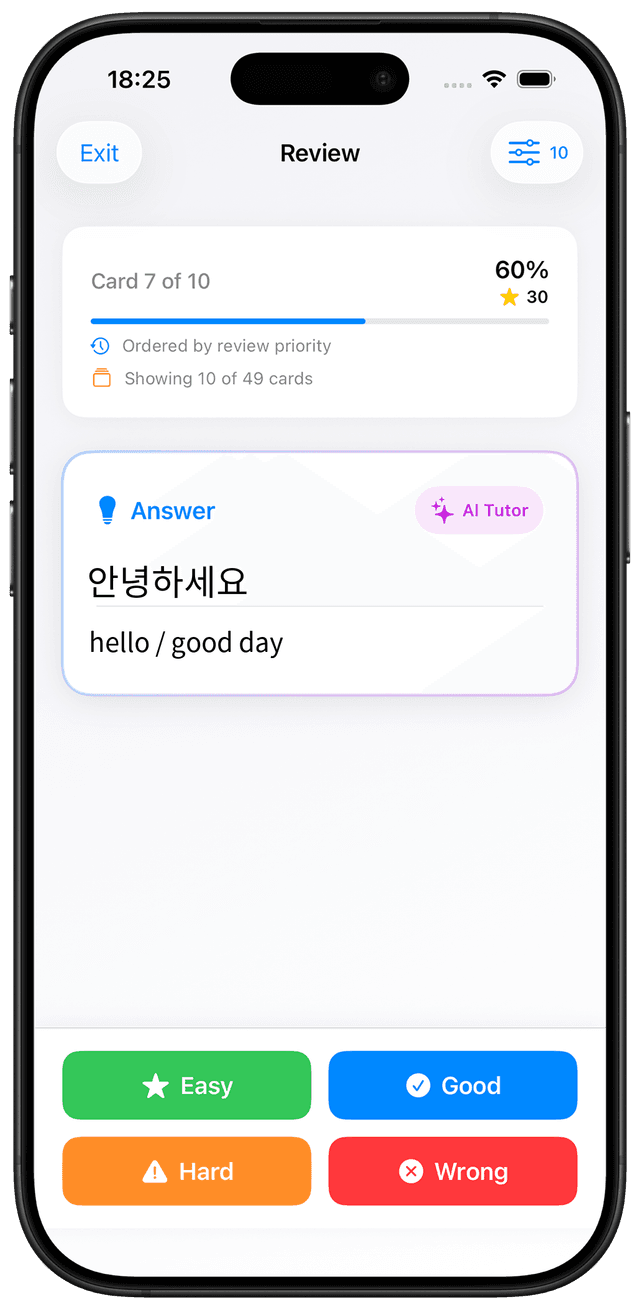
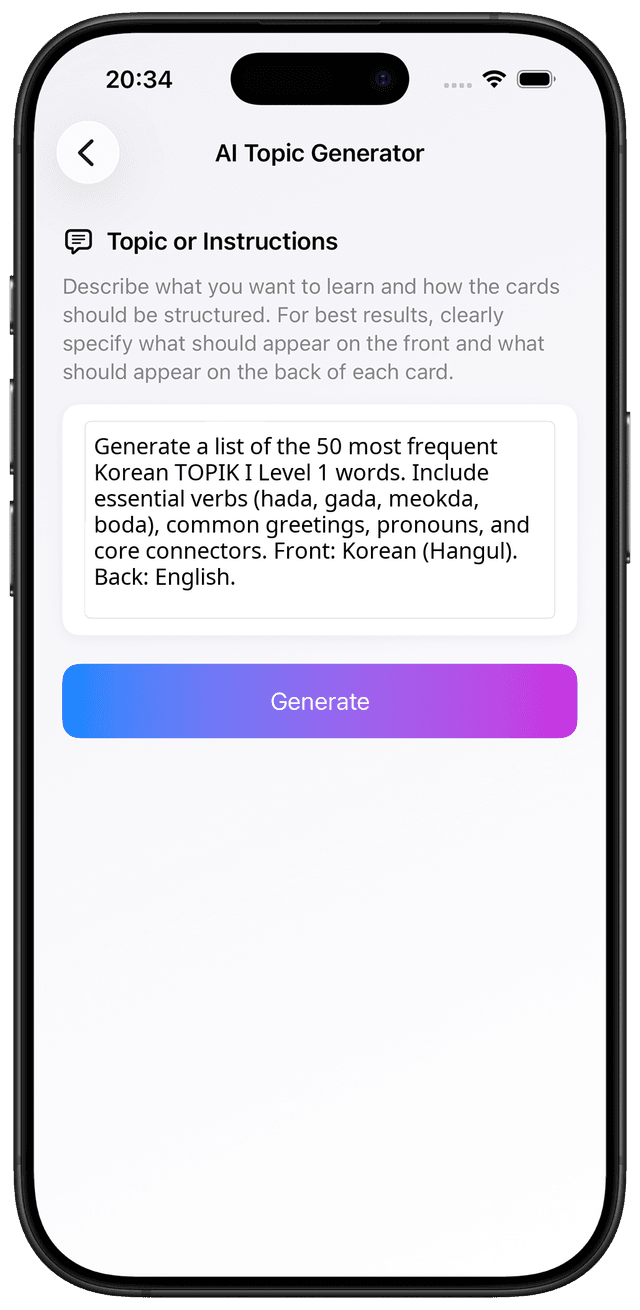
Start with the most frequent Level 1 words: greetings, pronouns, essential verbs, and everyday connectors. These words appear repeatedly in beginner reading and listening tasks.
Why start here? You quickly recognize common Korean sentence patterns used in introductions and daily conversation.
The strategy: Build your starter deck with Hangul on the front and English on the back for direct recall.
Generate a list of the 50 most frequent Korean TOPIK I Level 1 words. Include essential verbs (hada, gada, meokda, boda), common greetings, pronouns, and core connectors. Front: Korean (Hangul). Back: English.
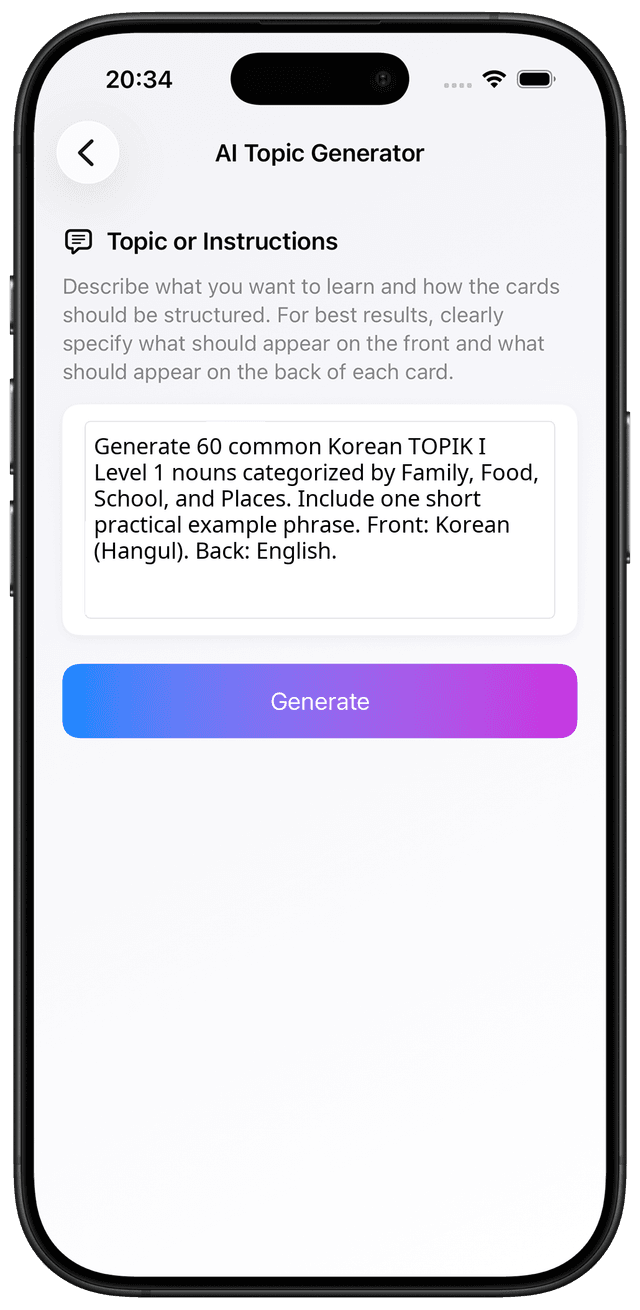
Expand into practical nouns for family, food, school, transport, and places. TOPIK I Level 1 reading passages lean heavily on concrete daily-life vocabulary.
Why this next? Level 1 questions rely on recognizing nouns in short dialogues and notices.
The strategy: Include one short example phrase so recognition transfers into listening and reading tasks.
Generate 60 common Korean TOPIK I Level 1 nouns categorized by Family, Food, School, and Places. Include one short practical example phrase. Front: Korean (Hangul). Back: English.
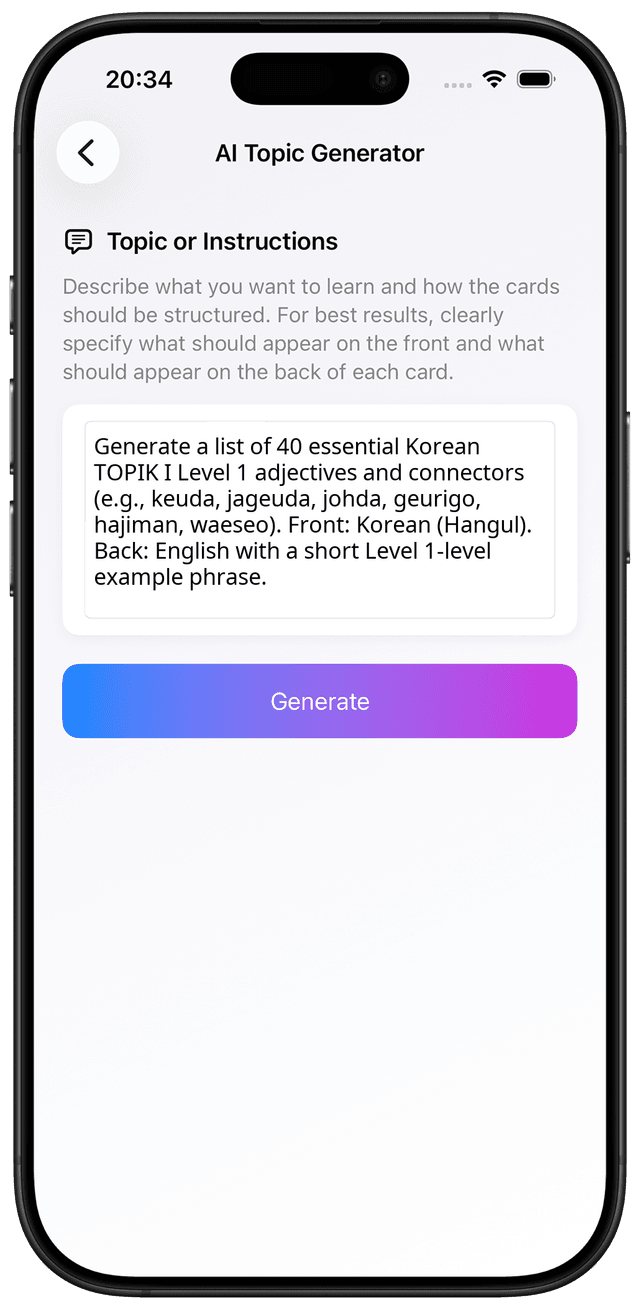
Add descriptive words and connectors so you can move from single-word answers to short complete sentences in Korean.
Why this matters: TOPIK I Level 1 tasks require basic descriptive meaning, not just isolated word recognition.
The strategy: Learn adjective and noun patterns together with connector usage for immediate sentence building.
Generate a list of 40 essential Korean TOPIK I Level 1 adjectives and connectors (e.g., keuda, jageuda, johda, geurigo, hajiman, waeseo). Front: Korean (Hangul). Back: English with a short Level 1-level example phrase.
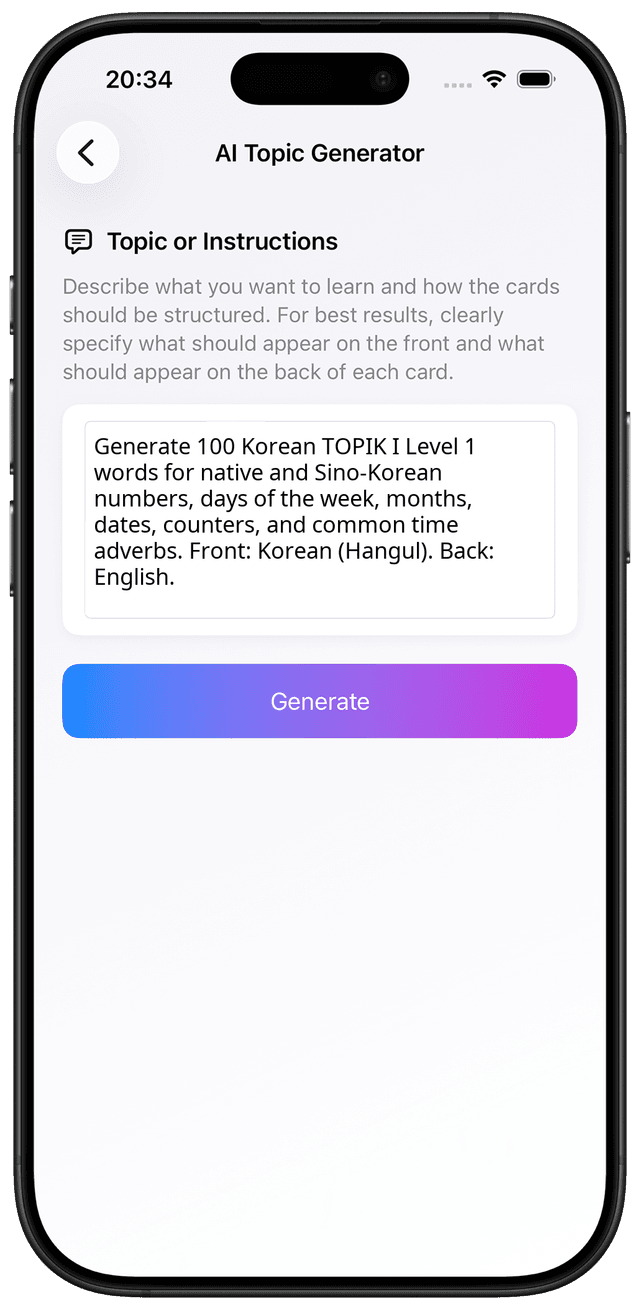
Learn numbers, days, months, dates, and time expressions to handle schedules, appointments, and routines in Korean.
Why this is vital: Time and date language appears constantly in TOPIK I Level 1 listening and reading questions.
Generate 100 Korean TOPIK I Level 1 words for native and Sino-Korean numbers, days of the week, months, dates, counters, and common time adverbs. Front: Korean (Hangul). Back: English.
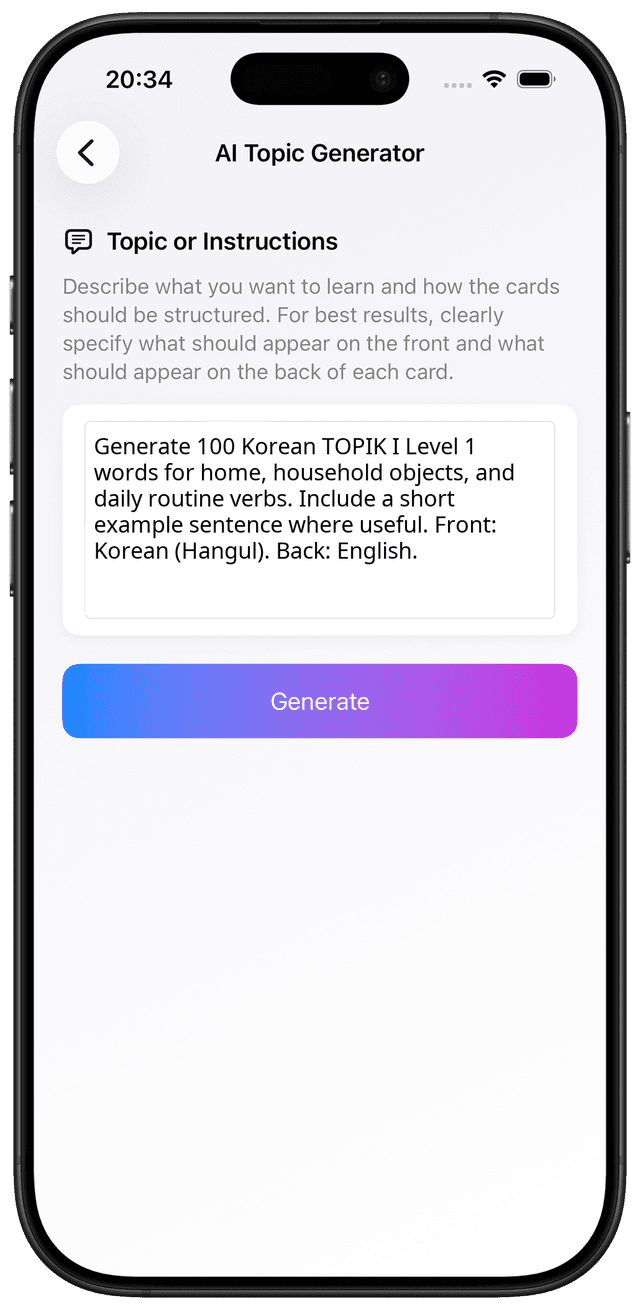
Cover vocabulary for rooms, household items, daily activities, and routine verbs so you can describe everyday life in Korean.
Goal: Handle beginner topics like waking up, going out, eating, studying, and returning home.
Generate 100 Korean TOPIK I Level 1 words for home, household objects, and daily routine verbs. Include a short example sentence where useful. Front: Korean (Hangul). Back: English.
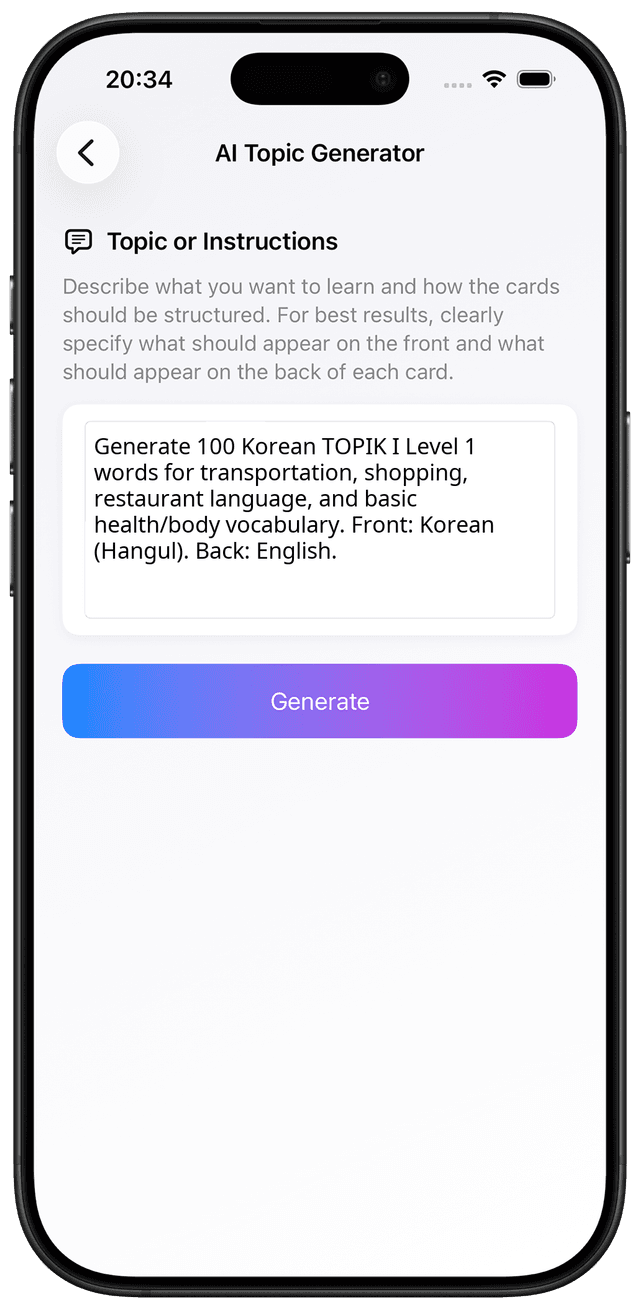
Learn vocabulary for stations, shops, cafes, and basic health situations. These words come up in real conversations long before any exam.
Why now? These are high-value scenarios where fast recall matters in both real conversations and Level 1 test contexts.
Generate 100 Korean TOPIK I Level 1 words for transportation, shopping, restaurant language, and basic health/body vocabulary. Front: Korean (Hangul). Back: English.
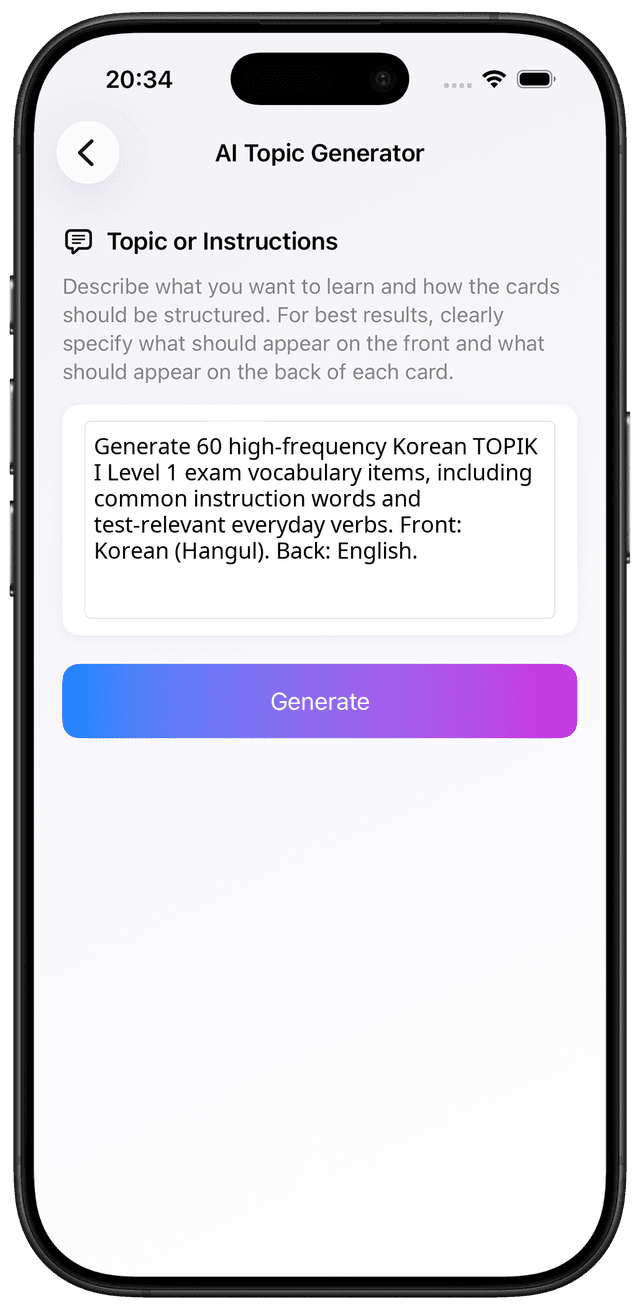
Finish with high-frequency Level 1 exam words: instruction terms, question cues, and practical verbs that appear in beginner tasks.
Milestone: At this stage, your vocabulary base covers the 800 words that support core TOPIK I Level 1 reading and listening performance.
Generate 60 high-frequency Korean TOPIK I Level 1 exam vocabulary items, including common instruction words and test-relevant everyday verbs. Front: Korean (Hangul). Back: English.
MindCards combines active recall and spaced repetition to move Level 1 vocabulary from recognition to real usage.
Keep this deck in daily rotation to strengthen recall speed, listening accuracy, and exam readiness.
Build practical Korean with smart flashcards, AI deck generation, and spaced repetition designed for long-term memory and TOPIK I Level 1 exam readiness.