
Spaced repetition explained
Why reviewing at the right interval locks in Brazilian Portuguese C1 vocabulary
You have B2. The future subjunctive no longer trips you up, you can read a Folha de Sao Paulo article without a dictionary, and formal writing feels manageable. C1 is where the remaining gap closes. Words arrive in chunks, not one at a time. Register shifts happen without thinking. You start to sound like someone who actually lives in Brazil.
Brazilian Portuguese C1 has two things most courses ignore entirely: register precision and giriria. A Brazilian civil servant who also texts friends in Sao Paulo slang has internalized two completely different lexical systems and knows exactly when to use each. This guide builds both. It starts with register control, then covers giriria paulistana, advanced connectors for CELPE-Bras writing, genre-specific formulas, idioms that mark near-native fluency, literary vocabulary, and oral performance strategies.
Each phase includes a ready-to-use AI prompt. Paste it into MindCards and build a focused deck around real Brazilian Portuguese C1 vocabulary and structures. Spaced repetition schedules each card just before you would forget it, so you retain more with less review time.
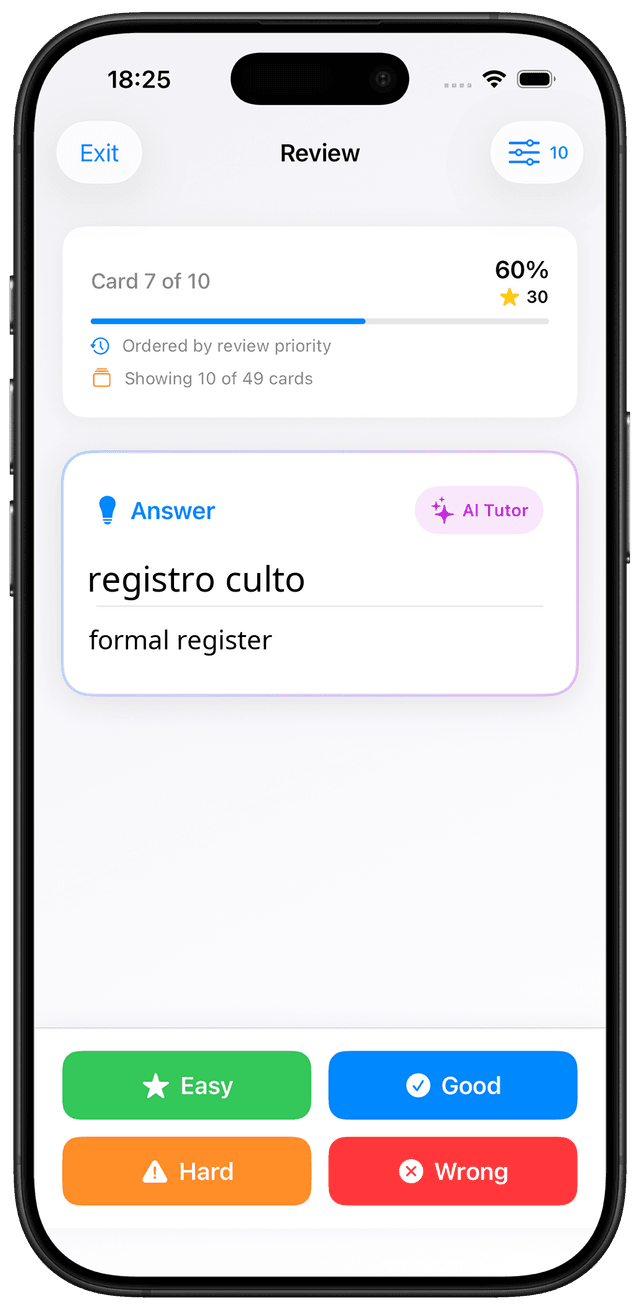
At C1, the gap between you and a native speaker is rarely grammar. It is register control. A Brazilian lawyer drafts a petition in registro culto and texts a friend in carioca slang within the same hour. They never confuse the two. Learners at B2 often carry one register into the wrong context: academic prose that sounds stiff in conversation, or informal phrasing that leaks into a formal report.
Brazilian Portuguese register control is specific and culturally loaded. The subjunctive mood sounds formal in Sao Paulo speech but normal in educated Rio speech. Tu appears in formal European-influenced writing but sounds odd in Sao Paulo casual speech where voce is universal. Constructions like hajam vista que, com efeito, and nos termos da legislacao vigente belong to legal and institutional writing. Knowing when to use each form is what C1 means in practice.
Why start here? Register confusion is the single most visible marker of a non-native speaker at advanced levels. CELPE-Bras C1 examiners specifically assess whether your writing matches the task register.
The strategy: This deck pairs formal and informal equivalents across multiple domains: legal, academic, journalistic, and everyday Sao Paulo speech. Each card shows the same idea in two registers so you absorb the contrast, not just the form.
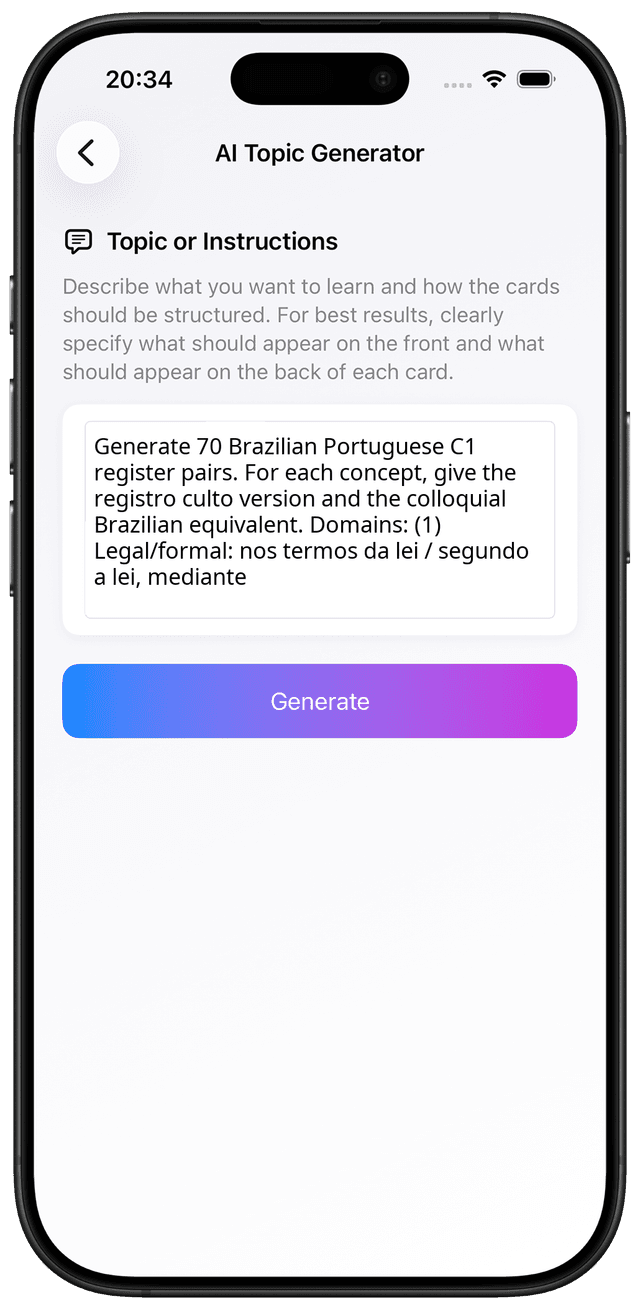
Generate 70 Brazilian Portuguese C1 register pairs. For each concept, give the registro culto version and the colloquial Brazilian equivalent. Domains: (1) Legal/formal: nos termos da lei / segundo a lei, mediante solicitacao / ao ser pedido, em conformidade com / de acordo com. (2) Academic: evidencia-se que / fica claro que, depreende-se de / da para entender que. (3) Journalistic: fontes governamentais afirmam / o governo diz. (4) Sao Paulo colloquial: ta bom / esta certo, que isso / que nada. Front: formal sentence. Back: informal equivalent + register label.
Giriria paulistana is not just casual vocabulary. It is the living surface of Brazilian Portuguese as spoken by 22 million people in Sao Paulo and understood across the country through music, internet culture, and television. Terms like mano, parça, trampar, vacilo, treta, pagar mico, ficar ligado, and zoar are constant in informal Brazilian speech at all education levels. Not knowing them is audible.
Regional variation beyond Sao Paulo is also part of C1 competence. Mineiros say uai and trem. Cariocas use cara, bicho, and a distinctive rising intonation on affirmatives. Nordestino speech uses oxe, visse, and abestado. Gaucho speech has bah and tri. You do not need to produce all of these, but recognizing them in films, podcasts, and conversation is what makes you genuinely fluent rather than just grammatically accurate.
Why giriria at C1? CELPE-Bras C1 oral tasks involve authentic spoken Brazilian Portuguese. Candidates who understand only formal input consistently misinterpret the listening passages.
The strategy: This deck focuses on high-frequency Sao Paulo slang with usage notes, then covers the most commonly misunderstood regional markers from Rio, Minas Gerais, and the Northeast.
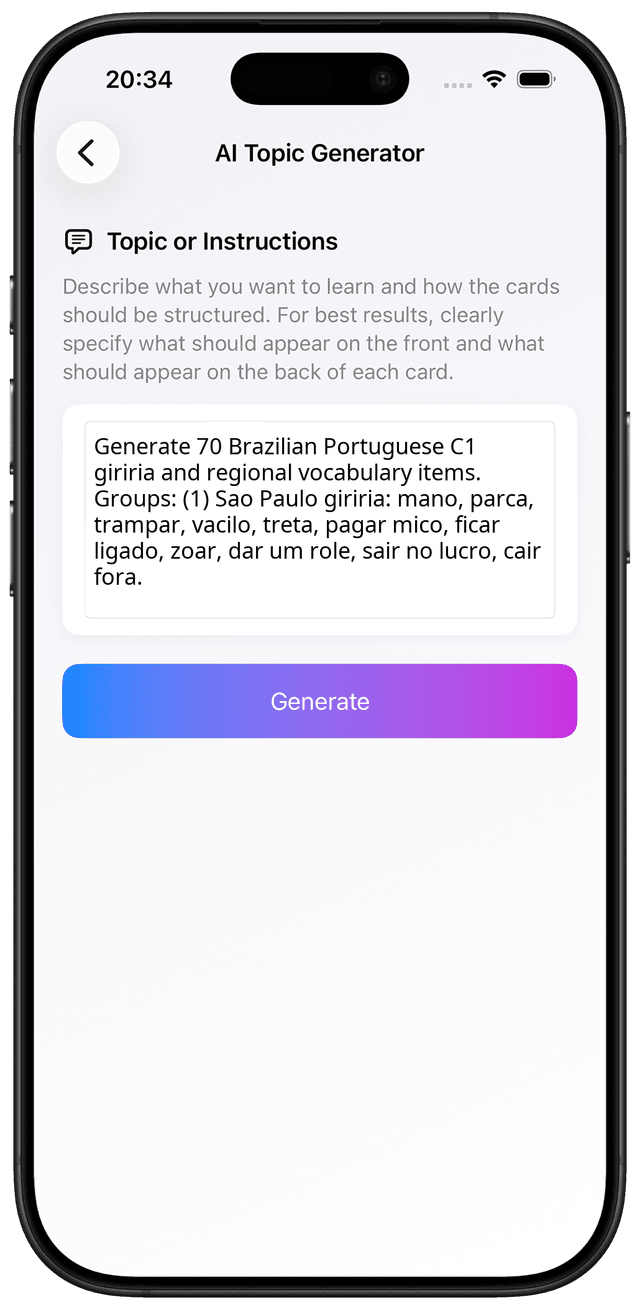
Generate 70 Brazilian Portuguese C1 giriria and regional vocabulary items. Groups: (1) Sao Paulo giriria: mano, parça, trampar, vacilo, treta, pagar mico, ficar ligado, zoar, dar um rolê, sair no lucro, cair fora, salvar, trocar uma ideia, na moral. (2) Rio carioca: cara, bicho, oxente, saudade do passado. (3) Mineiro: uai, trem, sô, misericórdia. (4) Nordestino: oxe, visse, abestado, arretado, massa. Front: expression + example sentence. Back: English meaning + region label.
C1 Brazilian writing does not just connect ideas. It structures them with precision: conceding a point while preserving the main argument, qualifying a claim without weakening it, and building toward a conclusion without telegraphing it too early. This requires a connector vocabulary that goes well beyond the B2 set of ao passo que and haja vista que.
The CELPE-Bras C1 written production task is graded on textual organization and cohesion. Examiners look for discourse markers that reflect genuine understanding of how academic and journalistic Portuguese organizes arguments. Phrases like conquanto, destarte, nao obstante, sem prejuizo de, e de se notar que, and cumpre ressaltar que appear in model C1 responses and essentially never in B2 ones.
Why this at C1? Cohesion is the category where C1 candidates most commonly fail to separate from B2. The same content organized with C1-level connectors scores significantly higher on CELPE-Bras.
The strategy: This deck groups connectors by function with before-and-after examples showing the upgrade from B2 phrasing to C1 phrasing for the same idea.
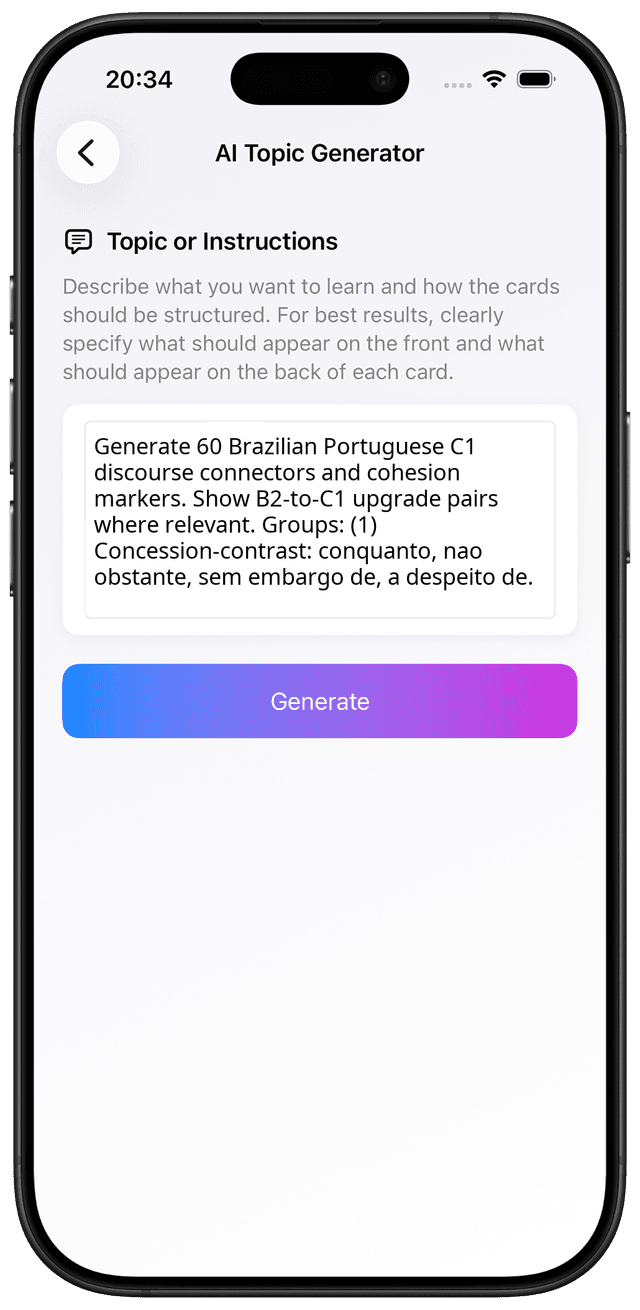
Generate 60 Brazilian Portuguese C1 discourse connectors and cohesion markers. Show B2-to-C1 upgrade pairs where relevant. Groups: (1) Concession-contrast: conquanto, nao obstante, sem embargo de, a despeito de, ainda assim. (2) Logical consequence: destarte, por conseguinte, infere-se que, daí decorre que. (3) Qualification: ressalvado que, sem prejuizo de, guardadas as devidas proporcoes. (4) Emphasis/reinforcement: cumpre ressaltar que, e de se notar que, nao e demais lembrar que. Front: C1 connector in sentence. Back: English meaning + B2 equivalent.
CELPE-Bras C1 written production tasks require you to produce a text in a specified genre with a specific interlocutor: a report for a company manager, an opinion piece for a newspaper, a letter to a public institution, or a blog post for a general audience. The register and genre conventions differ in each case, and switching between them accurately is the C1 competence being tested.
What distinguishes C1 written production from B2 is not length or vocabulary size. It is the ability to adapt to genre constraints: knowing that a carta aberta to a public official uses a different closing formula than a carta de reclamacao to a company, that an artigo de opiniao has a different argumentative arc than a relatorio, and that a resenha critica in a newspaper uses irony and hedging that would be out of place in an academic essay.
The goal: This deck builds the genre-specific vocabulary and formulaic phrases that CELPE-Bras C1 tasks demand. Each group covers one genre with its typical opening, body, and closing conventions.
The strategy: Flashcards cover genre formulas rather than isolated words, so you internalize the full construction as a usable unit.
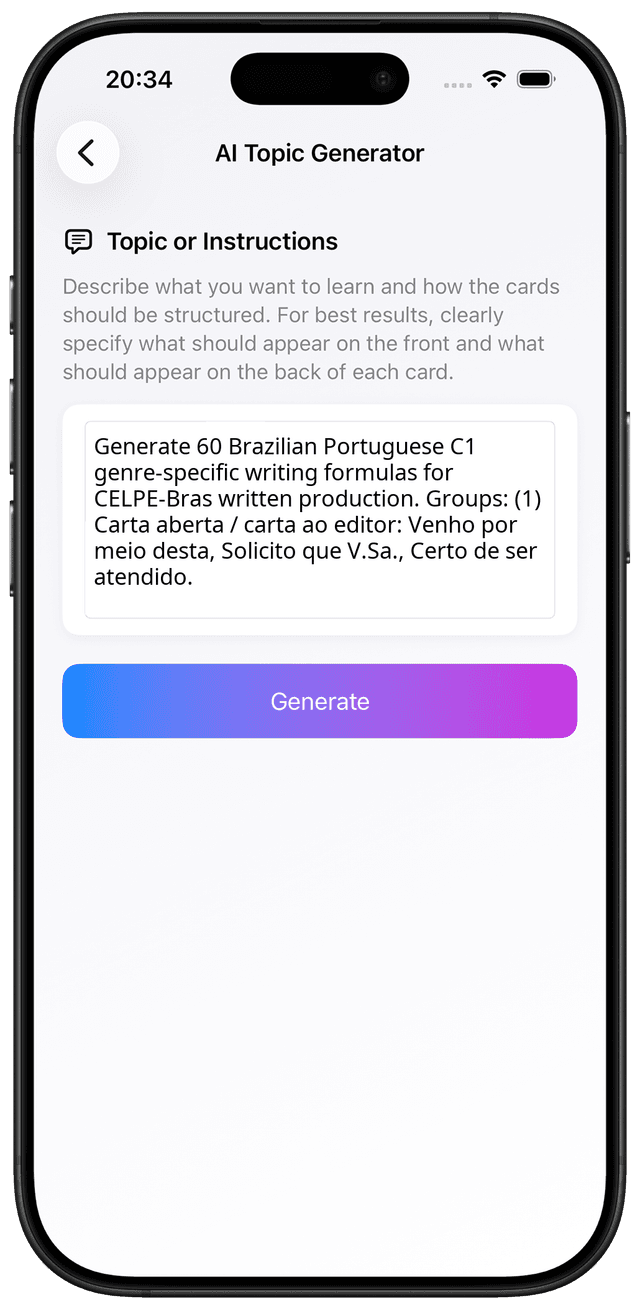
Generate 60 Brazilian Portuguese C1 genre-specific writing formulas for CELPE-Bras written production. Groups: (1) Carta aberta / carta ao editor: Venho por meio desta, Solicito que V.Sa., Certo de ser atendido, Respeitosamente. (2) Artigo de opiniao: Diante desse cenario, Nao e possivel ignorar que, O que se observa, em ultima analise, e que. (3) Relatorio: Conforme levantamento realizado, Os dados evidenciam que, Recomenda-se portanto que. (4) Resenha: A obra em tela, O autor sustenta a tese de que, A analise apresenta lacunas no que concerne a. Front: formula in context. Back: English + genre label.
Near-native fluency in Brazilian Portuguese is largely about chunk storage. Native speakers do not assemble phrases from individual words. They retrieve whole units: fazer vista grossa, dar de ombros, bater papo, perder o fio da meada, passar pano, pisar em ovos, pegar no sono, tirar o cavalinho da chuva, dar uma de, engolir sapo, and hundreds more. These are the collocations and idioms that appear in Brazilian comedy, political commentary, and everyday conversation.
Many of these are not translatable word-for-word and are not covered in standard grammar courses. They appear in Brazilian films, comedy specials like Porta dos Fundos and Chico Anysio, and in the works of writers like Luis Fernando Verissimo, whose crônicas rely on idiomatic fluency as the basis of humor. Reading and listening for them trains the pattern recognition that C1 requires.
Why idioms at C1? Idiomatic density is one of the most reliable markers of C1 versus B2 in Brazilian Portuguese. A speaker who avoids idioms sounds grammatically correct but foreign. A speaker who uses them naturally sounds Brazilian.
The strategy: This deck focuses on high-frequency Brazilian idioms with literal meaning, actual meaning, and a usage example. Spaced repetition builds chunk retrieval rather than word-by-word decoding.
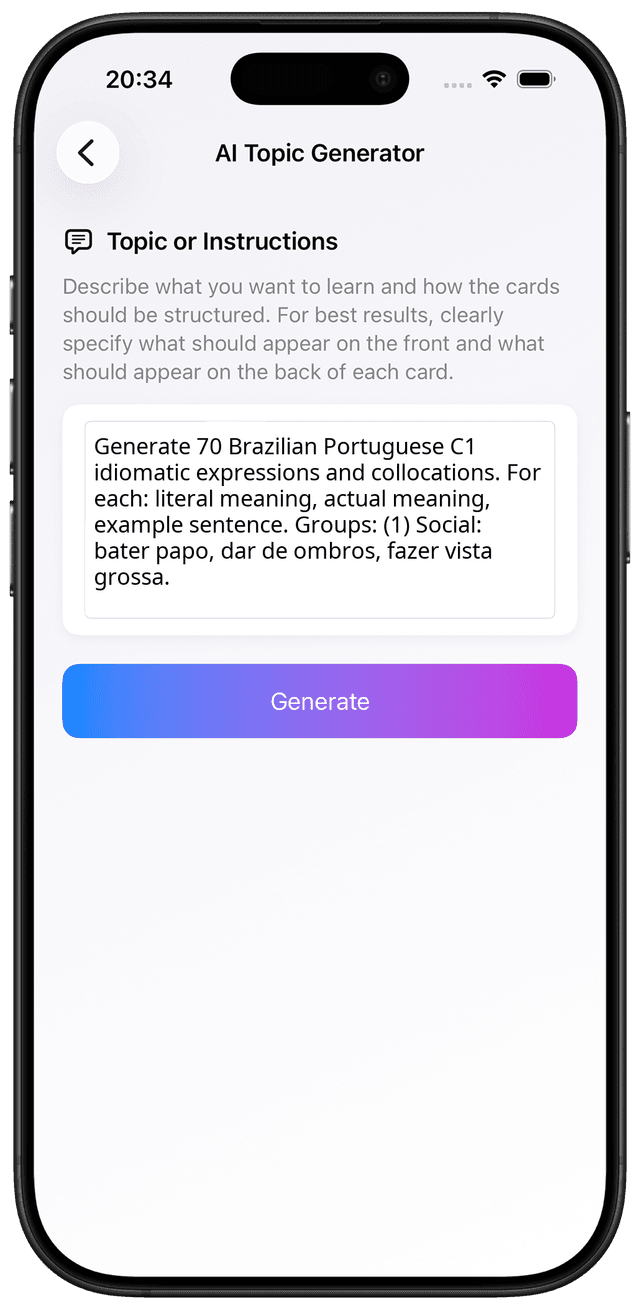
Generate 70 Brazilian Portuguese C1 idiomatic expressions and collocations. For each: literal meaning, actual meaning, example sentence. Groups: (1) Social: bater papo, dar de ombros, fazer vista grossa, dar uma de, engolir sapo, pisar em ovos. (2) Conversational: tirar o cavalinho da chuva, pegar no sono, perder o fio da meada. (3) Political/social commentary: passar pano, dar mole, fazer corpo mole, cair na malha fina. (4) Sao Paulo everyday: dar um rolê, trampar feito louco, sair no zero a zero. Front: Portuguese idiom. Back: literal + actual meaning + example.
Brazilian literary vocabulary is part of what educated Brazilians mean when they say someone speaks or writes well. References to Machado de Assis circulate as cultural shorthand for unreliable narrators, social irony, and malandro archetypes. Clarice Lispector's prose style introduced an interior vocabulary, a way of describing states of mind, that permeates Brazilian literary journalism and personal essays. Carlos Drummond de Andrade's poetry gave Brazilian Portuguese phrases that now appear in common speech.
This is not just about reading literature. Brazilian intellectual culture is media-saturated. Magazine Piauí, the podcast Roda Viva, literary supplements like Cult and Serrote, and social media accounts run by writers like Itamar Vieira Junior and Conceicao Evaristo have created a shared intellectual vocabulary. Knowing the terms, the names, and the arguments they connect to is part of C1 cultural literacy in Brazilian Portuguese.
Why this at C1? CELPE-Bras C1 oral and written tasks frequently reference Brazilian cultural and intellectual debates. Candidates who recognize the references perform more confidently and produce richer responses.
The strategy: This deck covers literary terms, intellectual vocabulary, and cultural reference points that educated Brazilians use in commentary and criticism.
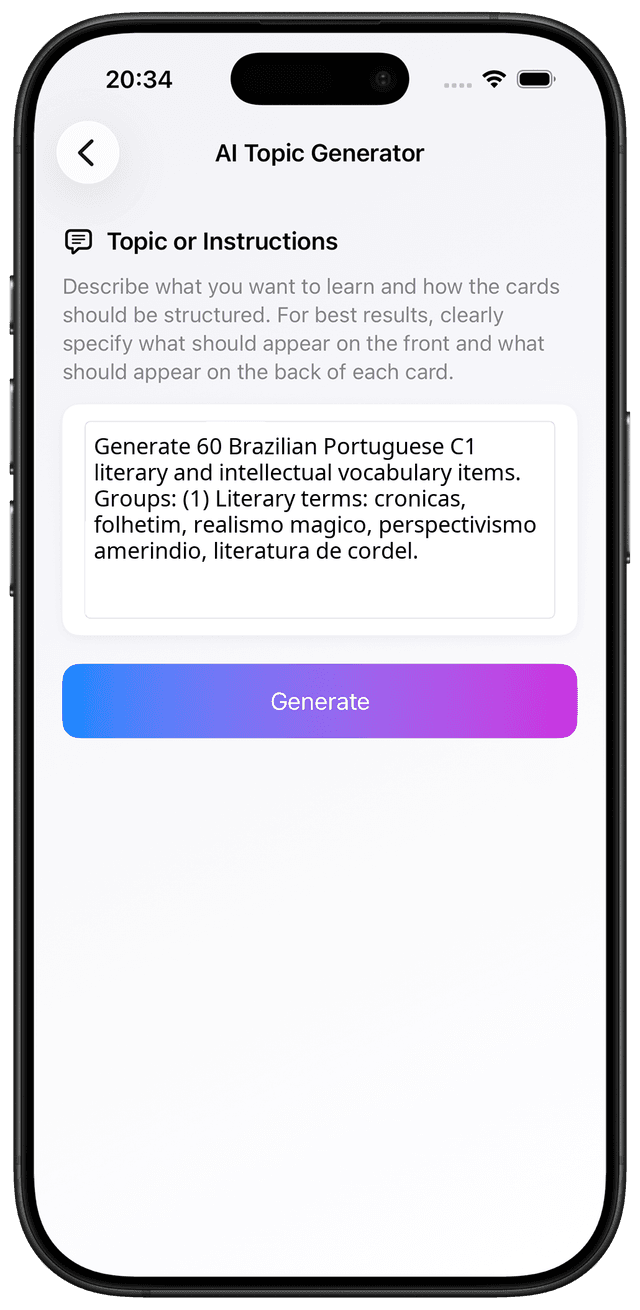
Generate 60 Brazilian Portuguese C1 literary and intellectual vocabulary items. Groups: (1) Literary terms: cronicas, folhetim, realismo magico, perspectivismo amerindio, literatura de cordel, regionalismo nordestino, stream of consciousness in Portuguese (fluxo de consciencia). (2) Key authors as cultural reference: malandro machadiano, o real marvilhoso, existencialismo clariciano. (3) Intellectual/media vocabulary: ensaismo, critica literaria, resgate historico, pertencimento, narrativa de si. (4) Academic verbs for literary analysis: problematizar, ressignificar, desconstruir, revisitar, tensionar. Front: term in context sentence. Back: English + cultural domain.
The CELPE-Bras C1 oral task pairs you with an examiner for a 20-minute conversation on a topic you have not prepared. The vocabulary that distinguishes C1 candidates is not what they know going in. It is what they can do in real time: rephrase a point when a word fails them, buy time without sounding lost, push back on an interviewer's framing without seeming defensive, and bring a complex thought to a clean conclusion.
Spontaneous oral fluency in Brazilian Portuguese also means handling the informal features of Brazilian conversation: the filler word ne that punctuates Brazilian speech, the overlapping turns that Brazilians use to show engagement rather than rudeness, the way entao functions as both a connector and a hesitation marker, and the social ritual of confirmar, which involves echoing back the speaker's last word to signal comprehension.
The milestone: With this phase complete, your C1 Brazilian Portuguese vocabulary set covers register precision, giriria paulistana, advanced cohesion, CELPE-Bras writing genres, idiomatic fluency, literary and intellectual reference, and oral performance strategies. That is the full C1 communicative range for CELPE-Bras and real-world Brazilian contexts at an advanced level.
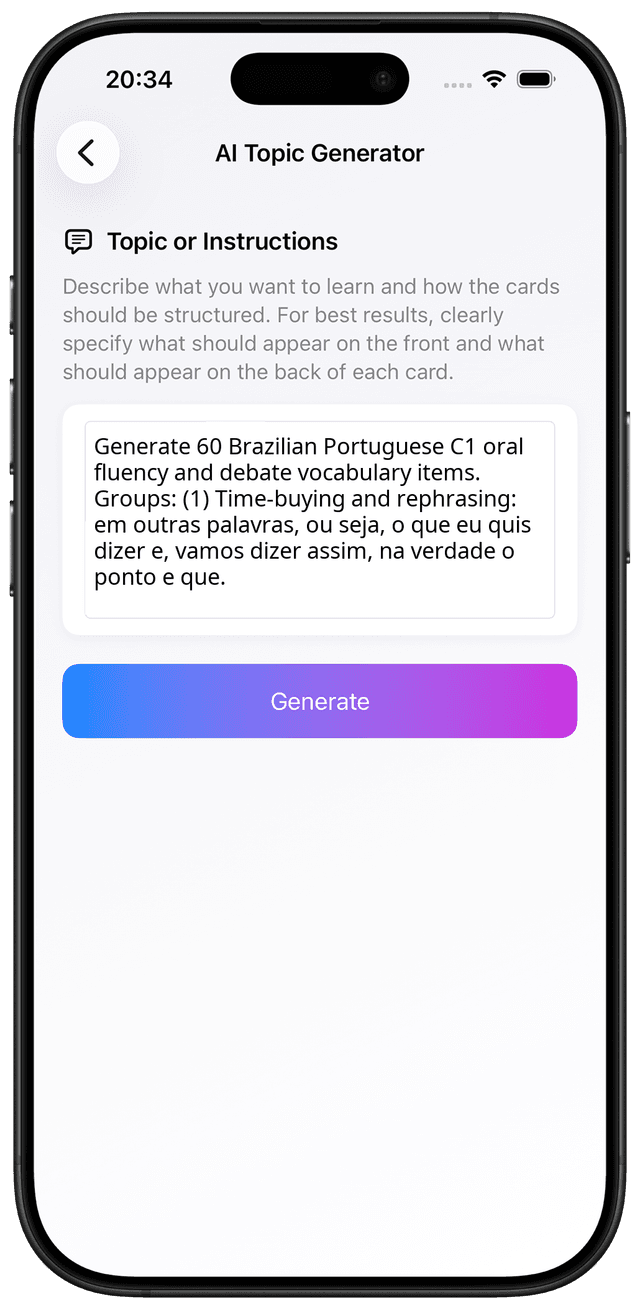
Generate 60 Brazilian Portuguese C1 oral fluency and debate vocabulary items. Groups: (1) Time-buying and rephrasing: em outras palavras, ou seja, o que eu quis dizer e, vamos dizer assim, na verdade o ponto e que. (2) Pushback and qualification: com todo o respeito, discordo em parte porque, nao e bem isso, o problema com essa perspectiva e. (3) Conversational markers: ne, entao, tipo (discourse particle), bom, olha. (4) Bringing to conclusion: portanto, para concluir, o que fica disso e, no fundo, em resumo. Front: expression in dialogue context. Back: English + pragmatic function.
C1 vocabulary is harder to acquire through exposure alone. Register pairs, idiomatic chunks, and genre formulas need the kind of deliberate retrieval practice that spaced repetition provides. MindCards schedules reviews at the interval where your brain is about to lose the item, which is exactly when retrieval does the most work. Advanced learners who rely only on input tend to plateau at B2. Deliberate vocabulary practice with spaced repetition is what breaks that ceiling.
C1 vocabulary is the advanced level above B2. Use the links below to review B2 content, continue to C2 mastery, or return to the full Portuguese guide.
Build your Brazilian Portuguese C1 vocabulary with AI-generated decks and spaced repetition that adapts to what you actually struggle with. Free to download. No account required. Start with the register precision phase or pick any section that fills a gap.