
Spaced repetition explained
Why reviewing at the right interval locks in Brazilian Portuguese A2 vocabulary
You have the A1 foundation. Now build something you can use in a real conversation in Brazil. At A2, the big jump is the Preterito Perfeito, Brazil's go-to past tense for completed events, along with the structures that separate halting Portuguese from natural Brazilian Portuguese: the Imperfeito for background descriptions, reflexive verbs for daily routines, and the ir + infinitive pattern for talking about plans.
A2 covers roughly 1,000 words and structures, and they are not all equal. This guide focuses on the ones that actually come up: the irregular past forms Brazilians use every day, the reflexive pronoun placement that differs from European Portuguese, and the opinion phrases that make your speech sound natural rather than textbook-flat.
Each phase includes a ready-to-use AI prompt. Copy it into MindCards and get a focused deck built around real Brazilian Portuguese grammar and vocabulary. Spaced repetition then schedules each card just before you are about to forget it, so you retain more with less study time.
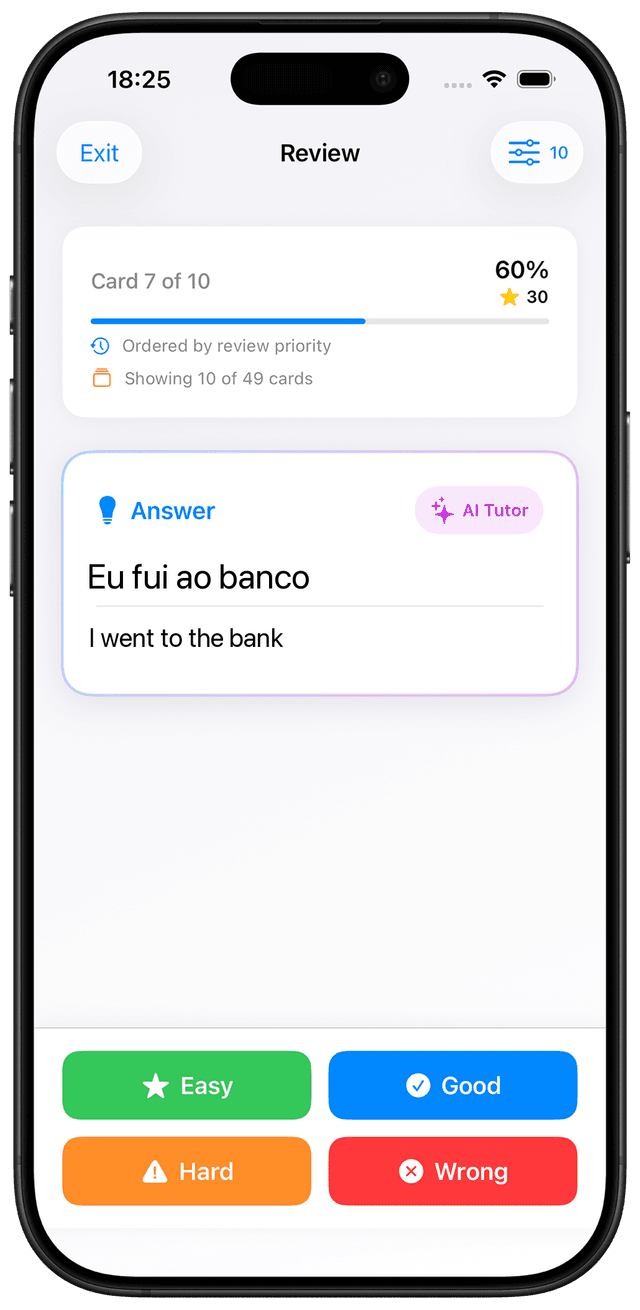
The Preterito Perfeito is how Brazilians talk about completed past events in everyday conversation. Unlike European Portuguese, Brazilian Portuguese rarely uses the Preterito Perfeito Composto (the 'tenho falado' form) for recent past. Brazilians reach straight for the simple past: fui, fiz, vi, comi. If you have been learning from European Portuguese resources, this difference trips people up.
Irregular verbs are where to start. Ser/ir share the same past form (fui), fazer becomes fiz, ver becomes vi, and ter becomes tive. Each of these comes up daily in conversation, so learning them as complete flashcard pairs is faster than trying to derive them from rules.
Why start here? Every other A2 topic assumes you can describe something that already happened. This is also the first structure tested in CELPE-Bras speaking tasks.
The strategy: This deck focuses on 60 high-frequency Brazilian Portuguese verbs in the Preterito Perfeito, with a natural sentence on the back so you see real Brazilian word order, not just isolated forms.
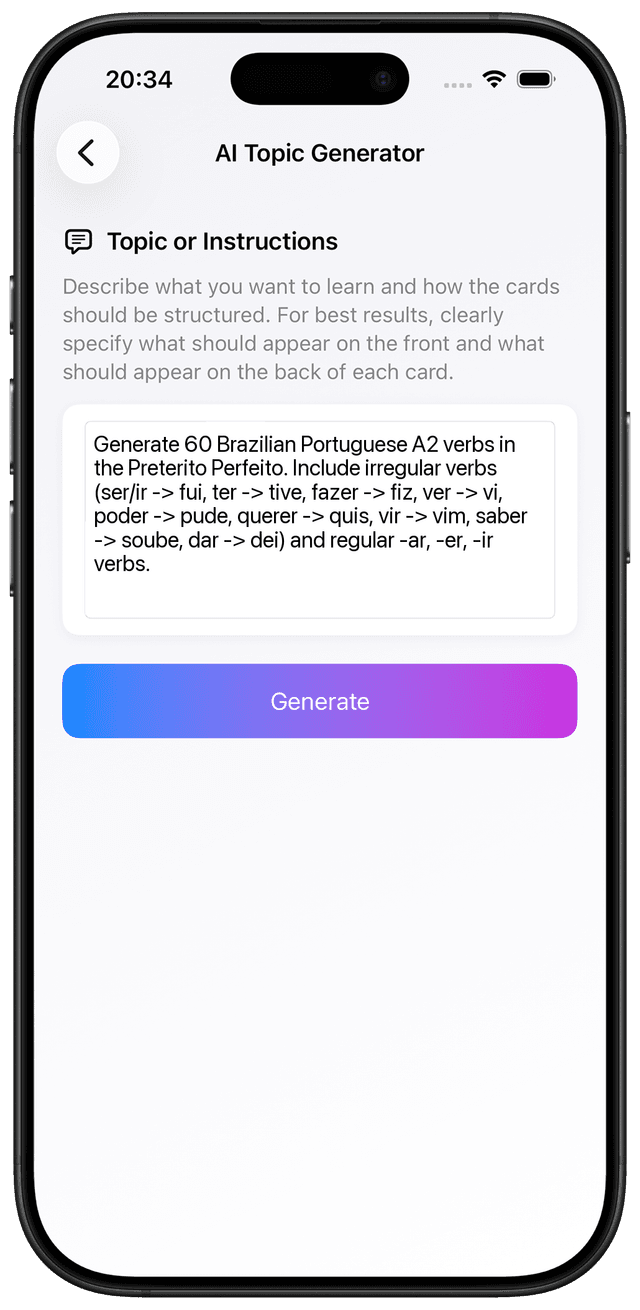
Generate 60 Brazilian Portuguese A2 verbs in the Preterito Perfeito. Include irregular verbs (ser/ir -> fui, ter -> tive, fazer -> fiz, ver -> vi, poder -> pude, querer -> quis, vir -> vim, saber -> soube, dar -> dei) and regular -ar, -er, -ir verbs. Front: infinitive + correct Preterito Perfeito form (eu). Back: English + a short example sentence in Brazilian Portuguese.
The Imperfeito describes ongoing states, background scenes, and repeated habits in the past. Where the Preterito Perfeito marks a single completed event, the Imperfeito sets the scene around it. Brazilian Portuguese uses this distinction in everyday storytelling: Eu morava em Sao Paulo quando conheci minha esposa.
Time markers reveal which tense to use. Sempre, todo dia, antigamente, quando era crianca, and normalmente all signal the Imperfeito. Ai, de repente, ontem, and naquele momento push you toward the Perfeito. The classic Brazilian sentence that shows the contrast: Eu estava assistindo televisao quando o celular tocou.
Why the Imperfeito next? At A2, you need both tenses to tell a proper story. CELPE-Bras writing tasks almost always require you to combine them.
The strategy: This deck covers the Imperfeito conjugations for core verbs, common time markers, and contrast pairs so you can choose the right tense in context, not just on paper.
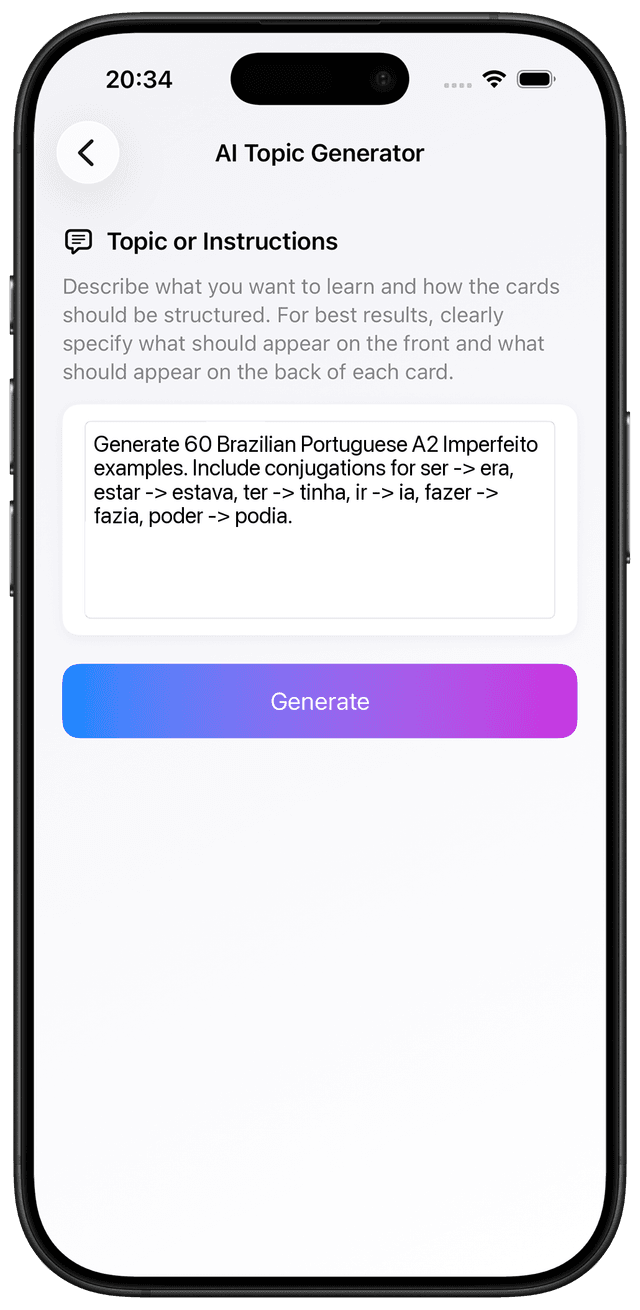
Generate 60 Brazilian Portuguese A2 Imperfeito examples. Include conjugations for ser -> era, estar -> estava, ter -> tinha, ir -> ia, fazer -> fazia, poder -> podia. Add 20 sentences with time markers (sempre, todo dia, antigamente, quando era crianca, normalmente). Add 10 contrast pairs showing Preterito Perfeito vs Imperfeito (e.g. Eu estava dormindo quando o telefone tocou). Front: Portuguese sentence. Back: English + tense label with usage note.
Brazilian Portuguese handles reflexive verbs a little differently from European Portuguese. In formal writing, the reflexive pronoun usually follows the verb (levanta-se), but in spoken Brazilian Portuguese it almost always comes before: eu me levanto, ele se chama, nos nos sentimos. If you learn only the written form, real conversations will sound off.
Daily routine verbs are the first group to master: levantar-se (to get up), deitar-se (to lie down), vestir-se (to get dressed), sentar-se (to sit down), lembrar-se (to remember), and chamar-se (to be called). These appear in nearly every personal description and health topic at A2 level.
Why reflexive verbs matter: Daily routine language, introductions, and health descriptions all rely on these verbs. They are tested in most CELPE-Bras A2 scenarios.
The strategy: This deck covers 50 high-frequency reflexive verbs with the pre-verb pronoun placement used in spoken Brazilian Portuguese, plus 10 Preterito Perfeito sentences showing the full reflexive past form.
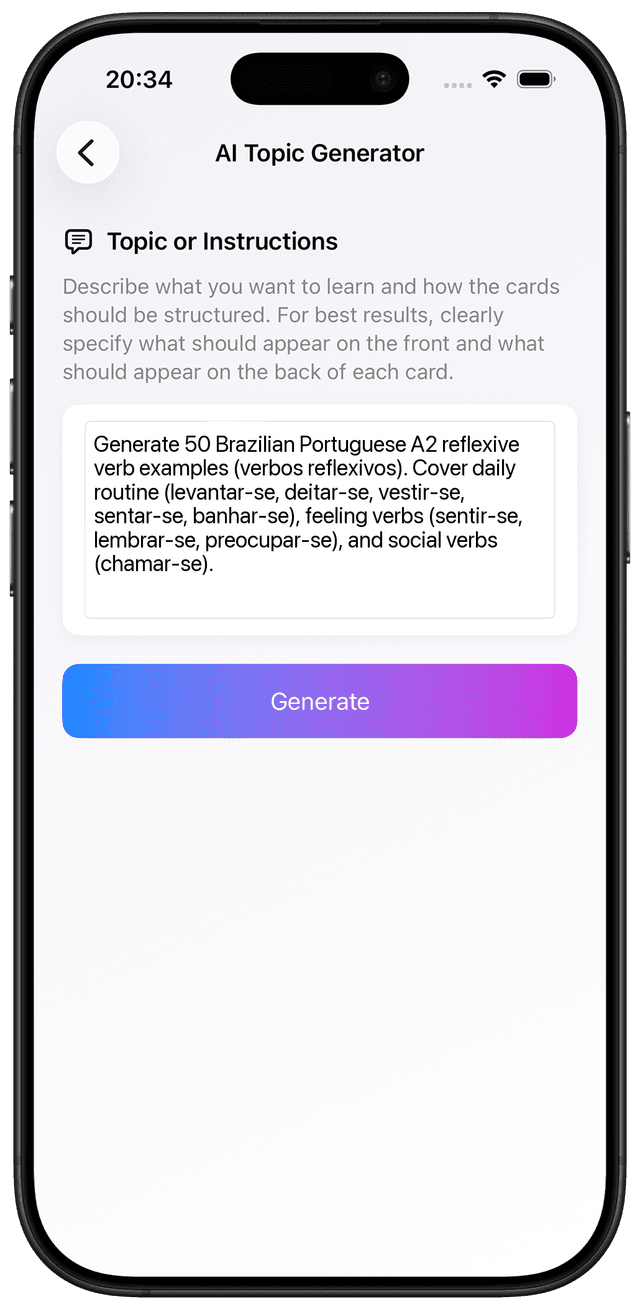
Generate 50 Brazilian Portuguese A2 reflexive verb examples (verbos reflexivos). Cover daily routine (levantar-se, deitar-se, vestir-se, sentar-se, banhar-se, pentear-se), feeling and state verbs (sentir-se, lembrar-se, esquecer-se, preocupar-se), and social verbs (chamar-se, encontrar-se, despedir-se). Use pre-verb pronoun placement (eu me levanto) as used in spoken Brazilian Portuguese. Add 10 Preterito Perfeito sentences. Front: Portuguese. Back: English + pronoun placement note.
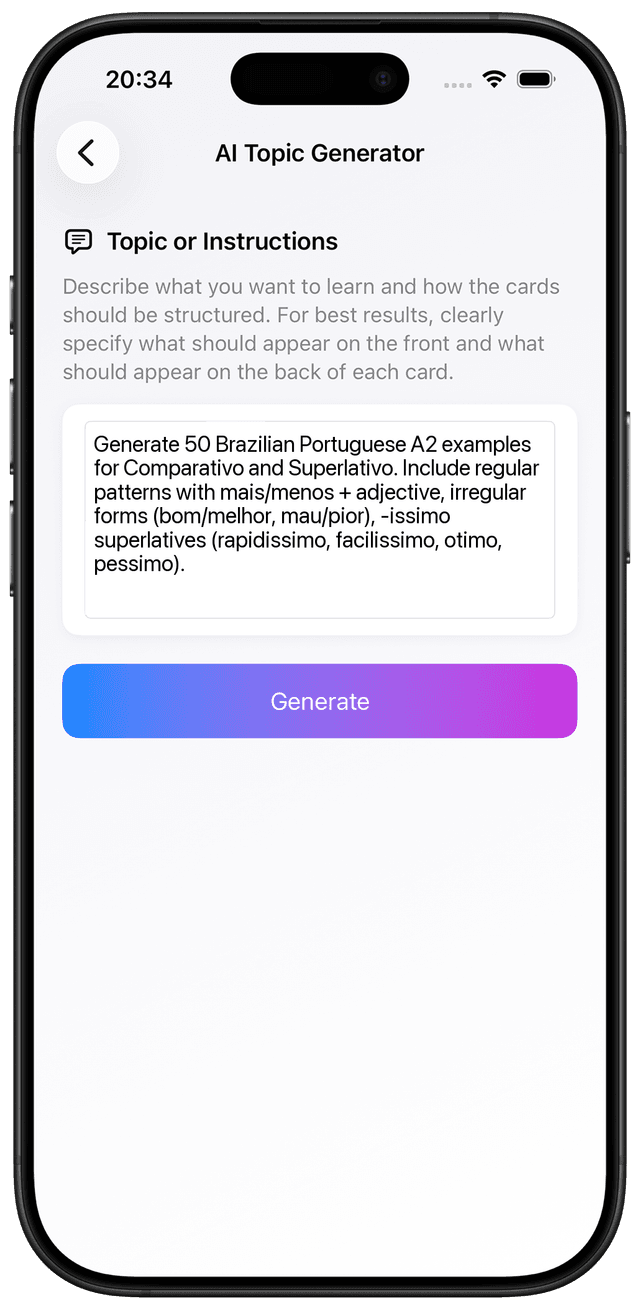
Brazilian Portuguese comparatives use mais and menos before the adjective. The irregular forms are a small but essential group: bom becomes melhor, mau becomes pior, muito becomes mais, and pouco becomes menos. The Superlativo Absoluto is especially common in Brazilian speech: otimo, pessimo, and the -issimo suffix (rapidissimo, facilissimo) appear constantly in everyday talk.
One thing that differs from European Portuguese: Brazilians frequently use muito bom or super bom instead of the synthetic superlative in casual speech. Both are correct at A2 level, but the intensifier pattern (muito, super, mega in informal contexts) is what you will hear in Rio de Janeiro or Sao Paulo.
Why add opinions now? After past tenses and reflexive verbs, the next thing CELPE-Bras tests is expressing views and reactions. Phrases like Acho que, Na minha opiniao, Prefiro, and Concordo are the natural opinion markers in Brazilian Portuguese.
The strategy: This deck combines comparative and superlative patterns with opinion vocabulary so you can evaluate, contrast, and recommend in one connected batch.
Generate 50 Brazilian Portuguese A2 examples for Comparativo and Superlativo. Include regular patterns with mais/menos + adjective, irregular forms (bom/melhor/o melhor, mau/pior/o pior), -issimo superlatives (rapidissimo, facilissimo, otimo, pessimo), and 20 opinion phrases (Acho que, Na minha opiniao, Prefiro, Concordo, Discordo, O que eu gosto e, Nao acho que). Front: Portuguese sentence. Back: English + pattern label.
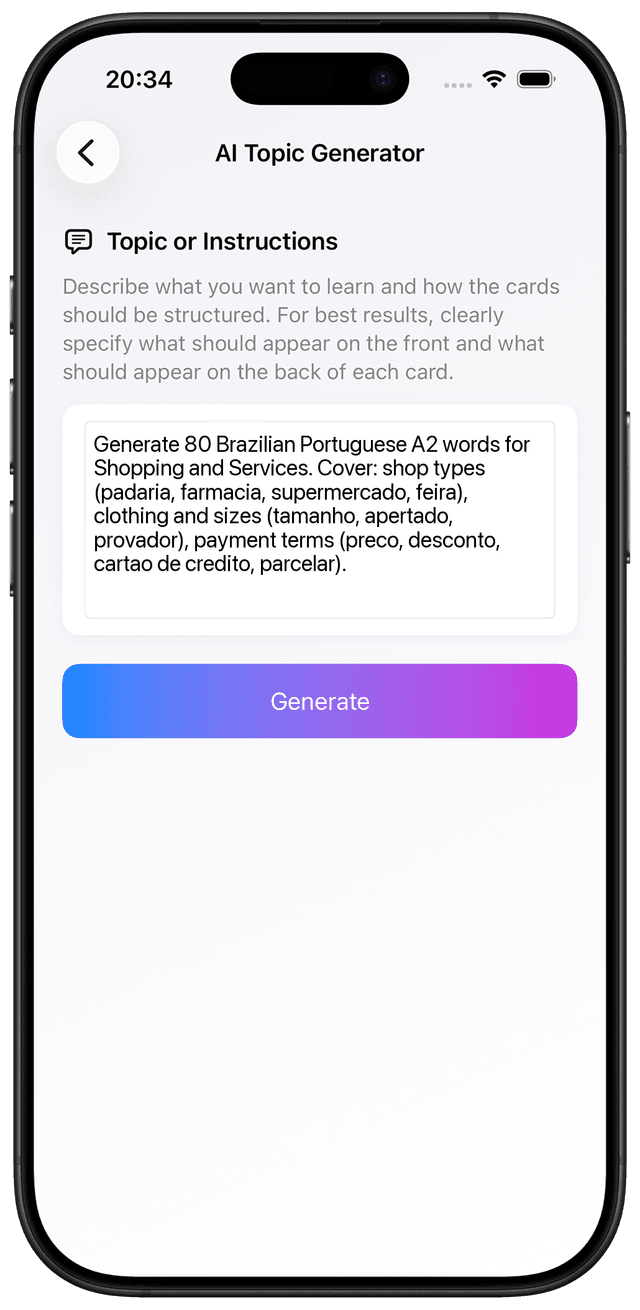
Shopping in Brazil has vocabulary that A1 never covers. Brazilians often pay in parcelas (installments), even for small purchases, so knowing terms like juros (interest), sem juros (interest-free), and cartao de credito (credit card) is genuinely practical. Brazilian malls (shoppings) and street markets (feiras) each have distinct vocabulary too.
One thing that surprises many learners: the word for 'cheap' in Brazilian Portuguese is barato, but the informal form baratao (really cheap) and the expression estar em conta (to be reasonably priced) are what you actually hear in markets in Belo Horizonte or Recife. The verb pechinchar (to haggle) is also common in feiras.
Why this is tested: Shopping and services are core CELPE-Bras A2 scenarios. This vocabulary is also directly useful for anyone visiting or living in Brazil.
The strategy: This deck mixes product vocabulary, payment terms, and service phrases so you can handle Brazilian transactions without reverting to English.
Generate 80 Brazilian Portuguese A2 words and phrases for Shopping and Services. Cover: shop types (padaria, farmacia, supermercado, correios, banco, livraria, feira), clothing and sizes (tamanho, numero, apertado, largo, provador), payment terms (preco, desconto, promocao, nota fiscal, cartao de credito, parcelar, sem juros, pagar em dinheiro), and service phrases (Voce tem no tamanho 40?, Quanto custa?, Posso trocar isso?, Aceita cartao?). Front: Portuguese. Back: English.
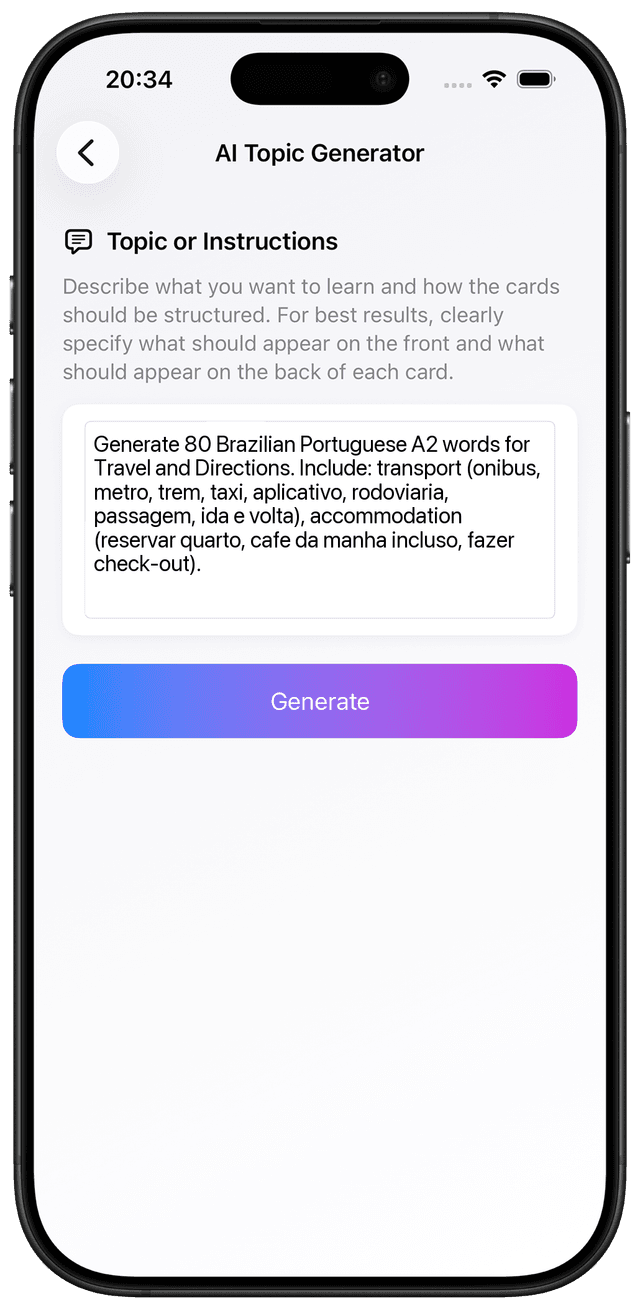
Getting around Brazil means understanding several transport types. The metro exists in Sao Paulo and Rio, but intercity travel relies heavily on onibus (bus), with rodoviaria (bus terminal) being the hub for most regional journeys. Uber and aplicativos de transporte are extremely common across Brazilian cities. Domestic flights (voos domesticos) also feature in everyday travel conversations.
Directions in Brazilian Portuguese mix standard terms with informal regional variations. The standard a esquerda (left), a direita (right), em frente (straight ahead) are universal, but Brazilians also use vira ali (turn there), segue reto (keep going straight), and fica perto do (it's near the) constantly in informal speech.
Why travel vocabulary matters: Travel is a core CELPE-Bras A2 topic, and this vocabulary transfers directly to navigating Brazilian cities.
The strategy: This deck combines bus, metro, accommodation, and directional language so you can get from the rodoviaria to the hotel without looking up every other word.
Generate 80 Brazilian Portuguese A2 words and phrases for Travel and Directions. Include: transport vocabulary (onibus, metro, trem, taxi, aplicativo, rodoviaria, plataforma, passagem, ida e volta, atrasar), accommodation (reservar quarto, quarto duplo, cafe da manha incluso, recepção, fazer check-out), directions (a esquerda, a direita, em frente, na esquina, em frente ao, a primeira rua a esquerda), and travel problems (O onibus atrasou, Perdi minha mala, Onde fica a estacao de metro mais proxima?). Front: Portuguese. Back: English.
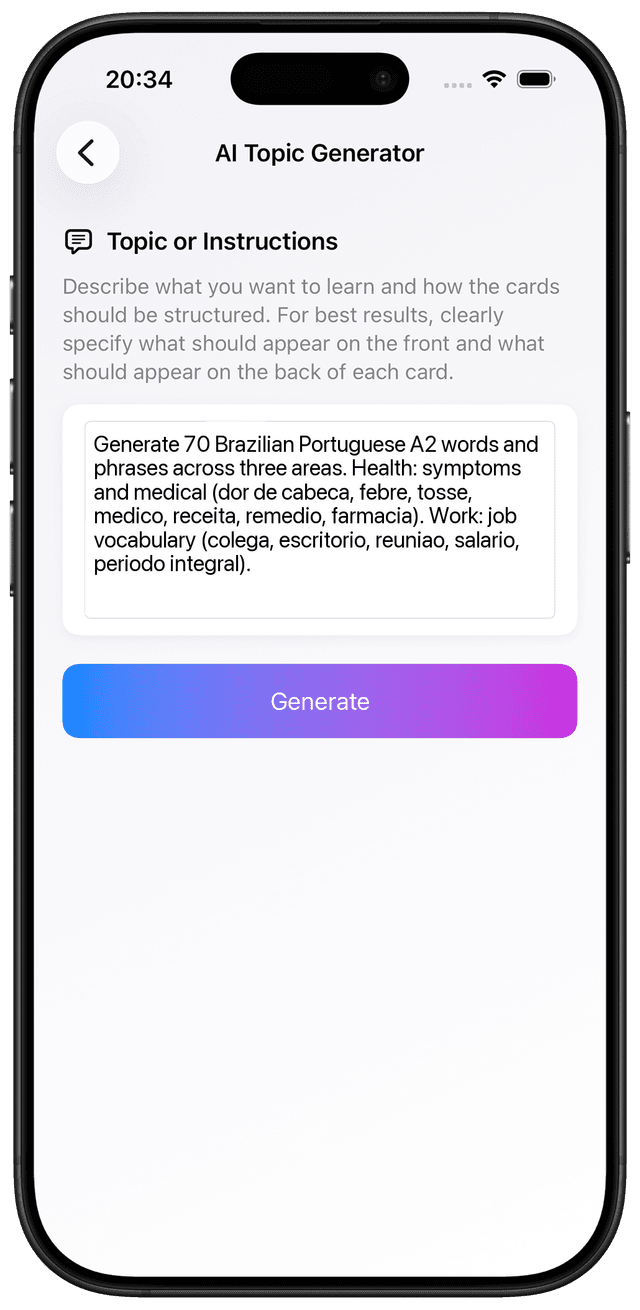
Health vocabulary in Brazilian Portuguese includes some Brazil-specific terms. A farmacia is on every block and the farmaceutico can recommend medication without a prescription for minor ailments, so knowing how to describe sintomas (symptoms) is practical. Plano de saude (health plan) and SUS (the public health system) come up in any conversation about healthcare in Brazil.
For the future, Brazilian Portuguese uses two forms. The Futuro do Presente (falarei, comerei) exists but is more common in writing and formal speech. In everyday spoken Brazilian Portuguese, people overwhelmingly use ir + infinitive: vou falar, vou comer. This spoken preference is stronger in Brazil than in Portugal, so if your input has been European Portuguese, this deck will recalibrate your instincts.
The milestone: With this deck, your A2 Brazilian Portuguese vocabulary is complete. You can describe past events with the Perfeito and Imperfeito, handle reflexive routines, navigate shopping and travel in Brazil, and talk about future plans using the spoken ir + infinitive pattern. That is the full A2 picture.
Generate 70 Brazilian Portuguese A2 words and phrases across three areas. Health: symptoms and medical appointments (dor de cabeca, febre, tosse, no medico, marcar consulta, receita, remedio, alergia, farmacia). Work: job and daily routine vocabulary (colega, escritorio, reuniao, fim do expediente, pedir demissao, salario, periodo integral, meio periodo). Future: 20 sentences contrasting ir + infinitive (spoken Brazilian: Eu vou sair amanha) with Futuro do Presente (Eu sairei amanha). Front: Portuguese. Back: English + category label (Health / Work / Future).
MindCards uses spaced repetition and active recall, both research-backed, to help you retain A2 vocabulary faster and for longer. The Preterito Perfeito, reflexive verbs, and Imperfeito all involve form-plus-meaning pairs that benefit from retrieval practice.
A2 vocabulary sits between the A1 foundation and B1 fluency. Use the links below to move between levels or return to the full Portuguese guide.
Build your Brazilian Portuguese A2 vocabulary with AI-generated decks and spaced repetition that adapts to what you actually struggle with. Free to download. No account required. Start with any phase that interests you most.